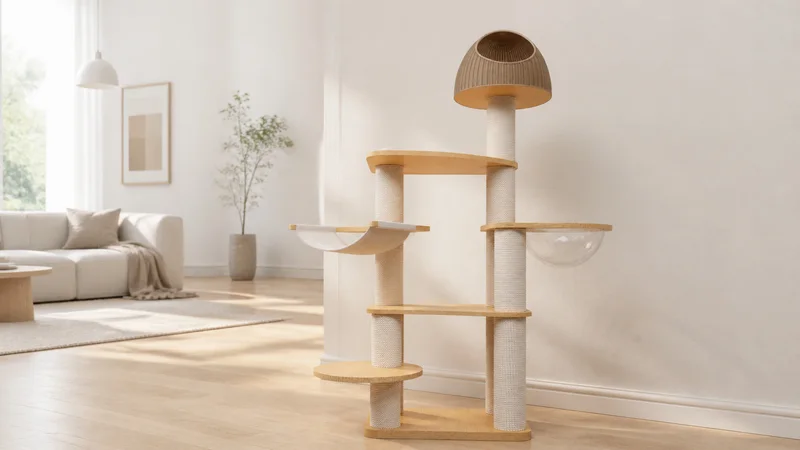
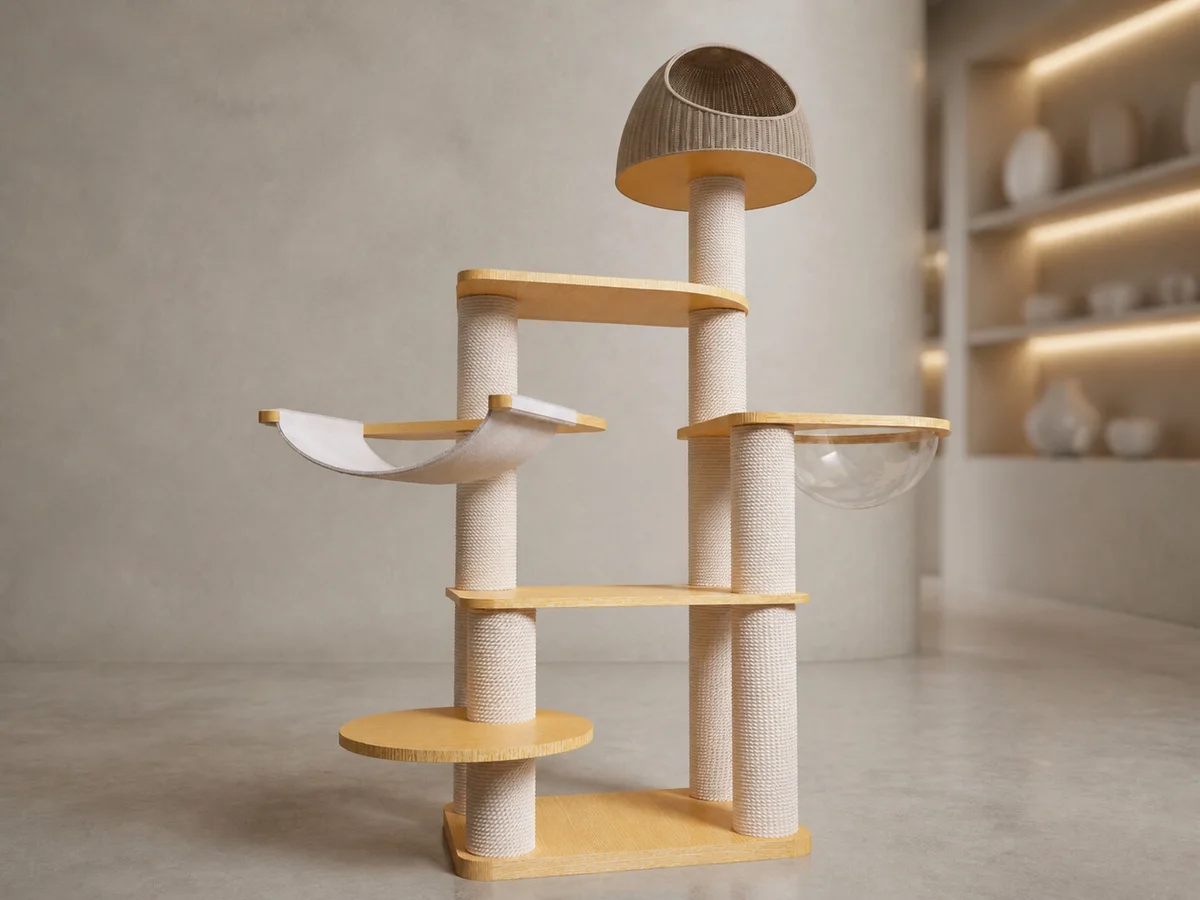
A memorable cat-tree SKU does not always need more levels or a louder colour direction. Sometimes it needs one form that makes the product recognisable from a distance and worth a closer product-page view. CT-0708-004 is a useful example. Its supplier reference shows pale wood platforms, white rope-wrapped supports, a left suspended hammock, a right clear resting bowl, a small round lower platform, and a tall woven-look upper canopy. The upper canopy gives the overall silhouette a clear point of difference, while the side features keep the model from reading as a simple vertical tower.
The imported product record lists a 170 cm overall height, a 60 x 40 cm base, 12 mm rubberwood boards, 8 cm solid-pine post fields, a 30 x 40 cm capsule field, a 62 x 42 x 47 cm carton, and an approximate 24 kg gross-weight field. These are supplier-sheet fields for early comparison, not a substitute for measuring a finished unit. The source image visibly supports discussion of the pale wood structure, rope-wrapped posts, left hammock, right clear bowl, platforms, and upper woven-look form. It does not identify the canopy material, bowl polymer, hammock fabric, fixing method, surface coating, hardware, load limits, assembly process, testing, suitability by cat size, or destination-market requirements.
Make the signature feature a named approval item
When a range is built around a recognisable form, the feature cannot be left to a broad description such as “top basket” or “decorative roof.” It needs a name and a controlled reference. For CT-0708-004, call it the upper woven-look canopy in every quotation, sample brief, content note, component list, and inspection checklist. A marked-up source image should identify its opening, rim or edge profile, visible weave pattern, supporting platform, support-post connection, orientation, colour direction, and relationship to the rest of the tree.
This approach has a practical benefit. It prevents a sales image from approving one silhouette while a later sample, listing asset, or reorder is discussed in vague terms. A buyer can ask whether the upper form matches the signed visual reference; a supplier can show the same named component in a prototype photograph; and a content team can avoid replacing the feature with an unrelated generic canopy in a marketplace image. None of that proves construction quality on its own, but it creates a common language for reviewing what is visibly important.
Keep the review narrow enough to be useful. The reference can establish the apparent location and overall character of the canopy. It cannot establish its raw material, internal construction, structural performance, or attachment security. Those must be requested separately through physical samples, drawings, component information, and destination-specific requirements. A distinctive appearance should lead to more precise questions, not broader assumptions.
Supplier-record specification snapshot
Use the model number as the stable anchor. Product titles, collection names, and search terms may evolve, but CT-0708-004 should remain unchanged in buyer correspondence, source imagery, prototype labels, carton documents, approval records, and replenishment files.
| Reference field | Recorded value | What to confirm on a physical sample |
|---|---|---|
| Model number | CT-0708-004 | Keep the code unchanged across content, drawings, samples, cartons, purchase records, and repeat orders. |
| Footprint and height | 600 x 400 mm; 1.70 m overall | Measure the assembled base boundary and the true topmost point, including the canopy's highest edge. |
| Board field | 12 mm rubberwood | Check actual board thickness, cut profiles, edge treatment, visible grain direction, colour, and finish on the approved sample. |
| Post field | 8 cm solid pine | Check the cores, rope coverage, post positions, platform joints, base interfaces, and the tall post that carries the canopy. |
| Capsule field | 30 x 40 cm | Define the dimensions in writing, then inspect the clear bowl, its rim, carrier, transparency, and its specific fixing arrangement. |
| Carton field | 620 x 420 x 470 mm | Use only for early planning; retake the sealed-carton measurement after the part layout, hardware, protection, manual, and carton marks are set. |
| Gross-weight field | Approx. 24 kg | Weigh the final closed carton before setting freight, warehousing, delivery, or handling assumptions. |
The product record does not state a MOQ, sample timing, production lead time, canopy material, hammock textile, bowl material, hardware type, coating system, replacement-part policy, or test programme. Keep those as explicit commercial or technical questions. That separation makes the page useful to a sourcing buyer without converting unverified details into marketing claims.
Use the silhouette to organise a focused image set
For a product with a strong upper form, the first image should show the complete outline from base to canopy without cropping the top or hiding the clear bowl and hammock. The next images should not be near-duplicates. One can document the canopy from the side and show its opening and support relationship. Another can focus on the bowl and its carrier. A third can record the hammock edge, attachment points, and adjacent platform. A full three-quarter sample photograph can make the sequence of lower round platform, central decks, posts, bowl, hammock, and canopy easier to review together.
That content order is suitable for an ecommerce listing, a trade-show line sheet, or a buyer presentation because every frame answers a different product question. It also creates a disciplined bridge between early supplier reference material and later production evidence. When the physical sample exists, replace illustrative details with direct photographs of the actual relevant item: the canopy connection, underside, rope winding, hammock seams, bowl carrier, board edges, fasteners, included hardware, assembly stages, protection inside the carton, and the sealed carton itself.
Do not let a styled room scene carry the technical burden. It can clarify proportion and visual direction, but it cannot prove assembly, performance, loading, safe use, finished materials, packing, or inspection. The two scenes on this page were generated from the supplier product reference to support early creative review. They are not photographs of manufactured goods or proof of measurements, production, tests, packing, or release inspection.
Build the range around a recognisable feature, not an unsupported story
CT-0708-004 can work as a design-signature SKU in a collection where several more conventional trees provide the core price and height choices. In that role, its upper canopy should be presented as a visible style feature, not as a claim about a specific raw material, comfort level, durability, or pet behaviour. The left hammock and right clear bowl can be called out as visible components, while their materials and fit-for-use details remain pending confirmation.
The merchandising decision is then clear: use the model to introduce a different silhouette and material direction within a controlled assortment. The sourcing decision remains separate: confirm dimensions, component construction, the approved finish, packing layout, costs, order conditions, and all buyer-defined requirements before committing to the final range. A good product page makes both decisions easier because it tells the buyer what is known, what is visible, and what still needs proof.
Separate appearance options from product changes
During an OEM or ODM review, a buyer may explore wood colour direction, rope colour, hammock textile direction, label placement, carton artwork, barcode fields, instruction artwork, and care-copy layout. Those are commercial presentation topics, and they should be approved together with the corresponding physical and print references.
Changing the base size, canopy construction or form, post layout, platform geometry, bowl dimensions or carrier, hammock attachment, board thickness, hardware, component count, or packing arrangement creates a revised SKU. It can require new drawings, a prototype, cost review, packing review, new photography, and an updated approval record. Treating such changes as a simple colour option risks publishing content for a version that is no longer the version in the carton.
A practical sample-control brief
- Set the review header as CT-0708-004 with its destination, intended retail channel, expected order band, required arrival date, and role as a signature item in the range.
- On the assembled prototype, record the base boundary, top height, panel and post measurements, canopy outer profile and opening, bowl and carrier, hammock mounting points, packed dimensions, and sealed mass.
- Use a visual checklist which names the canopy, its supporting post, hammock, bowl, central decks, round lower step, base, rope coverage, wood appearance, labels, manual, and supplied pieces.
- Capture close photographs of the canopy rim and interface, its underside, rope wrapping, bowl carrier, hammock seams and anchors, board edges, fasteners, loose parts, assembly stages, inner pack protection, and closed carton.
- Agree the measurable acceptance points for geometry, finish, visible component position, attachment condition, internal packing, outer marks, and buyer-defined market obligations.
- Keep MOQ, sample dates, production window, quotation expiry, payment terms, service-parts position, and freight basis in the commercial file.
CT-0708-004 gives a cat-furniture collection a model with a clearly identifiable upper form, without relying on exaggerated performance claims. The key is to protect that visible silhouette through named component review and then replace early illustrative content with physical sample evidence as the project develops. Review the CT-0708-004 product record, browse the capsule cat-tree category, consult the quality-control approach, or contact the sourcing team with the destination, forecast volume, target assortment, and sample-review criteria.