Large cat furniture is often selected for its silhouette, then handed to logistics as an afterthought. CT-0708-056 is a useful model for reversing that sequence. Its supplier record combines a 170 cm overall height with a 70 x 60 cm base, a 40 cm capsule field, a recorded carton size of 74 x 64 x 55 cm, and approximate gross weight of 66 kg. Those figures make it appropriate for an early carton-first review before a buyer commits to a retail price, storage plan, fulfilment method, or product launch calendar.
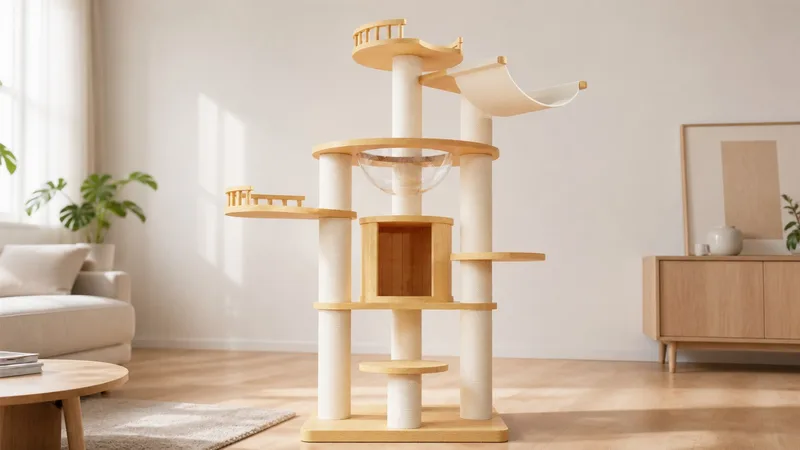
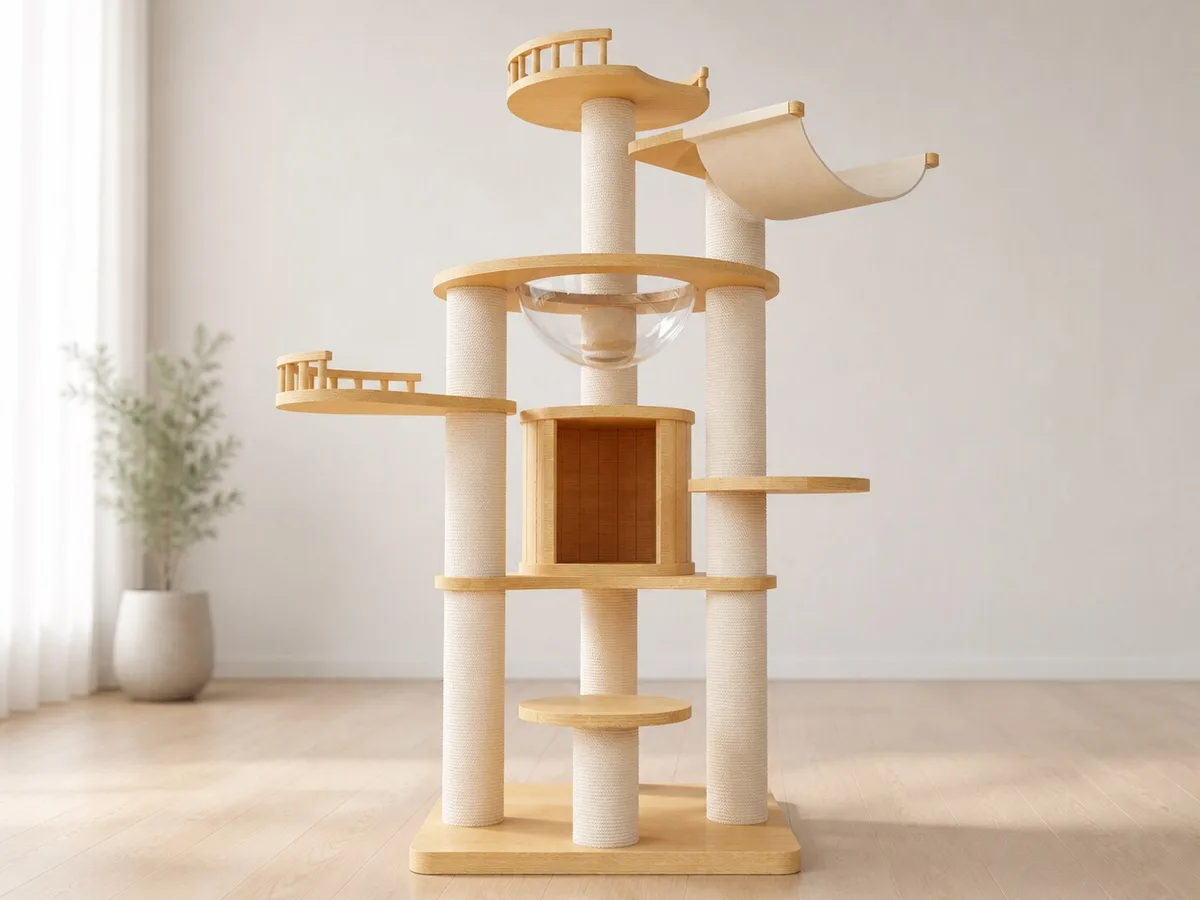
The reference image shows a wide pale-wood base, several tall rope-wrapped supports, a lower open-front wooden den, a short circular lower step, a clear suspended bowl below a curved central deck, a railed side shelf, a high curved perch with raised guard rails, and a fabric sling at upper right. This article recommends the model as a planning case for a premium, larger-format SKU. It does not establish load limits, finished carton weight, clear-bowl polymer, textile construction, hardware, drop-test result, assembly time, destination-market compliance, or suitability for any particular cat. Those points require the approved physical sample and the final production specification.
Why carton-first planning changes the assortment decision
A buyer can estimate a recorded 74 x 64 x 55 cm carton at roughly 0.261 cubic metres before considering pallet pattern, outer-carton tolerances, protective materials, or carrier rules. That is a planning calculation from the source dimensions, not a freight quote. The same record lists approximately 66 kg gross weight. Together, the carton volume and gross-weight field signal that this SKU should be reviewed with warehouse, receiving, delivery, and returns teams while the sample is still under discussion.
That does not make CT-0708-056 better or worse than a smaller tree. It makes the decision more explicit. A compact item may work where parcel restrictions or small storage locations dominate. A broad, tall model may fit a more premium assortment when a buyer can support its carton, handling route, display space, and cost structure. The range team should compare the model's visible furniture value against those operational facts rather than treating the carton as a detail to be resolved after imagery and selling copy are finished.
The product can therefore be presented as a large-format, feature-led option without promising freight efficiency. The den, clear bowl, sling, long curved shelf and raised top perch create several recognisable views. The same components also create packaging questions: what protects the bowl, how are the rail edges separated, where is the hammock stored, which boards require edge protection, and how are hardware, instructions, and loose components identified? Ask for the answers in a pack-out review, not from a styled interior photograph.
Supplier-record specification fields
Keep CT-0708-056 as the common identifier across the supplier image, sample brief, quotation, carton drawing, inspection sheet, content approval, and reorder file. The table preserves the imported product record while setting out the evidence a buyer should request before the model becomes a final retail or logistics commitment.
| Source field | Recorded value | Decision use and confirmation point |
|---|---|---|
| Model reference | CT-0708-056 | Use this code on drawings, sample photographs, component lists, packaging art, inspection records, and replenishment orders. |
| Overall format | 170 cm height; 70 x 60 cm base | Measure the completed product, including the highest rail and every point extending beyond the base footprint. |
| Board field | 18 mm rubberwood | Confirm panel thickness, board finish, wide-base construction, den panels, curved deck, rail pieces, and visible edge treatment. |
| Post field | 12 cm solid pine | Verify the core diameter, rope coverage, post count, platform junctions, lower fixings, and top connections. |
| Capsule field | 40 cm | Define what the field measures, then document actual bowl dimensions, material, rim, support method, condition, and packaging protection. |
| Carton field | 74 x 64 x 55 cm | Use for early volume planning only; measure the sealed final carton after packing materials, labels, and component arrangement are fixed. |
| Gross-weight field | Approx. 66 kg | Weigh the sealed sample carton before setting handling rules, shipment assumptions, or consumer-delivery instructions. |
The product sheet does not state final net weight, finished-carton tolerance, carton board grade, pallet pattern, stack limitation, freight classification, or delivery-service limits. It also does not state the hammock fabric, bowl resin, coating system, hardware type, test protocol, MOQ, lead time, or spare-part arrangement. These missing fields belong in the RFQ and sample controls; they are not appropriate to infer from an image or a category label.
Map the visible product into a packing checklist
The clear bowl should have a named protection method in the packing documentation. Ask to see its separate protective layer, contact points, location in the carton, and condition after unpacking. A clear object can look acceptable in a lifestyle photo while still needing a defined way to avoid scuffing, distortion, or pressure from adjacent parts. Record the bowl support and fastening method as well, because those are part of the assembled product rather than decorative details.
The upper guard rail and curved boards need their own review. Check rail joints, rail spacing, curved-edge finish, protective sleeves or separators, and the orientation of each piece within the carton. The lower den should be checked as a box assembly: front opening, panel alignment, interior edges, base contact, and any supplied fixtures. The upper sling should be documented separately with its mounting bars, connection points, fabric edges, hardware, and packing position. This component-by-component approach makes content, sampling, and inspection more consistent with one another.
For product photography, show the base completely, then take views that make the den, bowl, sling, rails, rope wraps, and curved platform easy to compare with the sample. Add component and carton images only after the actual prototype has been measured and packed. The source image is useful for defining appearance; it is not sufficient proof of final assembly sequence, material specification, or transport performance.
Build the warehouse conversation before launch
A product team should give operations a concise fact sheet before listing CT-0708-056: supplier-record carton dimensions, approximate packed mass, proposed carton count per SKU, expected receiving method, possible storage location, intended replenishment flow, and any carrier or marketplace restrictions that apply in the destination market. Operations can then identify questions that must be resolved before a purchase order: handling equipment, receiving access, pallet configuration, barcode placement, inspection access, and return-route requirements.
Retail display also needs the fully assembled dimensions confirmed. The 70 x 60 cm base is useful for preliminary floor planning, but display access, cleaning clearance, sight lines, local safety conditions, and the actual finished stability remain separate reviews. A buyer should not label this as a commercial installation product or make a stability claim unless the relevant design, test, and destination obligations have been documented.
Both room-set visuals in this article are AI-generated, product-faithful development illustrations based on the supplier reference. They support merchandising discussion only. They are not evidence of a physical sample, confirmed dimensions, completed production, packaging performance, test results, or inspection findings.
Separate aesthetic choices from pack-out changes
During an OEM or ODM review, buyers may consider approved wood tone, rope colour, fabric colour, brand mark position, carton artwork, barcode panel, instructions, care notices, and component labels. Those are presentation choices and should be signed off using the real sample and final artwork.
Changes to the base size, den dimensions, bowl size or support, post diameter, number or position of platforms, guard-rail form, hammock construction, hardware, or component attachment change the underlying product. They can also alter carton layout and material needs. Treat such requests as a revised product and pack-out approval, not as a small visual adjustment after the carton record has been circulated.
Buyer brief for CT-0708-056
- Open the RFQ with CT-0708-056, target market, expected order range, intended channel, required arrival period, and retail positioning.
- Measure the base, maximum assembled height, board and post fields, bowl field, finished carton, and sealed-carton mass on the physical sample.
- Approve the den, bowl, curved deck, left rail, upper guard rail, sling, post layout, finish, rope coverage, instructions, labels, and supplied components using annotated sample photography.
- Request a packing diagram and opened-carton evidence for the bowl, rails, curved boards, den, hammock pieces, posts, fittings, protective materials, hardware pack, and carton labels.
- Set acceptance criteria for dimensions, visible finish, edge treatment, component alignment, bowl condition, sling attachment, packaging protection, labelling, and any market-specific obligations.
- Document commercial terms separately: MOQ, prototype timing, production schedule, spare parts, quote validity, payment terms, shipment assumptions, and return handling.
CT-0708-056 gives a premium cat-furniture range a broad-footprint visual with an operational review that starts early: the product's base, height, clear bowl, sling, den, carton field, and weight field can all be treated as named decision points. Review the CT-0708-056 product record, explore the capsule cat-tree range, or send the sourcing team an inquiry with your market, volume, packaging constraints, and sample-control requirements.