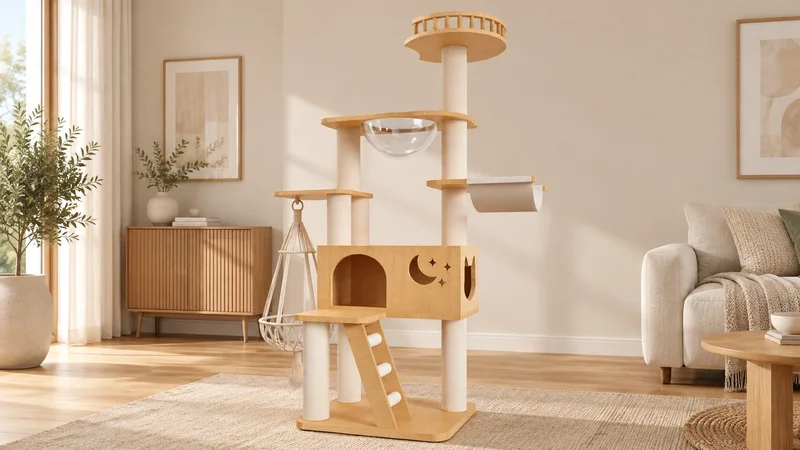
A cat tree with many visible features can be easy to merchandise and difficult to support if its components are not clearly defined. CT-0708-076 combines a wooden den, a clear bowl, a suspended rope basket, a fabric hammock, a ramp, several wrapped posts and an upper rail platform. That variety gives a buyer several product-page stories, but it also creates more materials, attachment points and replacement questions than a simpler tower.
The right purchasing question is therefore not only, “How many features are included?” It is also, “Can every supplied part be identified, checked, reordered and explained to the customer?” This guide uses the model to build a spare-parts and after-sales brief without turning a supplier image or spreadsheet field into an unsupported durability, safety or pet-capacity claim.
Start with the recorded specification, then build the component record
The supplier record is useful for model-level comparison. It does not identify every item inside the carton or explain which soft and transparent parts can be replaced separately. Buyers should connect the commercial specification to a controlled bill of materials, assembly manual and approved sample.
| Supplier-record field | Recorded value | Buyer follow-up |
|---|---|---|
| Model | CT-0708-076 | Use the same model and revision on the quotation, sample, carton, manual and replacement-parts list. |
| Overall height | 170 cm | Confirm the measurement points, assembled tolerances and full projected envelope. |
| Base field | 60 x 60 cm | Confirm the finished base and the maximum reach of projecting platforms and suspended elements. |
| Board field | 18 mm rubberwood | Map the field to named boards rather than assuming every wooden component has the same thickness. |
| Post field | 10 cm solid pine | Clarify whether the dimension describes the core or finished wrapped diameter and identify each post length. |
| Capsule field | 30 cm | Define the measured points and confirm whether this field refers to the clear bowl or another supplier convention. |
| Carton field | 62 x 62 x 40 cm | Verify the sealed production carton after protection, hardware and instructions are finalized. |
| Approximate gross weight | 42 kg | Verify packed gross weight, net product weight, carton count and handling requirements. |
The 42 kg field is a packaging and logistics input. It is not a platform rating, bowl capacity, hammock capacity or recommended pet weight. Likewise, the 30 cm capsule field is ambiguous until the supplier defines what was measured. Accurate content keeps those distinctions visible.
Give every customer-facing part a stable name
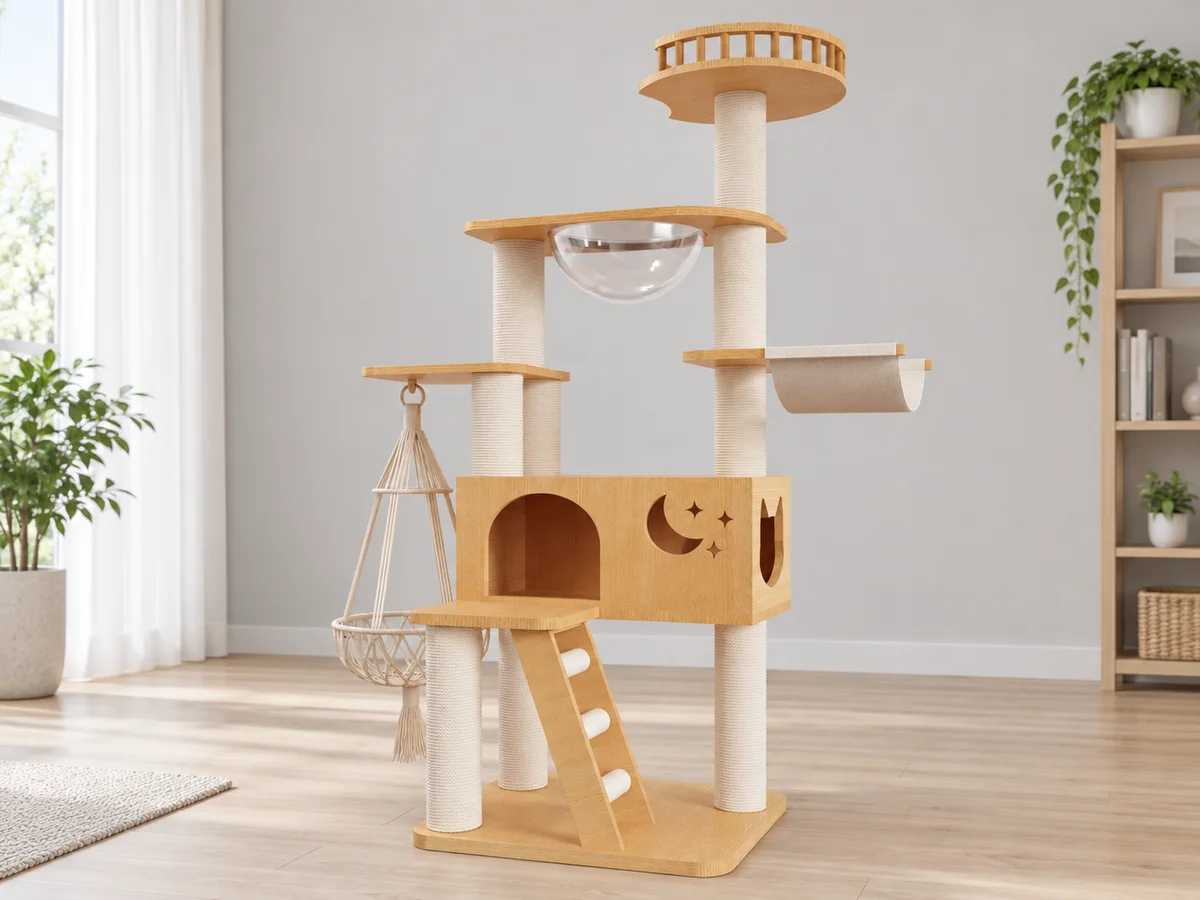
A replacement conversation fails quickly when the manual calls an item a “bed,” the website calls it a “hammock,” and the factory list calls it a “cloth.” Create one controlled component name and part number for each item. For this model, the visible list should at least distinguish the wooden base, ramp board, three ramp rungs, lower support posts, den body, den roof or platform, projecting shelves, rope basket and hanger, clear bowl and carrier, fabric hammock and rails, broad upper deck, upper post and rail-edged top platform.
The crescent-and-stars opening and cat-head side opening are design features of the den, not separate accessories. Nevertheless, they help identify the correct den revision when support staff compare a customer photo with the approved drawing. If an OEM version changes those cutouts, textile color, rope type, bowl fixing or platform shape, issue a new revision instead of silently using the old parts sheet.
Part numbers should remain readable without exposing factory-only terminology to the consumer. A retailer might use “right fabric hammock assembly” while the internal bill of materials divides it into textile, two rails and fasteners. The customer-facing name can stay simple as long as the support team can map it to the exact internal items.
Separate replaceable wear parts from structural components
Mixed-material cat furniture does not age uniformly. Rope and textiles may show use differently from wooden boards, transparent components and metal fasteners. A sensible after-sales plan identifies which parts the supplier permits the user or service team to replace, which require technical review, and which are not offered separately.
For the clear bowl, confirm material, finished dimensions, edge treatment, attachment method, cleaning instructions and replacement availability. Do not describe it as impact-resistant or suitable for a stated pet weight unless the claim has supporting evidence. For the hammock and rope basket, confirm fibre or textile specification, stitching or knot construction, attachment points, care limitations and the exact replacement assembly supplied.
Wrapped posts require another decision: is a customer expected to replace an entire post, a rope-wrapped sleeve or neither? The source record identifies solid-pine post and rubberwood-board fields, but it does not establish the rope fibre, adhesive, wrapping process or user-repair method. Those details belong in the approved material schedule and instructions.
Ask for an assembly drawing that supports troubleshooting
A customer may report that “the top platform is loose” when the actual issue involves the upper post, an insert, a bolt, a washer or the platform itself. An exploded drawing should show the order and orientation of every part, the correct fastener at each connection and any supplier-defined tightening or inspection instruction. Hardware bags should use matching labels.
The ramp deserves its own drawing detail. Confirm how the ramp board connects to the base or den platform, how the three cylindrical rungs are fixed, and whether the complete ramp is one replacement item. The reference image shows its location and appearance but cannot reveal hidden fasteners or approved repair procedures.
Include the suspended elements in the same document. The left rope basket and right fabric hammock use different structures and attachments. A generic instruction such as “install the hammock” is not enough when the customer needs to know which rails, rings, cords or fasteners belong to each side.
Build a sample inspection around interfaces
Component count alone does not confirm a successful assembly. During sample review, inspect the interfaces between unlike materials: clear bowl to wooden carrier, textile to rail, rope basket to hanger, ramp to supporting board, post to platform and guard rail to top deck. Record fit, alignment, finish and the approved method of attachment.
The quality-control brief should define observable acceptance points rather than rely on words such as “good quality.” Examples include matching part numbers, correct component count, absence of visible damage, consistent finish, verified dimensions, complete hardware, readable instructions and successful assembly using the supplied components. Any stability, load or durability requirement needs a separately defined method and acceptance criterion.
Photograph the approved sample from repeatable angles, including the complete product and close views of important interfaces. These photographs help distinguish a production deviation from a website rendering difference, but they do not replace measurements or tests.
Design the packaging record for fast claims handling
A 62 x 62 x 40 cm carton field and approximately 42 kg gross-weight field suggest that package handling deserves attention, but both values should be rechecked on the finished production pack. Ask for a packing diagram showing where boards, posts, the clear bowl, textiles, rope basket, ramp and hardware are protected. Transparent and projecting parts may require protection different from flat wooden boards.
Use an internal packing checklist that links every component to a quantity, part number and carton position. If the order uses more than one carton, identify which carton contains each part. Claims staff can then ask for the carton label, model revision, missing or damaged part number and photographs instead of requesting an entire product return without diagnosis.
Agree the remedy process before shipment: evidence required, response time, approved replacement units, responsibility for freight, treatment of discontinued revisions and the availability period for service parts. These commercial terms are especially important for retailers and ecommerce sellers that need a consistent customer-support script.
Publish features without overpromising
The product page can accurately describe the visible arrangement: lower ramp, enclosed wooden retreat, suspended basket, clear bowl, fabric hammock and elevated rail platform. It can also state the supplier-record dimensions with the same qualifications used in the buying file. Avoid converting appearance into unverified claims such as “indestructible bowl,” “washable hammock,” “supports large cats” or “easy one-person assembly.”
Styled room images should be identified as illustrative when they are generated from the product reference. They help a buyer understand the design language and feature hierarchy, but they do not prove color matching under all lighting, final production dimensions or assembly quality. Close-up photographs of the approved sample should be added before a retail listing makes material or care claims.
RFQ checklist for CT-0708-076
- Reference CT-0708-076 and the exact revision on every commercial and technical document.
- Request the controlled bill of materials, exploded drawing, assembly manual and hardware schedule.
- Define stable names and part numbers for the bowl, bowl carrier, hammock, rails, rope basket, hanger, ramp, rungs, den, posts and platforms.
- Confirm which parts are replaceable and who is authorized to fit them.
- Verify material, finish and care information for wood, rope, textile, transparent parts and hardware.
- Approve sample dimensions, component interfaces, visible finish and buyer-defined performance evidence.
- Recheck the sealed-carton dimensions, gross weight, package count, protection and packing diagram.
- Agree claim evidence, replacement availability, response time, freight responsibility and revision compatibility.
The recommendation
CT-0708-076 is a strong candidate for buyers who want one 170 cm model to present several distinct resting and activity zones. Its value is not only the number of visible features; it is the opportunity to turn those features into a controlled, supportable product offer. A clear component record makes samples easier to inspect, product pages easier to substantiate and customer claims easier to resolve.
Send an enquiry with your market, channel, order quantity, required spare-parts period and packaging expectations. The sourcing team can then confirm which drawings, samples and acceptance checks are needed before quotation approval.