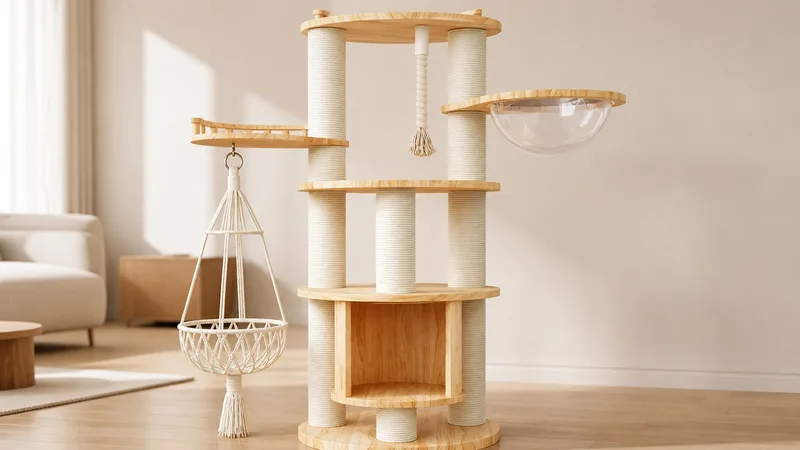
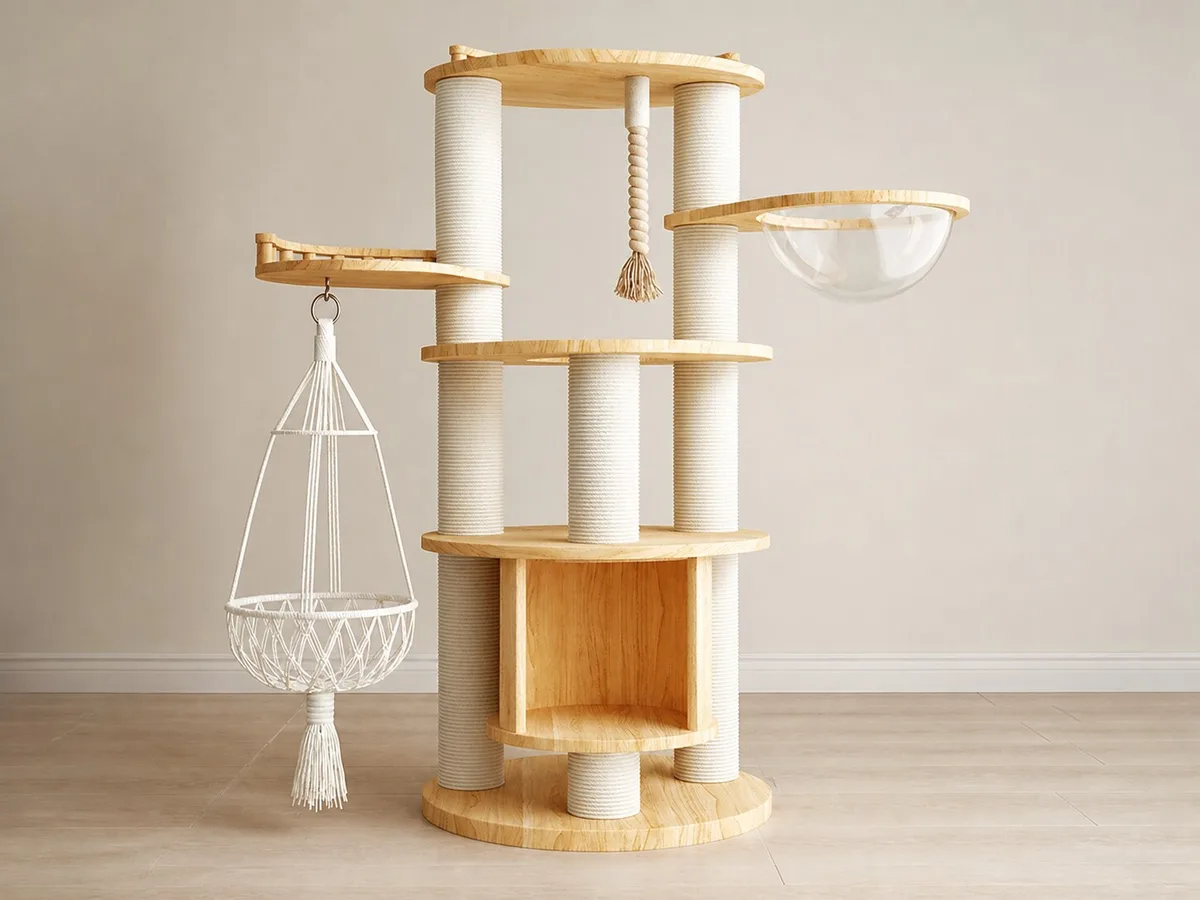
Some cat-tree models can be understood from one front image. CT-0708-015 should be presented differently. The supplier reference shows an open-front lower den, a left projecting deck with a short rail and a hanging rope-net basket, a right curved deck with a clear bowl, several rope-wrapped supports, a broad top perch, and a central rope tassel. Those features sit on different faces of the product. A buyer or retailer needs a deliberate wrap-around presentation plan so that the SKU does not collapse into a vague “multi-level cat tree” in a product listing or on a display floor.
The imported row for CT-0708-015 records an overall height of 1.60 m, a 600 by 500 mm footprint, 12 mm rubberwood boards, 8 cm solid-pine post fields, a 35 cm capsule entry, a 620 by 520 by 350 mm carton, and an approximate 30 kg gross mass. Treat these as controlled source data pending measurement of the physical sample. The lower den, net basket, clear bowl, rail sections, platforms, posts, and tassel are visible in the reference; bowl material, basket capacity, rope fibre, fastening method, finish system, hardware, required testing, cat-size suitability, and destination-market compliance remain unconfirmed.
Why the product needs more than a hero image
A front-facing image can establish the main outline, but it cannot fully explain CT-0708-015. The lower den needs a direct front view so a buyer can inspect the opening and panel profile. The left side needs a separate frame for the short rail, the hanging connection, the netting shape, and the basket clearance. The right side needs an image that places the transparent bowl, its rim, and its support platform in context. A slightly elevated image can make the top perch, middle deck, post positions, and the central hanging tassel easier to compare.
This is not an instruction to overproduce lifestyle images. It is a way to make each finished asset answer one buyer question. One complete silhouette can lead the product page. A left-side frame can document the rope-net basket assembly. A right-side frame can document the bowl placement. A rear or three-quarter view can show post spacing and the relationship between lower and upper decks. Component, assembly, and packed-carton images should come from the approved physical sample, not from an AI scene.
For a retailer, that sequence also supports shelf or showroom planning. The visual interest of this model comes from its wrap-around arrangement, not from one front panel. Place it where a shopper can see at least one side feature rather than hiding the basket and bowl behind another tall object. The recorded 60 x 50 cm base is useful for initial space planning, but the completed sample, local conditions, access, and buyer-defined safety requirements remain the decision basis for a final display.
Supplier-record specification snapshot
Use CT-0708-015 as the single reference in source photography, prototype notes, quotations, content approvals, component lists, carton artwork, inspection records, and future replenishment. The table distinguishes the imported values from the points that need direct sample evidence.
| Reference field | Recorded value | What the buyer should verify |
|---|---|---|
| Model number | CT-0708-015 | Keep the identifier intact across drawings, samples, retail assets, carton records, production checks, and reorders. |
| Footprint and height | 600 x 500 mm; 1.60 m overall | On the finished sample, record the outer floor contact area and the uppermost point, including every projecting rail edge. |
| Board field | 12 mm rubberwood | Confirm panel thickness, lower-den construction, curved or rounded board profiles, edges, colour, and visible finish. |
| Post field | 8 cm solid pine | Check the actual core, rope coverage, post count, platform joints, base connections, and top connections. |
| Capsule field | 35 cm | Define the dimension in writing and inspect the actual bowl diameter, rim, transparency, support shelf, and attachment method. |
| Carton field | 620 x 520 x 350 mm | Use only for preliminary planning; once the part layout, hardware, protection, instructions, and marks are fixed, record a new sealed-carton measurement. |
| Gross-weight field | Approx. 30 kg | Weigh a completed sample carton before fixing freight, delivery, handling, or warehouse assumptions. |
The product file does not identify the bowl polymer, basket material, net-knot specification, rail spacing, fastener type, coating system, test process, minimum order quantity, prototype timing, or production schedule. Ask for these as explicit sample and commercial items. A styled image can show the product's intended appearance; it cannot substitute for technical, packing, or compliance evidence.
Build a reference set around named viewpoints
Start with a full front image with the base in frame. Then create a left-side reference that includes the raised rail, the basket's upper connection, the full net profile, the lower tassel, and the adjacent post. A right-side image should show the full clear bowl and its supporting shelf without another component obscuring the rim. A three-quarter view can bring together the lower den, middle deck, posts, and top perch. Add an upward-looking or overhead detail only if it helps document the upper platform and the central tassel attachment.
Give each approved sample image a practical filename and a component list. For example, the left-side basket frame should identify the rail deck, connection ring, cord layout, basket body, lower tassel, nearby post, and platform edge. The right-side bowl frame should identify the bowl, rim, shelf, support region, nearby post, and edge finishing. This makes it easier for a content team, merchandiser, supplier, and inspector to refer to the same feature without relying on a casual phrase such as “the side thing.”
Do not interpret visible details beyond the source. The reference makes the basket, bowl, rails, den, posts, and tassel apparent. It does not state how much weight the basket supports, what material the bowl uses, how the net is fixed, or whether any component can be removed. Those questions should remain open until sample, drawing, and order documentation provide evidence.
Turn the wrap-around structure into useful retail content
For ecommerce, the lead image should state the complete outline and material direction. The next images can create a deliberate progression: left attachment and basket, right bowl and shelf, lower den, top perch, rope coverage and post locations, then verified component and carton photographs. This is more informative than offering several similar room scenes. It also gives the buyer a controlled way to compare an early reference image, a prototype, and pre-shipment inspection photographs.
For a physical retail floor, the model is best treated as an all-around furniture form rather than a single-front item. Give the side with the basket enough room so the net is visible and not pressed against a wall or neighbouring display. Keep the bowl side readable from another customer approach. Those choices affect visual access, not product performance; actual installation and display conditions must still be approved by the buyer for the intended market.
The two room-set scenes in this article are AI-generated product-faithful development illustrations created from the supplier reference image. They are used for presentation direction only. They are not evidence of a physical sample, exact dimensions, production output, assembly sequence, packaging outcome, test result, or inspection conclusion.
Separate brand direction from structural changes
In an OEM or ODM review, the commercial presentation can be developed separately: wood and rope colour direction, net colour, label location, shipping-carton graphics, barcode field, instruction artwork, care copy, and component naming. Release these only after the actual reference sample and print-ready artwork have been signed off together.
Changing the base footprint, lower-den dimensions, bowl size or shelf, basket construction, rail form, post position, platform shape, net attachment, tassel construction, or hardware changes the SKU. It may require a revised component list, engineering review, new prototype, updated packing arrangement, new product photography, and a new approval. Keep that distinction clear so the content does not describe a product version that the production carton no longer contains.
Sample-control brief for CT-0708-015
- Begin with the exact model code, destination, volume band, retail route, requested arrival window, and role of the item in the planned range.
- Record assembled footprint and vertical extent, actual panel and post measurements, bowl and basket measurements, packed-carton size, and sealed mass from the prototype.
- Create a marked-up approval sheet covering the den, rail deck, suspended net, clear bowl, both main decks, support layout, tassel, wood finish, rope winding, labelling, instruction pack, and included pieces.
- Obtain close sample evidence for the basket ring and cord work, lower tassel, bowl carrier, rail edges, den joins, underside, post wraps, loose pieces, assembly order, and closed carton.
- Write pass/fail criteria for measurements, surface finish, feature geometry, attachment state, bowl appearance, protection inside the pack, markings, and destination-specific obligations.
- Keep MOQ, sample schedule, production lead time, replacement-part terms, quotation expiry, payment approach, and freight basis in the quotation file.
CT-0708-015 offers a collection a product whose identity is distributed across its two sides, rather than confined to one flat front. The den, suspended net basket, transparent bowl, rail deck, supports, and upper platform each become a named review item. Consult the CT-0708-015 product record, review the capsule cat-tree category, or contact the sourcing team with the destination, forecast volume, needed content, packing limits, and prototype-review criteria.