Height is an easy way to sort a cat-tree catalogue, but it tells only part of the product story. A buyer comparing two mid-height models also needs to understand the boards, post cores, resting surfaces and space occupied by the finished structure. CT-0708-008 deserves a closer look on that basis: its supplier record pairs a 130 cm overall height with 18 mm rubberwood boards and 10 cm solid-pine post cores. The reference combines a padded upper round perch, a rail-edged deck, a broad middle shelf and a front vertical scratching panel.
For a retail collection, the model offers a wood-and-rope appearance with several recognisable details in a lower overall height than many tall statement trees. The useful buying question is whether that particular combination fits the range and the intended customer. It is not enough to rename it “heavy duty” on the strength of the board and post fields. Those dimensions help define what to examine; finished-product performance still needs its own evidence.
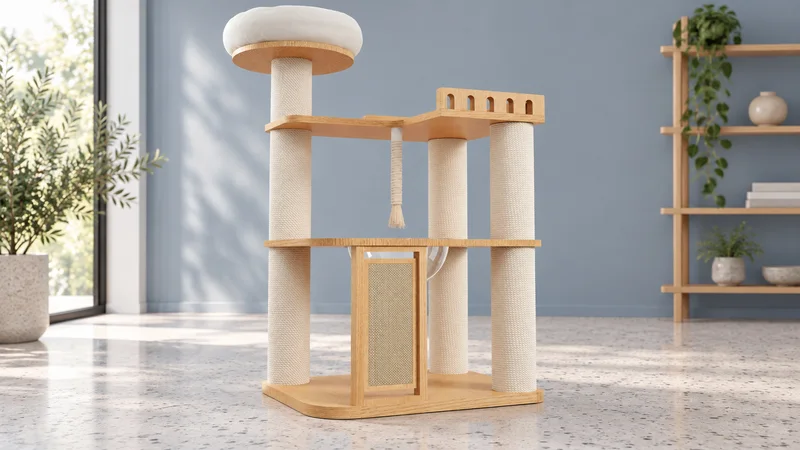
A mid-height model with a distinct material profile
The front scratching panel is an immediate point of difference. It sits vertically between the base and middle shelf, framed in wood with a textured inset. Above it, the reference shows an open gap with a hanging rope toy beneath the upper deck. A short slotted guardrail defines the right side of that deck, while the padded round perch rises on the left. A clear bowl is partially obscured behind the front panel and beneath the middle shelf. Its position is worth checking on the sample because a front catalogue view does not show the entire resting area.
These details give the product a specific visual vocabulary: upright panel, round padded perch, wood rails and substantial-looking wrapped columns. A buyer can explain those visible features without inventing a wood coating, rope fibre, cushion filling or bowl polymer. The source image establishes appearance, while the imported material fields identify rubberwood boards and pine post cores. Keep those two sources of information distinct in the specification file.
The supplier-record starting point
Use the following values when requesting a sample or comparing the model with other capsule cat trees. They come from the current product record imported from worksheet row 8, rather than measurements taken from the generated scenes.
| Specification field | Recorded value |
|---|---|
| Model reference | CT-0708-008 |
| Overall height | 130 cm |
| Base size | 60 x 40 cm |
| Rubberwood board thickness | 18 mm |
| Solid-pine post diameter | 10 cm |
| Capsule size field | 30 cm |
| Carton size | 62 x 42 x 35 cm |
| Approximate gross weight | 19 kg |
The capsule field does not define usable internal width or depth. The base measurement does not establish the widest projection of every platform. Gross weight includes packaging and must not be presented as product net weight or a supported pet weight. These distinctions matter when the sales team turns a supplier sheet into a customer-facing comparison chart.
Read board thickness and post diameter together
The 18 mm board field is a reason to inspect the platform construction closely. Confirm which boards it covers, where the measurement is taken, and whether the delivered sample matches the stated thickness. The base, middle shelf, upper deck, round perch and front panel should each have an identified specification; one general board figure should not silently become a promise about every wooden part.
Likewise, confirm whether the 10 cm post field describes the pine core before wrapping or the finished outer diameter. Ask how each post section is joined to the platforms and whether the wrapped surface changes the measured diameter. The visible thickness of a rope-covered column cannot answer those questions by itself.
A simple comparison illustrates the limit of these numbers: 18 mm is 50% thicker than 12 mm, and 10 cm is 25% larger in diameter than 8 cm. Neither calculation provides a percentage improvement in strength, stability or service life. Board span, joints, hardware, base geometry and the assembled design remain relevant. A specification-led purchase uses the figures to ask better questions rather than converting them into an unsupported performance ranking.
Measure the spaces the customer will actually use
At 130 cm overall, CT-0708-008 may suit a range that needs a mid-height option without moving to a floor-to-ceiling design. Before describing it as space-saving, obtain the complete assembled envelope: maximum width, maximum depth and any projection beyond the 60 x 40 cm base. Allowing for those projections is especially important when a customer plans to place it beside other furniture.
For the top perch, ask for usable internal resting diameter and rim height. For the upper deck, record the clear surface bounded by the rails and post. For the middle level, document the accessible landing area and the bowl opening behind the panel. Also request the vertical distances between surfaces. Overall height alone cannot establish a comfortable route or suitability for a particular cat's size or mobility.
The vertical scratching panel adds another measurable feature: exposed scratching height and width. Obtain those values, the inset material specification and the attachment details. A prominent rectangular panel in a photograph is not enough to claim a particular scratching reach or a replaceable insert.
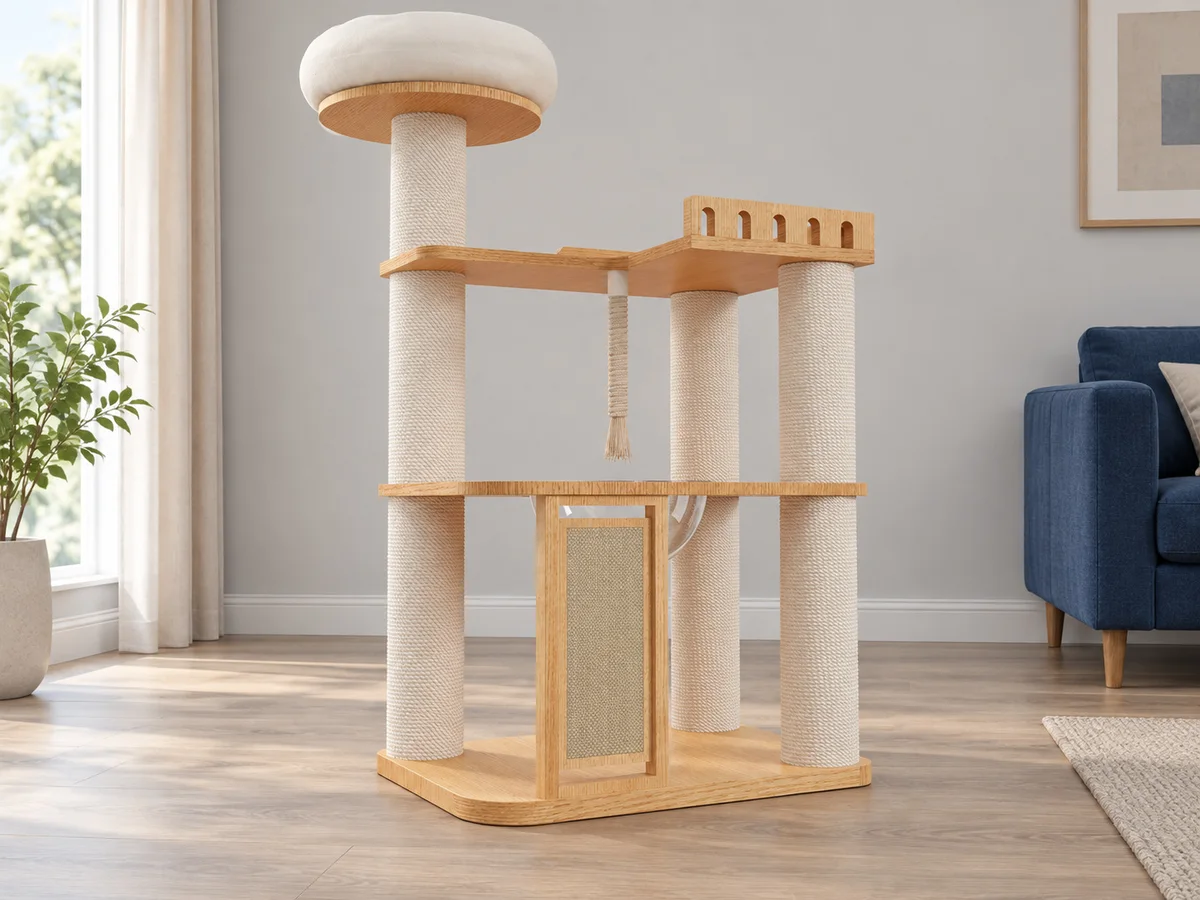
Give the model a clear role in a retail range
For specialty pet retailers, this is a candidate for a mid-height wood-furniture slot: a model whose upright scratch panel and raised round perch make it visually distinct from a simple stack of flat platforms. Present its visible features first, then use confirmed dimensions to help customers compare. A short specification card should distinguish overall size, usable resting dimensions and material fields instead of treating “medium” as a complete description.
For online listings, request photographs that answer the questions the front reference leaves open. A top view of the round bed can establish its usable space. A view around the front panel can show the bowl and its access. A straight side photograph can document platform offsets. Use the actual approved sample for those details. The two generated scenes here illustrate the product's appearance, but should not be reused as evidence of measured dimensions, finished materials, packing or testing.
Build a quotation that can be compared fairly
An OEM quotation request should name CT-0708-008 and specify the required board schedule, post-core dimensions, finish direction, cushion specification, scratch-panel material and bowl details. Ask suppliers to flag departures from the reference explicitly. Otherwise, quotations for different board thicknesses, post constructions or textile components can appear to describe the same model.
The recorded carton is 62 x 42 x 35 cm with an approximate gross weight of 19 kg. Treat those figures as an initial logistics reference and confirm them after the contents, protection and instructions are agreed. Keep MOQ, sample timing, production timing and spare-component terms as commercial questions; the source record does not fix them.
For the sample review, prioritise three decisions: whether the assembled geometry matches the reference, whether the materials and dimensions match the quotation, and what evidence supports any intended performance claims. The quality-control brief can then identify the relevant checks and acceptance criteria for the order, rather than assuming that a thicker board or wider post settles the whole assessment.
The recommendation
Shortlist CT-0708-008 when you want a mid-height capsule tree with a visible wood structure, front scratching panel and padded elevated perch, and when board and post specifications are important to your range selection. Its 130 cm height, 18 mm board field and 10 cm post field create a concrete basis for comparison. The next step is to confirm the usable dimensions and assembled construction, then write the listing around what the approved sample supports.
Send a sourcing enquiry with your destination, sales channel, forecast quantity and required sample measurements. That gives the sourcing team a clear brief for this specific product and gives your own buyers a better reason to select it than height alone.