A buyer choosing a cat tree with a hideaway often has to choose between an enclosed-looking product and one that photographs openly from every angle. CT-0708-078 offers a useful middle ground: a wooden box with a cat-head opening on one face and a large paw-shaped opening on another, plus open steps, a transparent bowl to the right and an elevated rail-edged perch. The design gives a range several ways to present the same model, from a quiet retreat to a visible lookout.
That visual story is only the start of an accurate listing. The openings, bowl and upper platforms need usable dimensions and material information before a seller can describe them as suitable for a particular cat. This guide shows where CT-0708-078 has a strong buyer-facing proposition, how to present it honestly, and what to confirm with the supplier before an assortment decision.
Why this model belongs on a shortlist
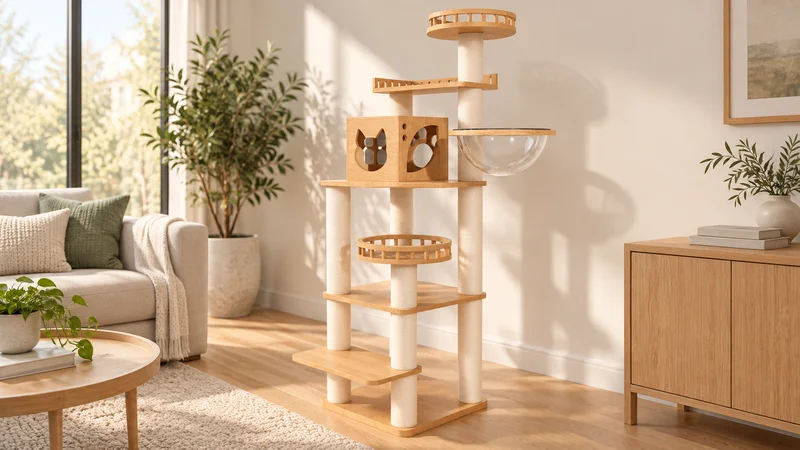
The product does not rely on one feature. Its square base supports a low offset step, an open middle level, a small round rail feature, the perforated wooden den, a longer upper ledge, a clear bowl on the right and a high round perch with a curved rail. The result is a recognisable silhouette from the front and side. For a retailer, that helps a single SKU communicate different resting positions in catalogue photographs.
The den is the distinguishing detail. Its two decorative openings make the wooden box less visually heavy than a fully solid cube. The cat-head and paw shapes can be repeated in a product title, comparison chart and close-up photography. The transparent bowl offers a different visual experience, while the top perch gives the product a clear highest point. These are observations from the reference image; they do not prove how any individual cat will use the zones.
CT-0708-078 is therefore most promising for a range that values a distinctive wooden hideaway and several visible positions in one model. If the buyer needs a specified load rating, a washable textile zone or a particular entrance size, those requirements must be checked separately. The record does not supply those answers.
Read the supplier fields precisely
The current product record supplies comparison values, not a complete approved specification. Keep the model number on every enquiry and request a controlled drawing that defines where each dimension was taken.
| Supplier-record field | Recorded value | What to verify |
|---|---|---|
| Model | CT-0708-078 | Use one revision across quotation, sample, carton, manual and product content. |
| Overall height | 170 cm | Confirm the finished measurement and height tolerance. |
| Base field | 50 x 50 cm | Measure the entire assembled envelope, including the right bowl and left steps. |
| Board field | 12 mm rubberwood | Identify the boards covered by this field and the actual finish. |
| Post field | 8 cm solid pine | Clarify whether the figure describes core or wrapped diameter; confirm each post length. |
| Capsule field | 35 cm | Define the component and measurement points before using this figure publicly. |
| Carton field | 52 x 52 x 40 cm | Recheck the sealed production carton and package count. |
| Gross-weight field | 34 kg | Verify packed weight; do not interpret it as pet or platform capacity. |
The 35 cm capsule entry needs particular care. It may refer to the clear bowl, a supplier naming convention or another measured component; the record does not say. A seller should request the bowl's actual usable inner dimensions and the den's entrance and interior dimensions instead of copying “35 cm capsule” into a consumer benefit.
Present the hideaway without overstating privacy
The wooden box can be described as a den or hideaway because the reference shows an enclosed roof and walls around openings. It should not be described as fully enclosed or dark: the cat-head cutout, paw cutout and other apertures admit light and give views through the structure. A good listing photographs the den from its entry side and its cutout side so customers understand the actual enclosure.
Ask for the clear width and height of the usable entrance, the interior floor dimensions, interior height, edge treatment and any removable or fixed parts. The outer box size cannot answer whether an individual cat can turn or rest comfortably inside. Request a physical-sample check with a ruler in view, and use that photograph alongside the styled scene.
The decorative edges also deserve attention. Confirm that the approved sample has smooth, consistent cutout edges and the intended finish around every opening. This is a practical visual and tactile acceptance point for the quality-control brief. It does not replace any performance evaluation that a buyer may require.
Explain the clear bowl as a separate choice
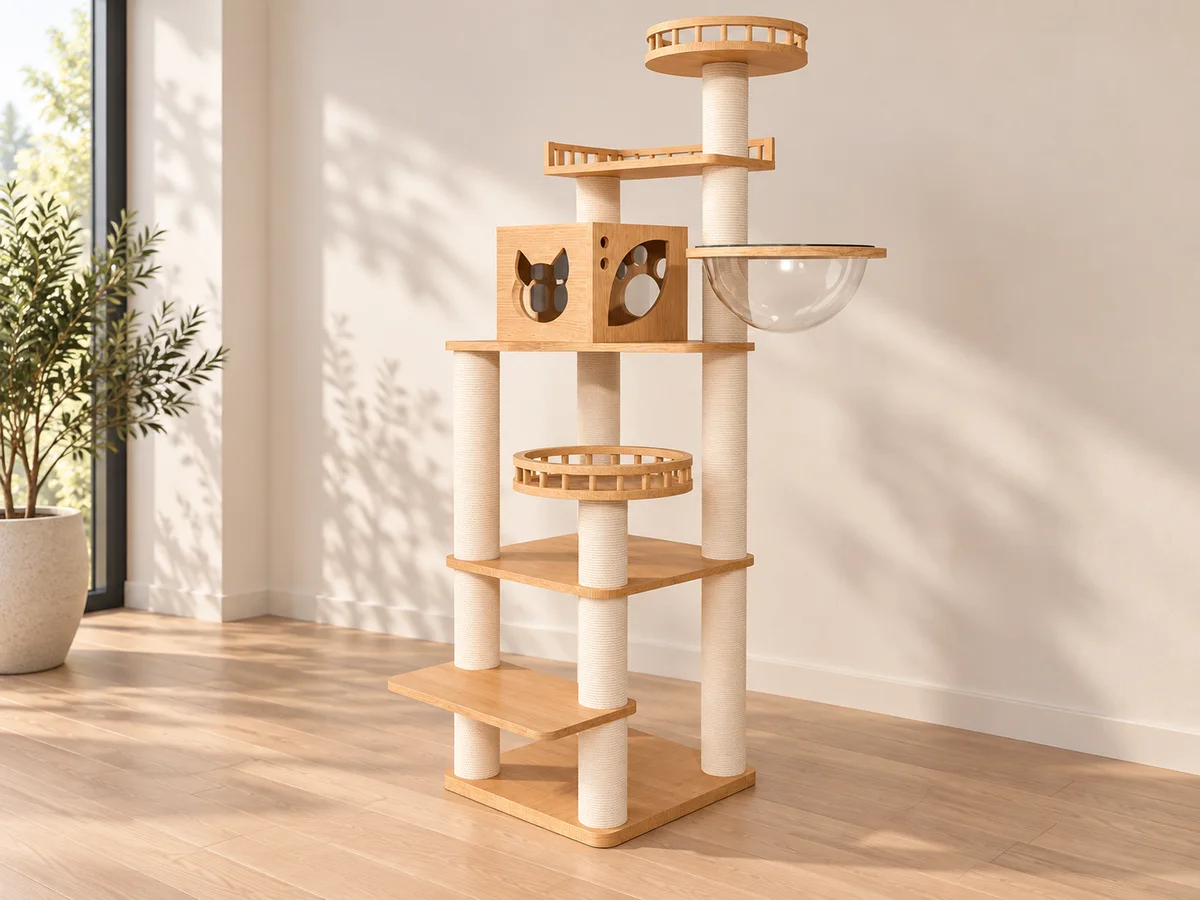
The right-side transparent bowl is visually distinct from the wooden den. It exposes more of the resting area to view and can show the cat's position in a product photograph. The source image does not establish its material, wall thickness, usable diameter, removal method, care instructions or rated capacity. Those points need supplier documentation and sample review.
Ask how the bowl is retained in its wooden carrier, whether it is supplied as a separate part and what a replacement would include. Check the visible rim and contact areas on the approved sample. If the retailer intends to claim that the bowl is acrylic, scratch resistant or easy to remove, verify the specific material or test evidence first. “Clear bowl” is the safer description until those facts are settled.
Product photographs should show both the side profile and the bowl's opening from above. A front-only view can make the bowl look like a shallow shelf, while a close-up alone can obscure how it connects to the tree. A short shot list helps an ecommerce team answer routine customer questions before they become returns.
Show how the levels relate to one another
The lower offset step, central open deck, middle rail feature, den level, upper ledge and highest perch form a visible sequence of levels. That sequence should be shown in one unobstructed full-height view. A floor-level lifestyle photograph cannot tell a buyer the vertical distance between steps, the usable landing area or the amount of space between posts.
Ask for a dimensional drawing that marks each platform's usable surface, the vertical rise to the next level, the horizontal gap and the overall projection of the bowl. Buyers serving specific cat sizes can then compare the model with their own criteria. The illustration alone should not be used to promise that every cat can climb a particular route or that multiple cats can use it simultaneously.
The top and middle rails should be treated as named design elements. Confirm their height, opening pattern and attachment on the approved sample before describing them as a protective barrier. The reference makes the rails visible; it does not quantify restraint or safety performance.
Build a product page that answers the first five questions
- What exactly is included? Show a full product view and name the den, clear bowl, steps and rail-edged platforms.
- How large is it? State verified assembled height, base and total projected envelope, with a simple dimensional drawing.
- How large are the usable spaces? Give the den entrance and interior measurements, bowl inner dimensions and platform surfaces.
- What are the materials? Map the recorded wood fields to specific parts and confirm the bowl, rope, finish and hardware separately.
- What can be maintained or replaced? Provide approved care instructions and a supplier-confirmed list of replacement parts.
Use one image to show the complete silhouette, one for the den openings, one for the clear bowl and one for the transitions between levels. A video of the approved sample can add perspective, but any generated scene should remain disclosed as an illustrative presentation. For retail buyers, this image set also gives staff a consistent way to explain the product without guessing at hidden dimensions.
A focused RFQ for CT-0708-078
- Confirm the model revision and request an approved physical sample.
- Request the assembled drawing with height, full projection, platform sizes and level spacing.
- Measure the den entry, interior floor, internal height and decorative cutouts.
- Identify the clear bowl's material, inner dimensions, retention method, care instructions and replacement option.
- Map board, post, rope, rail, finish and hardware specifications to named components.
- Confirm the sealed carton, packed weight, protection for the bowl and package count.
- Agree visual acceptance points, required performance evidence and the exact claims that may appear on the retail page.
The recommendation
CT-0708-078 is worth shortlisting when a buyer wants a 170 cm cat tree whose wooden hideaway and transparent resting bowl create two contrasting visual zones. The cat-head and paw cutouts give the den a recognisable identity, while the open platforms and upper perch make the full structure legible in a single catalogue image. Its 50 x 50 cm base is a useful recorded starting point, but the complete floor-space envelope and usable spaces still need measurement.
Send the sourcing team an enquiry with your target market, order quantity and intended product claims. Request a model-specific drawing and sample images before settling the final listing, carton and acceptance criteria.