A cat tree can look easy to maintain in a catalogue and still leave customers wondering how to reach a bowl rim, wipe the underside of a platform, or inspect a rope-covered joint. For buyers building a home-furniture range, those everyday questions deserve attention before the product page is written. CT-0708-007 offers a useful starting point: an open wooden structure with a clear resting bowl, staggered side platforms, rope-wrapped columns, and a rail-edged upper deck. Its appeal is a visibly open layout that buyers can evaluate for access and care, rather than an enclosed retreat filled with textile components.
The supplier record lists a 160 cm height and a 60 x 40 cm base. The reference image shows no enclosed den, suspended fabric hammock, or loose cushion. That gives the model a specific place in a collection: a capsule cat tree for customers who prefer exposed wood surfaces and an open outline. It does not establish a cleaning method, scratch resistance, waterproof finish, or maintenance time. Those details should come from the finished sample and the supplier's written care instructions.
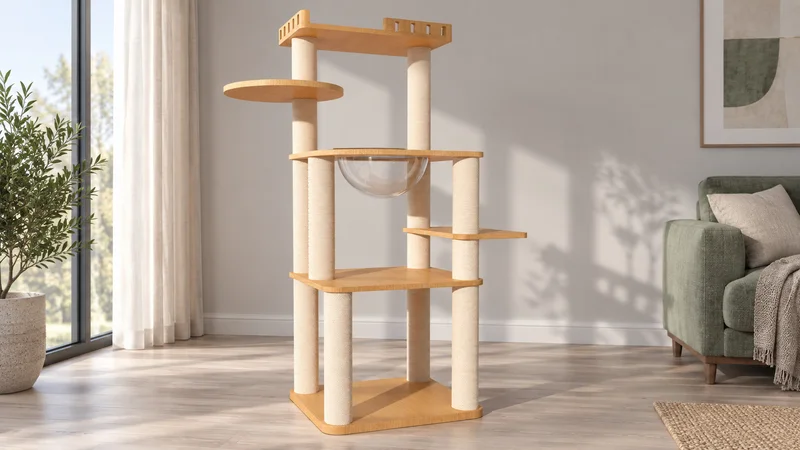
What makes this an open-layout option?
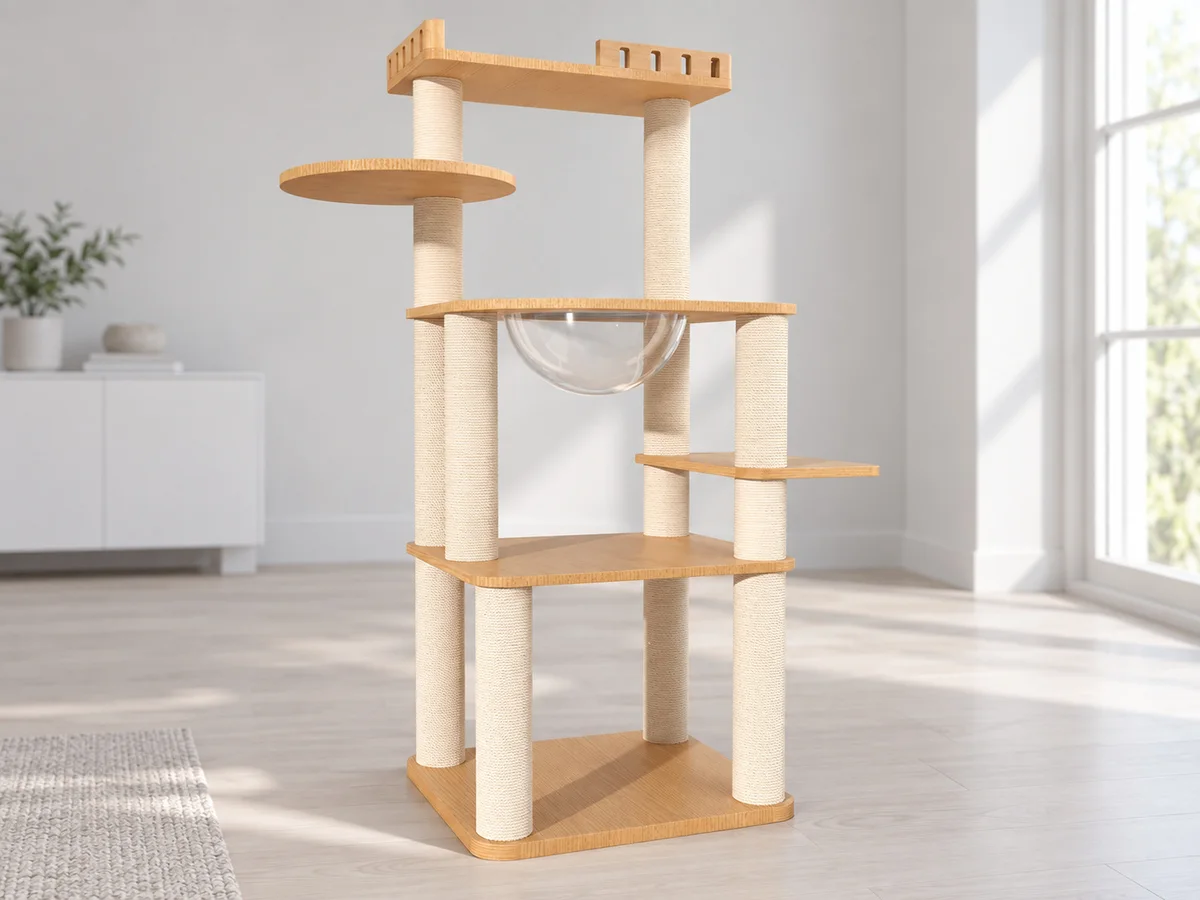
Read the structure from the floor upward. A rectangular base supports an open lower bay. A broad middle platform spans the main columns, with a smaller projecting step on the right above it. Higher up, a clear bowl hangs beneath its wooden carrier platform. A round perch projects to the left, while the top rectangular deck has short wooden guardrails. The resulting outline presents several different surfaces without concealing the lower area behind a box-shaped den.
For pet retailers, that difference is easy to communicate: show the open bay, the clear bowl and the staggered platforms as the product's visible features. Avoid calling the model “maintenance-free,” “hygienic” or “easy-clean” until those claims have a defined basis. A clear view through the frame is a design characteristic; convenient access to every contact point is something to check with the assembled unit.
Supplier-record dimensions and materials
The following values are transcribed from the imported product record linked to supplier worksheet row 7. They support initial comparison and quotation discussions. Measurements and material descriptions should be reconciled with the sample selected for the order.
| Item | Supplier-record value | Care-related detail still needed |
|---|---|---|
| Model | CT-0708-007 | Match the care sheet and component drawing to this exact version. |
| Overall height | 160 cm | Check how a user reaches the upper deck and its underside. |
| Base | 60 x 40 cm | Measure projecting platforms separately; the base is not the complete outer envelope. |
| Board field | 12 mm rubberwood | Obtain the coating specification and permitted cleaning procedure. |
| Post field | 8 cm solid pine | Confirm rope fibre, winding attachment and care restrictions. |
| Capsule field | 30 cm | Define whether this refers to an outer diameter or usable internal dimension; confirm bowl material. |
| Carton | 62 x 52 x 35 cm | Verify the final packed unit and inclusion of care and assembly instructions. |
| Approximate gross weight | 29 kg | Confirm packed weight; it is not the assembled net weight or a load rating. |
No cleaning chemical compatibility, bowl-removal method, dishwasher suitability, load capacity or service life is specified in these fields. Neither the reference nor the generated scenes can fill those gaps. Keep those questions in the sample brief instead of turning them into assumed product benefits.
Review access at five specific locations
The floor-facing base edge. Check the actual base perimeter, underside and contact points. Establish whether the tree must be moved to reach accumulated debris and what the supplier recommends for moving the assembled product. A 29 kg carton field is not enough information to decide whether one person can move it safely.
The open lower bay. Have the sample reviewer reach between the columns and beneath the broad middle platform. Record where the post placement restricts access. The absence of a den creates visible space, but usable access also depends on clearances that the product record does not provide.
The clear bowl and its wooden surround. Inspect the inside surface, outside curve and contact line around the rim. Ask whether removal is intended for routine care, which fixings are involved, and how correct reinstallation is verified. Do not describe the bowl as removable, replaceable or washable until the supplier confirms those details for this SKU.
The stepped platforms and top rails. Review the platform undersides, rail corners and the area beside each post. These are more useful inspection points than a general statement that “all surfaces are accessible.” Photographs should show the actual clearances and joints on the sample.
The rope-covered columns. Obtain care guidance for the rope itself, its ends and its connections to the wooden parts. The imported record identifies pine post cores but does not name the rope fibre or adhesive. A care process suitable for the boards must not automatically be applied to the rope or bowl.
Turn the sample review into a useful care sheet
A care sheet should identify the wood finish, transparent bowl and wrapped columns separately, then give the approved method for each. Ask the supplier to specify suitable tools, permitted products, moisture restrictions, drying requirements and any disassembly steps. Have these instructions reviewed against the actual materials and supplied hardware before translating them for the destination market. Avoid adding a household cleaning recipe simply because it sounds familiar.
The sheet should also tell an owner what to inspect and when to seek support: changes at joints, a damaged bowl, loose rope or visible component damage, for example. The supplier needs to define the response and any stop-use criteria. Present these as part of the information to obtain, not as a claim that this model has already passed a maintenance programme.
For ecommerce programmes, put the approved care sheet alongside assembly information and actual product photography. A customer should be able to distinguish surface care from assembly adjustment. Keep the model and revision visible so that advice for another bowl, coating or fastener arrangement is not reused by mistake.
Check service questions before promising spare parts
The clear bowl is a visually distinct component, but that does not prove it is supplied separately. Ask whether a bowl, post section, platform or hardware pack can be ordered individually; request part identifiers, matching dimensions and revision information where available. Also establish whether a replacement requires partial disassembly and whether the supplied instructions cover that work. Until commercial terms are agreed, customer-facing copy should invite a support enquiry rather than promise stocked replacements.
During an OEM or private-label discussion, a change in coating, rope, bowl material or construction can change the required care guidance. Review the instructions again after approving such a change. Colour choices are not a substitute for a confirmed material specification.
Who should put CT-0708-007 on the shortlist?
This model is worth reviewing when a range needs an open wooden capsule tree with staggered perches and no visible enclosed den or fabric hammock. It offers a straightforward contrast to textile-heavy or hideaway-focused models. Buyers can develop a more useful listing by explaining the exposed layout and publishing verified care information, rather than repeating broad comfort or durability promises.
It is not yet a justified recommendation for a particular cat weight, mobility requirement, multi-cat capacity or commercial cleaning regime. Those use cases require additional dimensions and evidence. For the next sourcing step, send the model number, destination, expected quantity, preferred finish direction and your care-document requirements through the quotation enquiry page. Request an assembled sample review covering the five access locations above, then agree the approved instructions through the quality-control process. That produces a launch decision grounded in the product customers will actually receive.