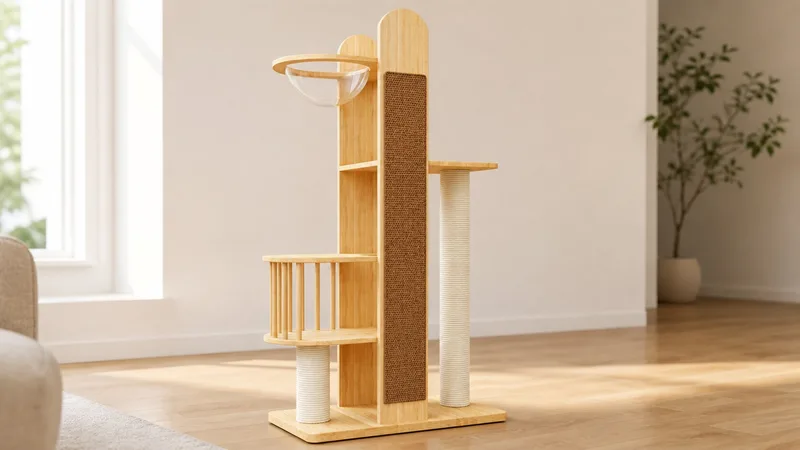
Some cat trees compete by adding more platforms. CT-0708-087 takes a more architectural route: one tall vertical brown scratch panel runs beside a pale wood spine, while a clear bowl, a small railed deck, and a separate rope-wrapped post sit around it. The supplied product record lists an 80 x 40 cm base and 150 cm overall height, creating a long, shallow footprint rather than a wide square tower.
This is a recommendation for buyers who want a visibly different item within a capsule-cat-tree assortment. The identifiable elements are the rectangular base, rounded top on the central wood spine, full-height brown scratch panel, circular bowl ring, clear hemispherical bowl, low semicircular rail deck, short rope-wrapped support, and one taller rope-wrapped support carrying a square side platform. The article does not claim load capacity, cat-size suitability, safety certification, scratch-life, bowl material, or performance outcomes that are not confirmed in the supplier record. Those points belong in sample review and the final order specification.
Why the vertical panel changes the assortment role
A rope-wrapped post is a familiar cat-tree cue. A broad, uninterrupted vertical panel reads differently in product photography and on a store floor. On CT-0708-087, the brown panel is visible from the front and rises almost the full height of the central assembly. It creates a single strong material contrast against the pale wood structure and the white rope supports. That contrast makes the model easy to distinguish from a collection dominated by beige towers, small circular perches, or fully carpeted forms.
For a brand or retailer, that difference can give the product a defined job: a vertical-surface-led option in a mixed range. It is not necessary to describe it as universally better than a rope-only model. Instead, present the tangible distinction: a buyer can assess the panel's surface, edge treatment, fixing method, alignment, and visible colour against the approved sample. Those are specific points that can be photographed, recorded, and checked again on a production batch.
The profile also supports a focused visual sequence. Use a complete front image first. Follow it with close views of the scratch panel from top to bottom, the panel-to-spine join, the bowl ring and bowl support, the low railed deck, both rope-wrapped supports, the small right-side platform, and the base. This lets ecommerce teams explain the construction without inventing behavioural claims or hiding the product behind a lifestyle setting.
Supplier-record specifications for CT-0708-087
The imported record identifies CT-0708-087 as a 150 cm solid wood capsule cat tree. It lists an 80 x 40 cm base, 18 mm rubberwood boards, 10 cm solid pine scratching posts, a 30 cm capsule field, an 82 x 42 x 45 cm carton, and an approximate gross weight of 45 kg. Treat these values as a sourcing baseline. Measure the approved sample and verify the completed carton before using them for a listing, freight calculation, retail planogram, or purchase order.
| Record field | Supplier value | Control point before approval |
|---|---|---|
| Model reference | CT-0708-087 | Use this identifier on reference images, drawing files, quotation sheets, inspection records, parts lists, and repeat-order discussions. |
| Overall footprint | 80 x 40 cm base | Measure the finished base length and depth, corner treatment, level contact points, and the positions of the central spine and both supports. |
| Overall height | 150 cm | Measure the assembled height from floor contact to the rounded top of the central wood spine. |
| Board record | 18 mm rubberwood in the import file | Assess board gauge, grain appearance, rounded tops, edge treatment, the frame around the brown surface, and exposed joins. |
| Post record | 10 cm pine supports in the import file | Inspect the timber core, wrap coverage, lower-left support, right-hand tall support, and their attachment points. |
| Capsule field | 30 cm | Identify what the 30 cm field measures, then assess the clear bowl, rim, hardware, finished edge, and seating location. |
| Carton record | 82 x 42 x 45 cm; approx. 45 kg | Recheck outer dimensions, packing method, actual gross weight, hardware pack, instructions, and protection of the tall panel and bowl. |
The source data does not establish the clear-bowl material, scratch-panel composition, coating system, rope specification, structural test scope, order minimum, production schedule, or final pallet arrangement. List those as open confirmation items rather than filling gaps with generic product language.
Plan for an 80 x 40 cm base, not an abstract "slim" claim
The 40 cm depth is one useful planning figure, but it does not alone describe every placement requirement. A buyer should consider the full assembled silhouette, clearance around the bowl and deck, opening direction for a carton, customer assembly space, and the route from receiving area to display or home room. The 80 cm base length is also material to merchandising: it changes how the product occupies a wall run compared with a compact square-base unit.
For an online catalogue, show both the long side and the shorter depth. For a physical display, draw the product's recorded base outline on the floor plan, then allow additional space for customer viewing and staff access. Do not turn the 40 cm record into a promise that the product fits every narrow location. Site conditions, skirting boards, doors, floor tolerances, and local safety expectations still need their own review.
This is a useful distinction for assortment planning. A collection can contain several different footprint stories: a low square-base starter piece, a taller tower with a wider activity layout, and a long-base vertical-panel item. CT-0708-087 earns its place when the buyer wants that third silhouette, not when it duplicates an existing tall tree with a different SKU code.
Keep the feature hierarchy intact in photographs and samples
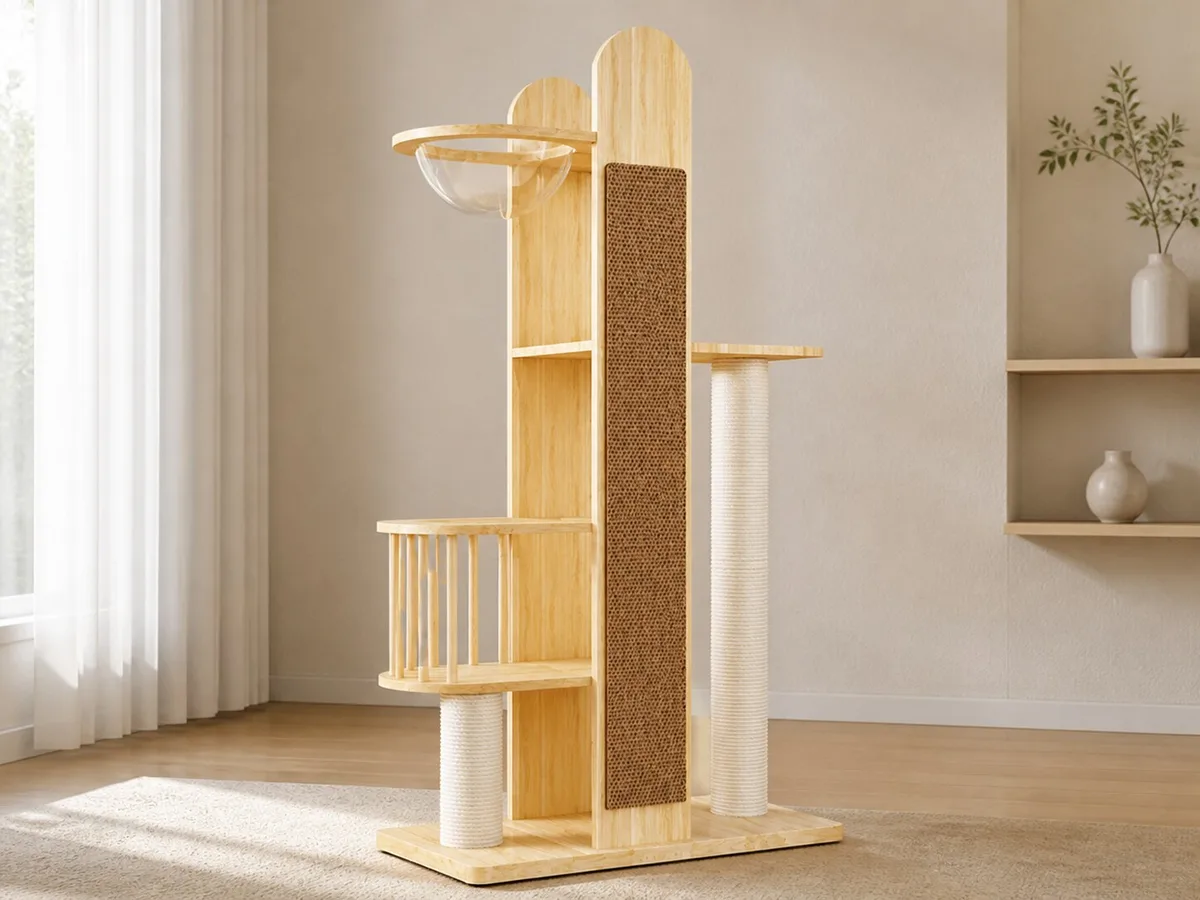
The central scratch panel is the primary feature, but the surrounding pieces explain the product's structure. The bowl is held by a thin circular wooden ring at upper left. A small rounded arch is visible behind that bowl area. The lower left deck has a semicircular face with a vertical rail detail and sits on a short wrapped support. On the opposite side, the tall wrapped support rises to a small square platform. Each item should be present and placed consistently in the approved version.
Use annotated source photos during the sample review. Number the central wood spine, scratch panel, bowl ring, bowl, rail deck, short support, tall support, right platform, and base. That makes it easier to flag a shifted platform, a shortened panel, an omitted rail, a different bowl fixing, or a changed support position. A vague instruction such as “follow the image” makes later checks harder because it does not identify what matters most.
The interior visuals here were generated from the supplier product reference while retaining its distinctive construction. They are layout studies, not production evidence. Use physical samples, measured dimensions, confirmed materials, batch photographs, pack tests, and inspection records for approval decisions.
Turn a visual signature into an OEM control list
Some OEM decisions concern presentation: agreed wood tone, rope colour, logo label, carton art, barcode location, instruction format, care note, and part-number convention. Check these against artwork and a sample before print release. They can position the model within a branded range without changing its agreed construction.
Other requests modify the product and should be treated as a new technical decision. These include changing the base length or depth, shortening the vertical panel, changing the panel surface, moving the bowl ring, removing the rail deck, altering the rounded spine, increasing post diameter, or moving the right-side platform. Each affects the visual signature and may affect drawings, parts, assembly, packaging, price, and approval timing. The OEM and ODM process is the correct place to document those changes instead of adding them informally to a final production message.
Use packaging information as an early operational checkpoint
The supplier record gives an 82 x 42 x 45 cm carton and approximate 45 kg gross weight. That information is useful for initial receiving and freight discussions, but not final until the carton is measured and the packaged sample is weighed. Ask how the full-height panel is protected, how the clear bowl is wrapped, whether the rail deck is protected against edge damage, where fittings are located, and whether the assembly instructions match the parts in the carton.
A good packing review begins with a diagram of every major component and every protection layer. It should identify the base, central spine, scratch panel, bowl and ring, rail deck, both supports, right platform, hardware, tools if agreed, instructions, labels, and protective inserts. Photograph the sealed carton, opened carton, components before assembly, hardware pack, and finished build. This record makes a repeat order more dependable than relying on an old catalogue image.
Buyer brief for CT-0708-087
- State CT-0708-087, destination market, expected quantity, customer channel, and required delivery window in the initial request.
- Confirm the 80 x 40 cm base, 150 cm assembled height, 18 mm board record, 10 cm post record, and 30 cm capsule field on the physical sample.
- Approve the long base, rounded central spine, brown vertical scratch panel, bowl ring and bowl, lower rail deck, short wrapped support, tall wrapped support, and square side platform with marked images.
- Specify what evidence is needed: full views, panel close-ups, bowl fixing, joints, rope wrapping, underside, loose parts, assembly sequence, and completed carton.
- Set pass/fail criteria for finish, dimensions, component location, panel alignment, bowl seating, carton protection, labels, and target-market obligations.
- Record commercial decisions separately: MOQ, sample timing, production schedule, spare-part approach, quote validity, and shipping assumptions.
CT-0708-087 is not a generic tall cat tree. Its value is the clear hierarchy between the vertical scratch panel and the surrounding bowl, deck, and support structure. For a buyer building a differentiated product line, that gives a concrete starting reference. Review the CT-0708-087 product page, then contact the team with your market, anticipated volume, finish preference, packaging constraints, and sample-evaluation points.