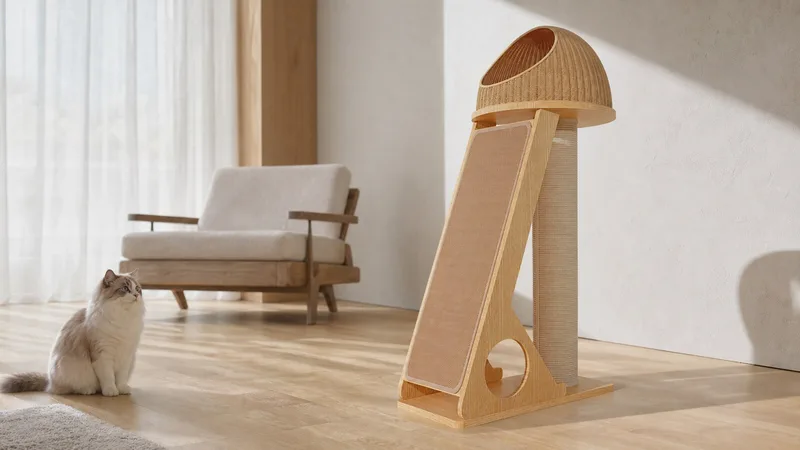
Some cat furniture earns attention because it has many modules. Others work because one clear silhouette is easy to recognize in a social post, a product-page thumbnail, a catalog cover, or a retail campaign. Solid wood cat scratching post SP-0708-091 belongs to the second group. Its A-frame side profile, large inclined scratching panel, round lower opening, single tall post, and dome-style upper retreat create a distinctive front-facing product story.
That does not mean the product should be marketed with vague “luxury” language. A statement SKU works when the creative content matches the real sample and when the buyer can understand exactly what is visible. For a private-label or pet brand campaign, the supplier image, approved sample, lifestyle photography, dimensions, packaging, and after-sales component list must all describe the same object.
Why a statement scratcher needs a campaign brief
A standard scratching post can often be sold through a basic dimensions table and a functional product photo. SP-0708-091 needs a more deliberate brief because the form itself is part of the offer. The buyer has to decide what the headline feature is, which view leads the campaign, what details support the story, and what claims are excluded until they are tested.
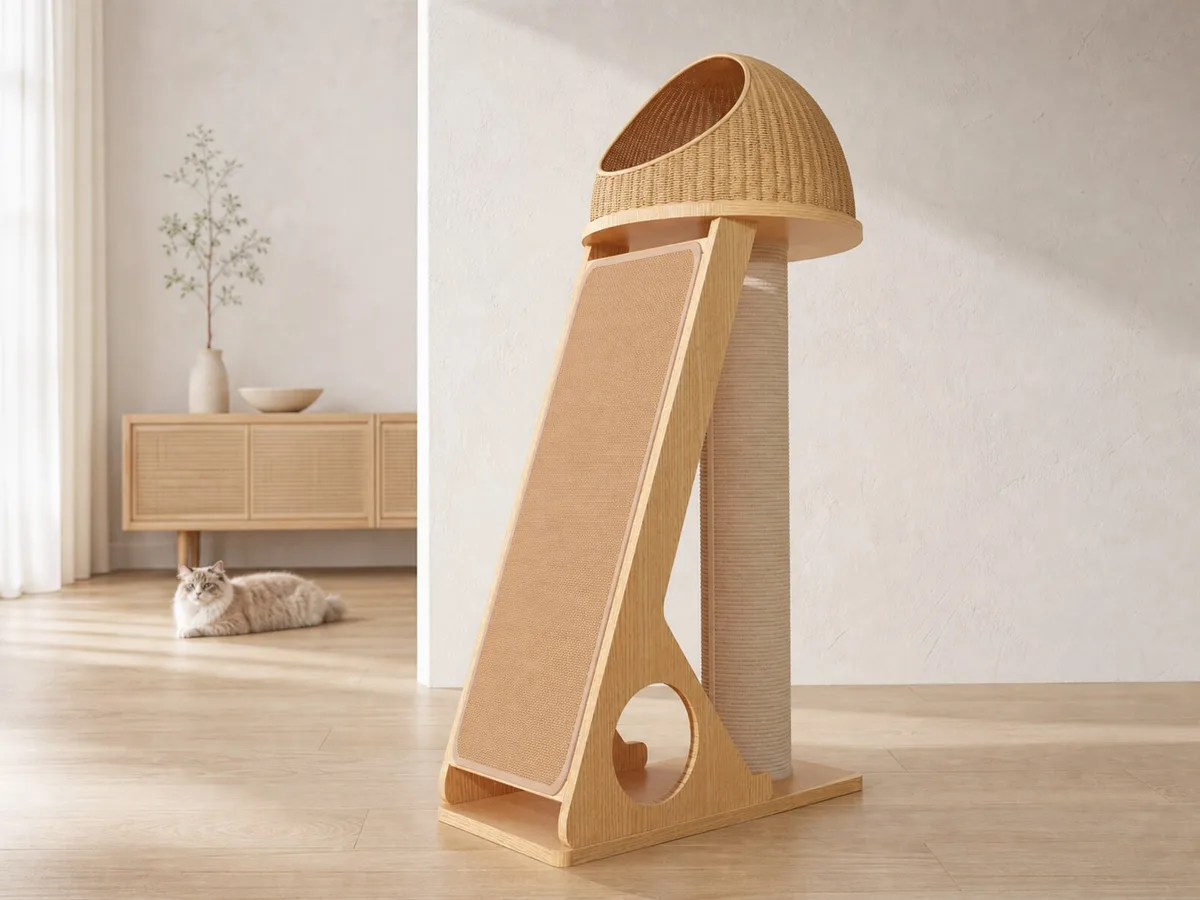
The front view is the strongest starting point. It shows the tall pale scratching panel within the wood frame, the round lower opening, the tall wrapped post behind it, and the dome-style upper form. This makes the product immediately different from a vertical post or a multi-level tower. The campaign should communicate this visible composition rather than inventing a long list of behavioral promises.
A useful positioning phrase is “a statement scratching-and-resting furniture form.” It describes the product's visual character and the existing surfaces without claiming a particular number of cats, a specific load, a medical benefit, or a guaranteed behavior. Those performance claims require a defined test method and evidence for the approved configuration.
Confirmed record for SP-0708-091
The supplier record lists SP-0708-091 at 110 cm high with a 60 x 30 cm base. It identifies 18 mm rubberwood board and 15 cm solid pine posts. Packaging is recorded as 70 x 50 x 115 cm, with an approximate gross weight of 35 kg.
The recorded carton occupies about 0.403 cubic metres when its three dimensions are multiplied. Use that figure only for an early side-by-side comparison. A freight decision still depends on the final pack-out, actual production weight, pallet arrangement, destination requirements, and the carrier's dimensional-weight rules.
| Item | Current record | Campaign and buying relevance |
|---|---|---|
| Product number | SP-0708-091 | Keeps the source image, sample, artwork, inspection, and reorder tied to one reference. |
| Overall height | 110 cm | Sets the scale for lifestyle photography and listing dimensions. |
| Base size | 60 x 30 cm | Supports product placement, floor-space comparison, and dimension graphics. |
| Board | 18 mm rubberwood board | Provides a record for sample measurement, edge finish, and construction confirmation. |
| Post | 15 cm solid pine post | Creates a component reference for post diameter and wrapping review. |
| Carton | 70 x 50 x 115 cm | Equals about 0.403 m3 before palletisation or added protection. |
| Approx. gross weight | 35 kg | Needs to be reviewed against handling, warehouse, and delivery requirements. |
The current record does not specify the exact dome-surface material visible in the source image, the scratch-panel composition, coating system, order minimum, production calendar, capacity rating, or destination-market certification. Confirm these points against the approved sample and quotation. Visual appearance should not be converted into an unsupported technical claim.
Turn one silhouette into a complete content system
A strong campaign starts with one hero image but should not end there. The hero image needs a calm background and enough space around the product to make the A-frame outline readable. The next images should remove uncertainty: a close front view of the scratch panel, a side view of the post and support structure, the round lower opening, the upper retreat opening, base corners, attachment points, underside connections, hardware pack, assembled product, and final carton.
Every image should have one job. The hero frame creates recognition. The side view shows the depth and rear post. The close-up proves texture and finish. The dimension visual gives the 110 cm height and 60 x 30 cm base. The packaging image helps a B2B buyer understand the recorded 70 x 50 x 115 cm carton. The assembly image shows how the approved component map becomes the finished structure.
This avoids a common product-content mistake: repeating the same attractive front shot while leaving the buyer unable to see the connections, base, reverse side, or packed configuration. A visually distinctive model has more to lose from an inaccurate lifestyle image because buyers notice even small changes in the outline.
Keep visual storytelling separate from performance claims
The source image supports specific, observable descriptions: a large inclined scratching panel, a tall wrapped post, an A-frame wood structure, a round lower opening, and an upper dome-style retreat. It does not by itself prove that the product is suitable for every cat size, can carry a specified weight, prevents furniture scratching, or is safe for unsupervised use.
For brand content, this distinction is useful rather than restrictive. Tell a visual story about material contrast, vertical form, and the product's presence in a room. Use phrases such as “designed around an inclined scratching surface and an elevated retreat form.” Keep any stability, load, material-safety, durability, or cleaning statements inside the approved specification and supporting reports.
When a buyer wants a particular usage claim, write the requirement into the RFQ. Define the sample condition, test method, responsible party, acceptance criterion, and report needed. The resulting evidence can then support the final claim without disconnecting marketing from production reality.
Build the listing page around observable detail
The product title should be clear before it is poetic. “Solid Wood Cat Scratching Post SP-0708-091” keeps the item searchable and traceable. Supporting copy can introduce the A-frame shape and dome-style upper retreat. Search filters should use real fields, such as scratching posts and boards, 110 cm height, 60 x 30 cm base, and the material references recorded for the board and post.
For an ecommerce content program, keep the campaign image, product listing, comparison chart, carton information, and inquiry form aligned. A shopper or wholesale buyer should not find a different post diameter, an added platform, a changed dome opening, or a missing round cutout when moving from social content to the product page.
The public description should also make the information hierarchy easy to scan. Start with the silhouette and key dimensions. Follow with an image-led component list. Then add material fields, packaging, approved custom options, and a request for quotation. This sequencing lets the buyer appreciate the product's visual signature before reviewing the commercial details.
Package a tall visual SKU with the same care used in photography
The recorded carton is taller than many compact cat furniture cartons. At 70 x 50 x 115 cm and approximately 35 kg gross weight, SP-0708-091 should be checked against receiving doors, storage racks, parcel or freight thresholds, lifting equipment, and delivery-team handling. The product's distinctive upper form and inclined panel also need clear packing instructions.
Request a pack-out diagram showing the base, A-frame panels, post, upper retreat, scratch panel, hardware, instructions, and protective materials. Confirm which components are removed, how the upper form is shielded, how the inclined panel avoids abrasion, whether wrapped surfaces can touch hard edges, and how hardware is secured.
Packaging is part of brand perception for a statement SKU. A damaged edge, compressed surface, or scratched upper form weakens the same visual story that the campaign created. The carton should therefore be assessed as part of the approved product package, not as a separate logistics afterthought.
Approve the sample by silhouette, surface, and connection
Start with the complete outline: 110 cm height, 60 x 30 cm base, A-frame angle, post position, upper retreat opening, and round lower cutout. Compare the sample from front, left, right, and rear views against the approved reference. The visual identity is sensitive to proportion, so a small change to the panel angle or dome position should be recorded rather than ignored.
Then inspect 18 mm board thickness, 15 cm post diameter, edges, joints, post wrapping, panel surface, upper-form finish, fastener coverage, base contact, and assembly orientation. The quality control plan should hold the approved image set, measurements, visual tolerances, carton check, and any required test documents together.
For replenishment, keep a component list and reference images for the upper form, scratch panel, post, base, hardware, and instructions. That makes it possible to identify a replacement need without trying to describe a distinctive component from memory.
Make OEM choices without changing the campaign object by accident
Within an OEM cat furniture program, buyers can define wood-tone references, wrapping color, panel appearance, upper-surface material, labels, logo placement, carton marks, barcode, instructions, and replacement-part codes. These choices can align the product with a brand's visual identity when the approved sample remains the reference.
Changes to height, base size, the A-frame angle, post diameter, panel dimensions, cutout, upper-form shape, or component position are structural changes. They require a new engineering review, drawing, sample, packaging assessment, and any relevant testing. They should not be treated as simple cosmetic customization.
RFQ checklist for SP-0708-091
- Open the request with model SP-0708-091, destination country, intended campaign channels, expected order volume, and target launch date.
- Verify the 110 cm overall height, 60 x 30 cm footprint, 18 mm board, and 15 cm post on the physical sample.
- Approve the upper-retreat surface, inclined-panel material, wrapping, wood color, hardware treatment, care wording, and any brand markings.
- Sign off the A-frame angle, lower round opening, post location, dome opening, base orientation, and assembly connections with annotated photographs.
- Review the 70 x 50 x 115 cm carton, approximately 35 kg gross weight, pack-out diagram, protection plan, and destination handling limits.
- Specify the required hero, side, rear, detail, dimension, assembly, packaging, and social-campaign assets before production photography starts.
- Set measurable acceptance criteria for visual quality, dimensions, packaging, and any required stability, material, or destination-market verification.
- Close the quotation only after the order minimum, sample timing, production calendar, spare-part approach, delivery route, and validity period are agreed.
SP-0708-091 is useful when a brand wants a scratching product that can lead a visual campaign without relying on invented functionality. Its A-frame outline, inclined surface, single post, round opening, and upper retreat give the product a clear identity. Review the SP-0708-091 product page, then submit the target market, content direction, quantity, packaging limits, and test requirements through the inquiry form.