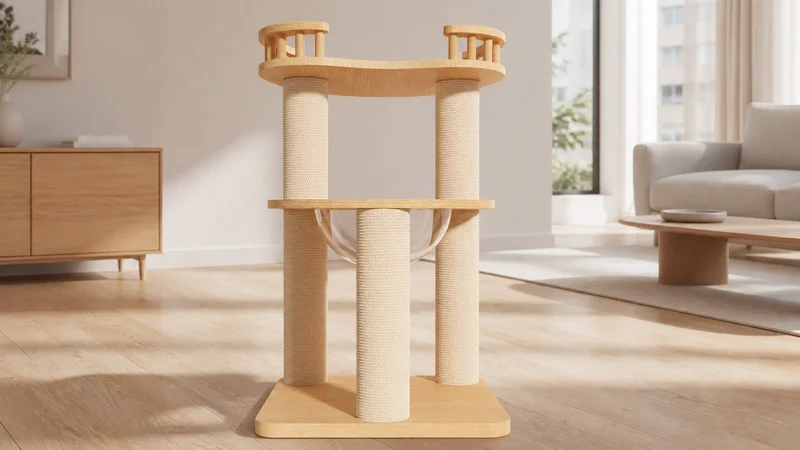
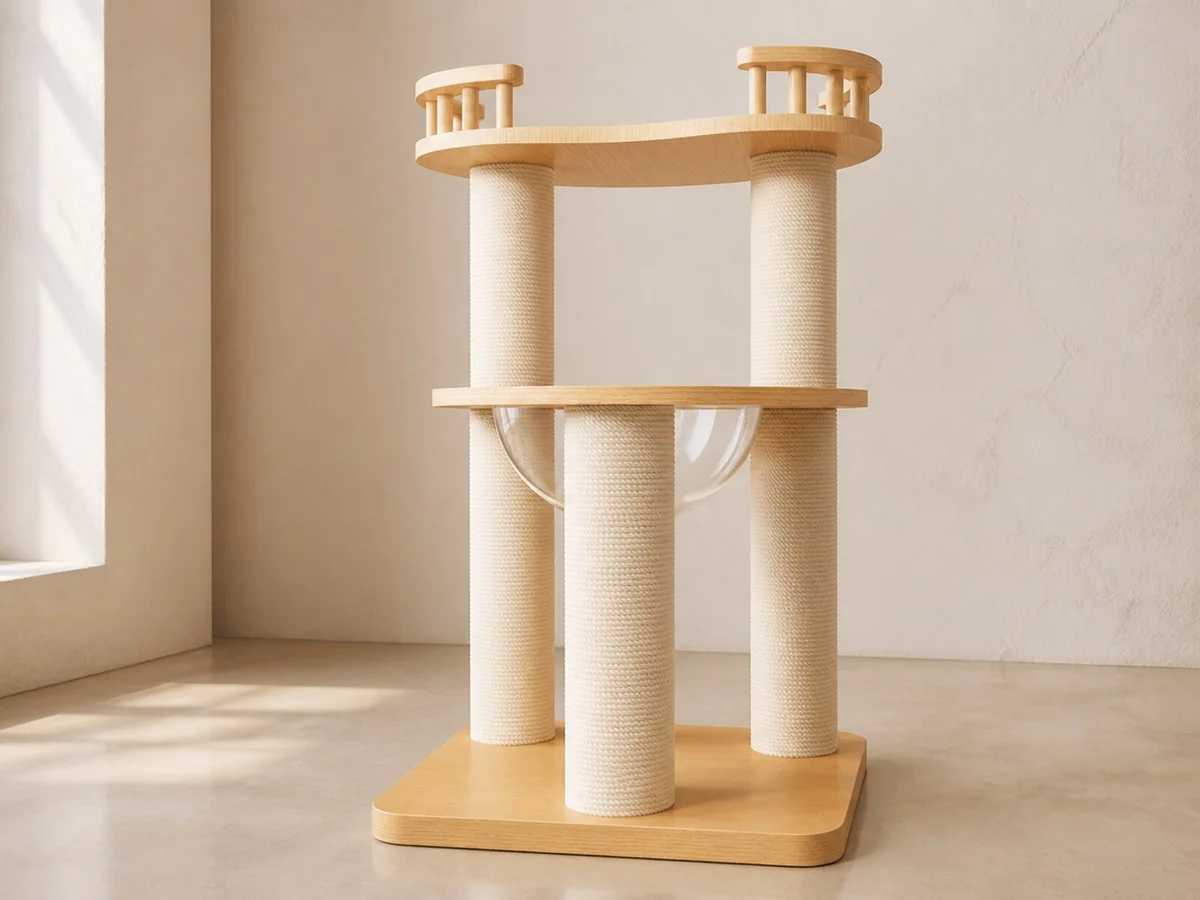
Compact cat furniture does not need to look generic. CT-0708-013 uses one continuous curved top deck to give a small-format cat tree a recognisable profile. The supplier image shows a rounded-corner square base, three rope-wrapped posts, a clear hemispherical bowl below the middle deck, and a broad upper platform that sweeps across the full width. Two small raised rail sections finish the left and right ends of that top deck.
This is a product recommendation for buyers who need a compact model with a clear visual identity. The 90 cm height and 50 x 50 cm base are supplier-record figures, while the curved platform, three posts, bowl, and paired end rails are visible in the reference product. It deliberately leaves out load ratings, certification, animal-size suitability, anti-slip performance, and unrecorded material details. Confirm those points with measurements and handling checks on the approved physical sample.
Why one continuous top deck matters
Many compact towers are assembled from unrelated round platforms. CT-0708-013 reads differently because the top is a single broad element rather than several separate perches. The curved front edge gives the product a calmer outline, while the two raised end rails make the upper profile easy to recognise from a distance. The deck becomes the visual anchor for the model, and the three-post lower structure remains open beneath it.
That is useful when a buyer wants a product line with clear distinctions at small scale. The first listing image can lead with the complete silhouette. A second view can focus on the continuous deck and both rail sections. A third can show the bowl and its mounting area under the middle deck. Additional close-ups can document rope wrapping, board edges, post positions, base corners, and hardware. This gives a product team specific images to work with instead of multiple versions of the same room photograph.
Recorded specifications for CT-0708-013
The imported supplier record lists a 50 x 50 cm base and a 90 cm overall height. It records rubberwood panels at 18 mm and solid pine scratching posts at 10 cm diameter. The capsule field is listed as 35 cm, which should be clarified as the intended bowl or capsule measurement on the sample. Its packing entry gives 62 x 52 x 30 cm, with an approximate gross mass of 22 kg. These figures are a controlled starting point for sourcing, not a replacement for physical measurement and final packing confirmation.
| Record field | Current value | What to verify |
|---|---|---|
| Model reference | CT-0708-013 | Keep this identifier with source photography, sampling, quotations, inspection records, replacement components, and reorders. |
| Overall dimensions | 50 x 50 cm base; 90 cm height | Measure the fully assembled product, including the continuous top deck and both rail sections. |
| Board record | Rubberwood panels listed at 18 mm | Check panel thickness, curve, edge treatment, base outline, top-deck profile, and rail construction. |
| Post record | Solid pine posts listed at 10 cm diameter | Confirm core, diameter, rope coverage, post positions, and all connection points at the base and decks. |
| Capsule field | 35 cm | Clarify the measurement format and inspect the actual clear bowl diameter, material, edge finish, and fixing method. |
| Carton record | 62 x 52 x 30 cm | This indicates an early cube of about 0.097 m3 before the final pack-out is agreed. |
| Listed gross weight | Approx. 22 kg | Confirm the finished-carton weight before estimating freight, handling, or warehouse capacity. |
The supplier file does not specify the clear-bowl material, rope composition, wood coating, fastening system, rail spacing, required test programme, order minimum, or production calendar. Put those open points in the sample brief and RFQ. A lifestyle visual or a category name is not evidence of a technical specification.
Use the curved profile as a content asset
A compact product should not be presented as a smaller version of every other tower. For CT-0708-013, photograph the top deck from front, side, and slightly above so that the continuous curve and paired rails remain evident. Keep the 50 x 50 cm base fully visible in at least one assembled frame. Show the three posts separately enough that a buyer can see their location relative to the bowl. The middle deck should be photographed from below to document where the clear bowl sits.
These pictures can then support a clear product-page sequence: full profile, top-deck detail, rail detail, bowl detail, post wrapping, base and floor contact, components, assembly, and packed set. The sequence is more useful than trying to make one hero image answer every question. It also lets a buyer compare supplier photography, a pre-production sample, and batch inspection photos in a consistent order.
The two lifestyle scenes in this article are product-faithful development illustrations generated from the supplier reference image. They are intended to show the visual presentation direction only. They do not replace real sample photography, measurements, production approval, or inspection evidence.
Keep the structural brief concise and exact
For this model, the approved feature list is short: one square base, three posts, one middle deck, one clear bowl, one continuous curved top deck, and two raised rail sections. That is a benefit in communication. A buyer can ask whether the middle bowl remains centred, whether the top deck keeps its full width and curved front edge, and whether both end rails are present. A supplier can map those items onto a drawing, parts list, assembly guide, and packaging layout.
Do not treat visible geometry as decoration. A revised rail shape, a shorter top deck, a relocated bowl, a changed post count, or a different base outline would change the product’s identity. Photograph and annotate any revision before product content is approved. The quality control process works best when it compares named components and stated measurements rather than a vague “same as picture” instruction.
Sample review for a compact model
Start with the documented 50 x 50 cm base and 90 cm height. Compare the base corners, three post locations, middle deck, bowl position, top-deck curve, and both rail sections against marked source images. Check the specified panel gauge and post diameter. Review board surfaces and edges, rope coverage, transparent bowl, rail joints, hardware, finish consistency, floor-contact points, and included assembly parts.
Keep the results together with the approved photos and buyer-defined criteria. If the sample uses a different bowl material, rail pattern, wood finish, or connection method, decide whether it is an acceptable revision before any catalogue image, instruction, or carton graphic is released. A clean compact design makes changes easier to spot, which is a reason to document them rather than overlook them.
Separate branding choices from product changes
During an OEM or ODM review, buyers can consider confirmed wood tone, rope colour, brand label position, carton graphics, barcode, care information, instructions, and replacement-component identifiers. Test those presentation choices against the signed sample and the final artwork files.
Changing the base footprint, vertical measurement, board thickness, post diameter, top-deck arc, rail geometry, bowl size, bowl placement, or joining method changes the structure. That needs updated drawings, another prototype, revised packing, and a fresh approval. This separation prevents a product page from describing a version that no longer matches its carton.
Use the carton data as an early reference
The listed 62 x 52 x 30 cm carton equals about 0.097 cubic metres. Treat this as an early planning figure, not a shipping commitment. Actual logistics depend on the finished carton, protective materials, component layout, final weight, pallet pattern, receiving conditions, and carrier calculation. Reconfirm the recorded 22 kg gross weight after packaging is final.
Request a packing diagram that identifies the base, top deck, rails, posts, bowl, fittings, instructions, and protective materials. Review bowl protection, curved-edge protection, hardware placement, and the unpacking order for assembly. The package needs to retain the top-deck profile that gives this compact model its design value.
Buyer brief for CT-0708-013
- State CT-0708-013, destination market, estimated order quantity, retail context, and requested delivery date at the start of the brief.
- Measure the physical prototype: base, full height, board thickness, post diameter, capsule field, carton dimensions, and completed-carton weight.
- Approve the continuous curved deck, two end rails, three supports, central bowl, finish, rope wrapping, hardware, labels, instructions, and packed components with marked-up reference photos.
- Collect image evidence for every face, the underside, close-ups, loose components, assembly stages, and the completed carton before release.
- Set acceptance criteria for measurements, bowl position, rail contour, finish appearance, carton protection, and applicable destination needs.
- Record MOQ, prototype lead time, production timing, spare-part approach, delivery assumptions, and quotation expiry in the commercial offer.
CT-0708-013 is a compact cat-tree model with a recognisable curved-deck signature rather than a crowded feature list. The three posts, centred clear bowl, two end rails, and uninterrupted upper platform create a practical base for supplier review, product photography, and sample approval. See the CT-0708-013 product page, then send an inquiry with destination, anticipated volume, finish preference, packaging limits, and evaluation points.