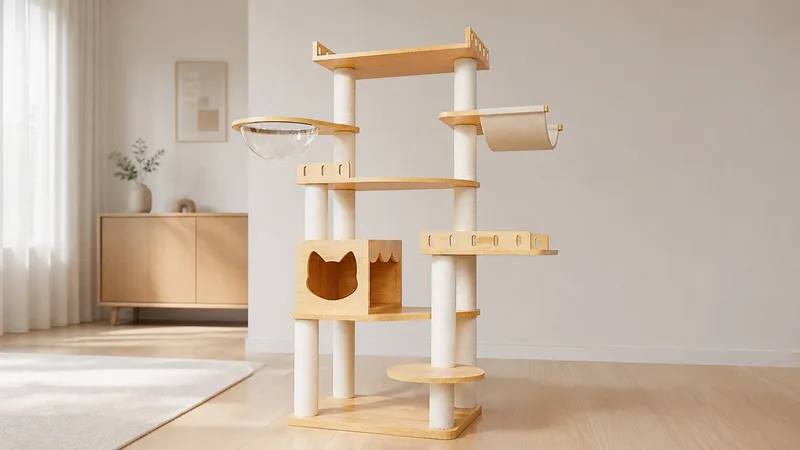
A cat tree can give a retailer more than one visual reason to list a tall SKU. CT-0708-074 is organised as a sequence of distinct resting and climbing zones: a lower enclosed wooden den with a cat-head-shaped entrance, an open central route, a clear capsule bowl on the left, a suspended fabric hammock on the right, a broad middle ledge, and a high rectangular perch with raised rails. Rather than presenting the model as just another tall tower, this article considers how that visible mix of zones can support a more differentiated range plan.
The supplier record identifies the model as 160 cm high with a 60 x 50 cm base. It lists 12 mm rubberwood boards, 8 cm solid pine scratching-post fields, a 35 cm capsule field, a 62 x 52 x 47 cm carton, and an approximate 35 kg gross weight. The product reference visibly shows the lower den, clear bowl, hammock, multiple rope-wrapped supports, curved platforms, and rail-topped upper platform. Load capacity, bowl material, hammock fabric specification, hardware, finish system, test programme, cat-size suitability, and destination-market compliance are not established by those records. Confirm them against the approved physical sample and final order documents.
Sell a sequence of zones, not an undifferentiated tall tower
For a buyer building a cat-furniture assortment, the most useful distinction is often not a generic claim about activity. It is whether a shopper can see a different product story at a glance. CT-0708-074 has three easily legible rest formats: an enclosed lower space, a transparent suspended bowl, and a fabric sling. Above them, the open ledges and top perch add a vertical route and a lookout-style silhouette. Each part creates a separate photography subject and a separate point to preserve during sample review.
That makes the model a useful candidate where a range already contains simple posts, floor scratchers, or small open-frame trees. Those items may cover entry price or compact placement. This model can instead be considered for a higher-feature interior-furniture slot because the shopper sees a den, bowl, hammock, and upper platform before reading a specification. It should not be described as a guaranteed multi-cat solution or a behaviour claim: household use, assembly quality, placement, and buyer-defined requirements still need to be assessed independently.
The merchandising lead image should show the entire structure and keep the rectangular base in view. Supporting images should isolate the cat-head entrance and its finished edge, the bowl rim and mounting area, the two hammock attachment points, the curves of the ledges, the rail pattern on the upper perch, the rope coverage on each support, and the underside of the lower assembly. This image sequence is more useful to a retail team than repeatedly showing the product from one room angle.
Controlled source fields for buyer review
The table retains the imported values and separates them from points that need physical confirmation. CT-0708-074 should remain the common reference across source images, quotations, sample notes, inspection records, parts lists, packaging art, and future repeat orders.
| Reference field | Recorded value | What to confirm on the sample |
|---|---|---|
| Model number | CT-0708-074 | Use the same identifier on the RFQ, annotated photos, drawing revisions, carton markings, inspection file, and reorder records. |
| Base and height | 60 x 50 cm base; 160 cm height | Measure the fully assembled footprint and highest point, including the upper rail assembly. |
| Board field | 12 mm rubberwood | Check actual panel thickness, edge treatment, curved shelf profile, lower-den construction, and visible wood finish. |
| Post field | 8 cm solid pine | Confirm core diameter, rope coverage, post count, top and lower fixings, and the relationship between posts and platforms. |
| Capsule field | 35 cm | Clarify exactly what the 35 cm field measures, then verify bowl dimensions, rim, transparency, support, and fastening method. |
| Carton field | 62 x 52 x 47 cm | Measure the sealed final carton and document component layout, protection, labels, hardware pack, and opening sequence. |
| Gross-weight field | Approx. 35 kg | Weigh the packed sample before using it for freight, delivery, warehouse, or handling estimates. |
The current product data does not state an exact bowl polymer, hammock textile, rope fibre, surface coating, hardware specification, assembly tool list, safety test, MOQ, or production lead time. These are open procurement questions, not details to fill in from a lifestyle image. Ask for them in the quotation and validate them on the approved sample.
Make each rest format inspectable
The enclosed lower den is a primary structural feature because it gives the product a distinctive front silhouette. Review the cat-head opening shape, panel joints, interior access, base contact, edges, and the relationship of the den to the vertical posts. Its opening dimensions are absent from the supplier sheet, so consumer copy should not invent a size. Photograph it from front, side, and inside once a sample is available.
The clear bowl deserves its own acceptance point. Review the bowl rim, transparency, surface condition, retained shape, support shelf, perimeter clearance, and fixing method. The 35 cm supplier field should be defined in writing before it is used in product assets. Likewise, inspect the right-hand sling as an assembly: its material, edge binding, tension, connection method, clearance below the platform, and replacement-part approach must be agreed from the physical sample rather than assumed from the source picture.
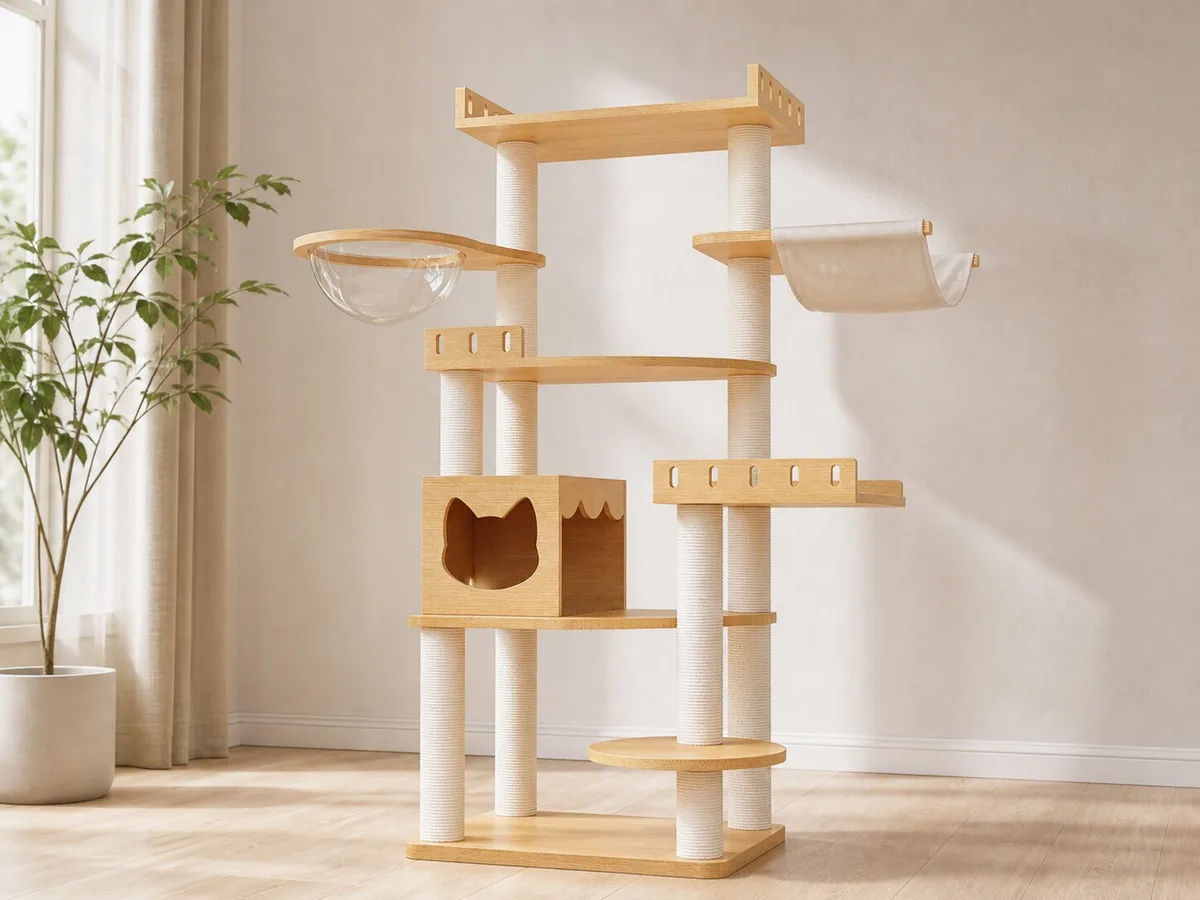
The upper section also has a recognisable geometry. The curved middle platform forms a visible route across the structure, while the top rectangular perch is finished with raised slotted rails. Treat changes to the rail pattern, platform curvature, bowl location, hammock position, lower-den opening, post placement, or base footprint as changes to the product definition. These revisions should trigger a revised drawing, component list, packaging check, and a fresh approval rather than being handled as a simple colour option.
Use content that supports comparison, not unverified promises
For ecommerce, one full-product image can establish the silhouette, then detail frames can answer concrete comparison questions. Where is the den? Which side carries the bowl? Where is the hammock suspended? How many visible levels and rail sections are there? Showing those facts clearly can help a merchandising team position the SKU against a basic pole, a compact scratcher, or a conventional cube-based tree without making unsupported claims about durability, cat count, or performance.
For a retail floor, give the side profile enough sight line that the bowl and hammock are not hidden. Keep the den entrance visible from the customer approach. The recorded 60 x 50 cm base is suitable for preliminary planograms, but a display plan still needs verified finished dimensions, local safety rules, customer circulation, cleaning access, and the actual product's stability and assembly state.
Both room-set images are AI-generated visualisations developed from the supplier product reference. They help a buyer plan presentation direction, but are not proof of an approved sample, measured dimensions, production output, pack-out, test result, or inspection result.
Separate presentational choices from structural revisions
In an OEM or ODM discussion, buyers can review confirmed presentational choices such as wood tone, rope colour, fabric colour, label position, carton artwork, barcode placement, care information, instructions, and replacement-part identifiers. Each should be approved against a real sample and final artwork rather than a generated scene.
By contrast, changes to the dimensions, den construction, opening shape, clear-bowl size or location, sling configuration, post diameter, platform contours, rail design, connection system, or base geometry alter the SKU itself. Record these as engineering changes. They can affect components, tooling, assembly instructions, protective materials, carton configuration, product photography, and the information that appears in a buyer's catalogue.
Plan the carton around fragile and visible components
The source carton entry is 62 x 52 x 47 cm with an approximate 35 kg gross weight. This is an early supplier record, not a final shipping quotation. Ask for final packed dimensions and mass after the component layout and protective materials are confirmed. The bowl, rail edges, curved boards, den panels, rope-wrapped posts, hammock hardware, and loose fittings should all appear in a packing diagram and in opened-carton evidence.
Request photos of separated components, hardware packs, protective layers, assembly stages, completed product, and sealed carton. Use the quality control process to compare named parts with the approved sample. A generic request to make the tree “like the image” is not enough for a structure with several visually important zones.
Buyer brief for CT-0708-074
- Open the request with CT-0708-074, target market, volume band, sales channel, desired arrival date, and intended position in the range.
- On the prototype, record the 60 x 50 cm footprint, 160 cm assembled height, board and post fields, 35 cm capsule field, final carton dimensions, and packed mass.
- Use annotated reference photography to sign off the den body and opening, bowl, sling, curved ledges, support layout, upper rails, finish, rope wrapping, labels, instructions, and supplied parts.
- Collect evidence of the bowl support, sling anchors, den joints, shelf joints, wrap coverage, underside, loose parts, assembly sequence, carton protection, and closed carton.
- Write separate acceptance criteria for dimensions, cosmetics, edge finish, bowl condition, sling build, component alignment, package protection, markings, and market-specific obligations.
- Place MOQ, sample schedule, production timing, spare-part policy, quote expiry, payment arrangement, and freight assumptions in the commercial offer.
CT-0708-074 gives a buyer a tall cat-tree model with a visibly differentiated rest-zone story: enclosed den below, clear bowl and hammock at the sides, and open platforms up to a rail-topped perch. It is a practical candidate for a collection that needs more than minor variations of the same tower. Use the CT-0708-074 product record as the reference, and contact our team with the market, volume band, desired finish, packaging constraints, and prototype review criteria.