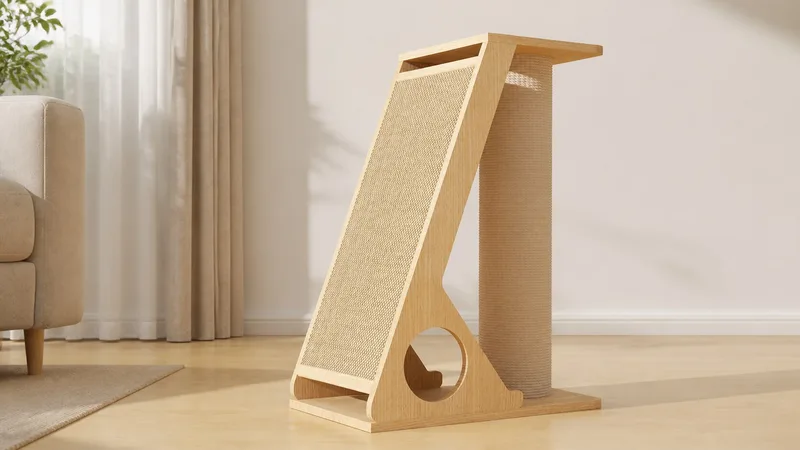
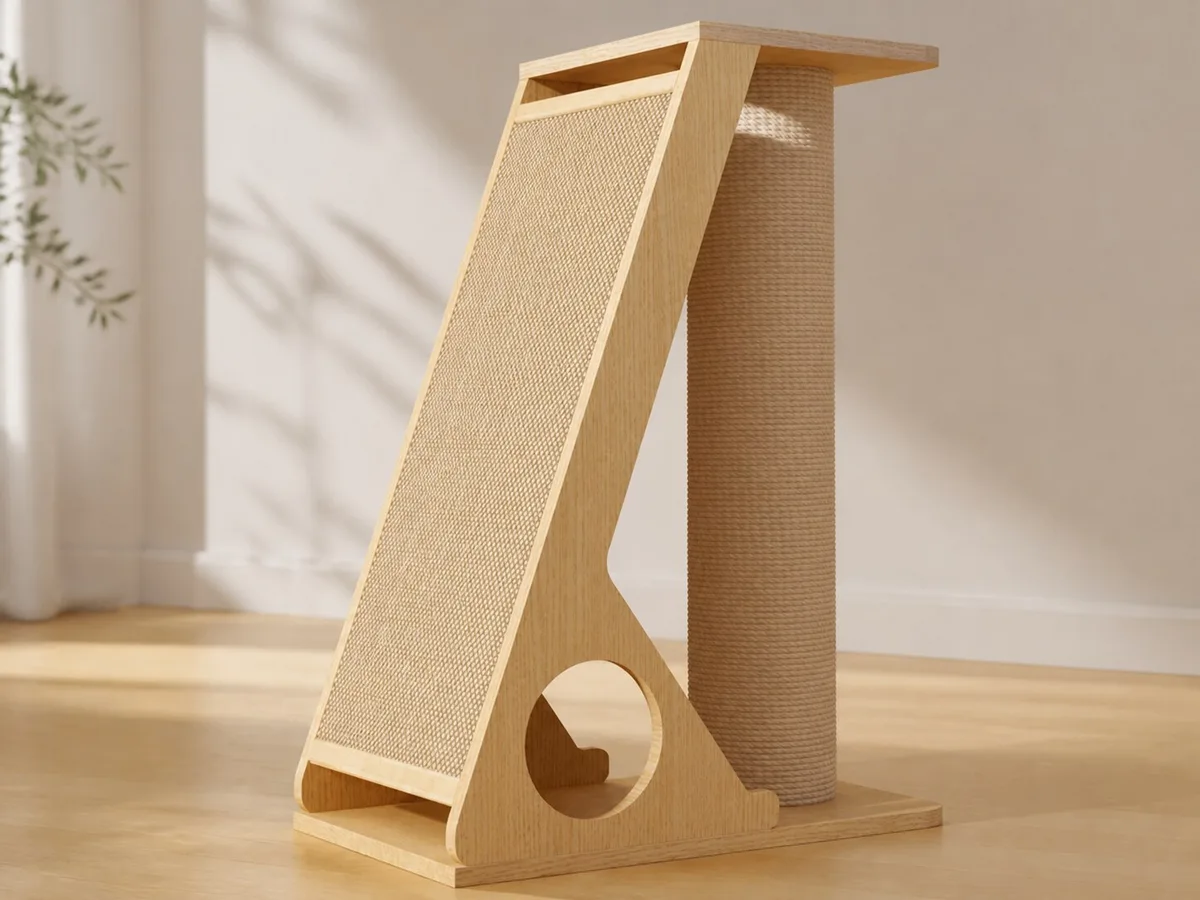
Retail cat-furniture assortments do not need every scratching item to be a vertical pole or a mini tower. SP-0708-089 uses an A-frame silhouette: a broad inclined scratch panel sits on the front, a single thick rope-wrapped post rises on the right, and a narrow top deck projects across the upper structure. A circular opening is cut into the lower wood side panel, while the product sits on one long rectangular base.
This article recommends the model as a distinct visual option for a feature-led retail range, not as a performance promise. The supplier record lists a 60 x 30 cm base, 65 cm height, 18 mm rubberwood boards, a 15 cm solid pine post, a 70 x 35 x 70 cm carton, and approximate gross weight of 30 kg. The reference image visibly shows the inclined panel, circular opening, one rope-wrapped post, top deck, and pale wood frame. Load rating, panel material, attachment method, surface durability, cat-size suitability, and compliance requirements are not established here; confirm them through the approved sample and order documentation.
Why an A-frame silhouette earns a separate SKU
Most small scratchers are read instantly as posts, pads, or cubes. SP-0708-089 offers another recognisable product type. The diagonal front creates a broad visible plane, while the right-side cylinder and upper deck stop the product from reading as a simple board. The triangular wood side and round lower opening give the side profile a repeatable cue for catalogues, shop displays, packaging artwork, and a buyer's internal product review.
That recognisability matters when a collection needs choices that do not cannibalise one another. A compact floor pad can cover an entry price. A tall post can cover a vertical form. A small climbing tree can cover multi-level use. This A-frame model can occupy a fourth slot: a structural scratcher that has a visible front surface and a distinct furniture-like silhouette. It should be ranged for that difference, rather than described as an interchangeable version of another scratching post.
For product photography, lead with the entire front and keep the base in frame. Then show the diagonal panel from a shallow angle, the top deck overhang, the right-side rope wrap, the lower circular opening, and the two long edges of the base. Buyers can compare those details against a sample much more reliably than against a generic lifestyle image.
Supplier-record specification snapshot
The product file identifies SP-0708-089 as a 65 cm solid wood cat scratching post. The following table preserves the supplier values while showing what a buyer needs to establish before treating them as final product or shipping data.
| Reference field | Recorded value | What the buyer should document |
|---|---|---|
| Model number | SP-0708-089 | Carry this reference through source images, prototype notes, price sheets, packaging art, inspection photos, parts lists, and reorders. |
| Base | 60 x 30 cm | Measure the complete base, its thickness, corner finishing, floor contact, and the position of the A-frame and wrapped post. |
| Assembled height | 65 cm | Measure from the finished base to the highest point of the upper deck. |
| Wood-board field | 18 mm rubberwood | Verify board thickness, visible grain/finish, A-frame edges, circular opening finish, deck shape, and the way the inclined panel is framed. |
| Post field | 15 cm solid pine | Confirm the core diameter, wrapping coverage, top and base fixing, and the relationship between the post and top deck. |
| Carton field | 70 x 35 x 70 cm | Measure the outer carton after packing and record its opening direction, labels, hardware location, and protection sequence. |
| Weight field | Approx. 30 kg | Weigh the sealed sample carton before setting freight, warehouse, handling, or consumer-delivery assumptions. |
The product record does not name the inclined-panel surface material, panel backing, rope fibre, finish system, hardware, test plan, MOQ, production timing, or pallet pattern. These omissions should remain visible in the RFQ and sample checklist. Avoid interpreting the image itself as proof of a material specification or test result.
Read the front plane and the post as two separate review areas
The inclined front face is one inspection area, not a decorative background. Ask for close images that make its surface, frame, lower edge, top return, and attachment points visible. Check whether it lies at the agreed angle, follows the A-frame outline consistently, and sits cleanly above the base. If the surface material, colour, or frame section changes, treat that as a sample decision because it changes the product's front-facing identity.
The wrapped cylinder is a second review area. Its stated 15 cm pine-post field should be checked at the core, not guessed from the outer rope diameter. Photograph the wrap density, start and end points, top junction, and lower fixing separately. The upper deck should also be checked as a component with its own outline, edge finish, projection, and joint to the A-frame. Separating these details gives a sourcing team a workable checklist instead of one broad request to "make it like the photo."
The lower circular opening is small but important. Its diameter is not provided in the supplier sheet, so do not add an unverified dimension to a retail listing. Mark its location and finished edge on the sample reference image, then decide whether a specific opening tolerance is necessary for the production specification.
Position it between a floor scratcher and a cat tree
SP-0708-089 is best presented as a compact furniture item with a clear surface-and-structure story. It is not a substitute for a full climbing tree, and it is more visually substantial than a basic floor pad. This middle position can help a retailer build a more legible progression: simple scratching products at one end, an architectural A-frame option in the middle, then taller trees and villas for buyers seeking more complex structures.
For ecommerce, create images that make that role understandable without overstating use. A full silhouette answers what the object is. Detail images explain the inclined panel, post, deck, and opening. A scale image or measured drawing can be added only after the supplied dimensions are confirmed on a physical sample. Keep the description factual: the item has an inclined surface, one wrapped post, and an upper deck. Do not infer how many cats it serves or promise a fixed behavioural outcome.
For retail, place the A-frame model where shoppers can see the diagonal profile from a few steps away. The front should not be hidden behind another tall post because the panel is the feature that differentiates this SKU. Its 60 x 30 cm base is useful for early space planning, but actual floor placement also needs allowance for sight lines, access, cleaning, and the local display environment.
Use the sample to protect the defining geometry
Mark the prototype photograph with six named items: base, inclined panel, A-frame side, circular opening, wrapped post, and top deck. Then compare each item to the supplier source. The A-frame should retain its open triangular side space. The inclined panel should remain the dominant front plane. The post should remain on the right-hand side of the structure, and the deck should preserve its visible projection. This makes a geometry change easy to discuss before it becomes a packaging or content problem.
The two interior scenes in this article are product-faithful development illustrations derived from the supplier reference image. They are intended for visual-presentation planning only. They do not replace the physical sample, measured specifications, production photographs, carton validation, or inspection evidence.
Separate branding from structural changes
During an OEM or ODM review, buyers can evaluate confirmed presentation choices such as wood colour, rope colour, brand label location, carton artwork, barcode placement, instruction format, care card, and component identifiers. Confirm these against the approved sample and final artwork before print release.
Changing the base dimensions, panel angle, front-surface construction, circular opening, post diameter, post location, top-deck projection, or A-frame geometry changes the product itself. These requests may require an updated drawing, revised component list, another prototype, adjusted carton protection, and a fresh approval. Keeping the distinction clear prevents product content from describing a sample that no longer represents the final carton.
Plan the carton around the diagonal assembly
The imported carton entry is 70 x 35 x 70 cm with an approximate 30 kg gross weight. It is a starting point for operational discussion, not a confirmed freight commitment. Request the final packed dimensions and sealed-carton weight, then review how the diagonal panel edges, circular-opening area, top deck, and rope-wrapped cylinder are supported during transport.
A packing diagram should identify the base, A-frame pieces, front panel, post, top deck, fittings, instruction sheet, labels, and protective materials. Ask for opened-carton photos, component photos, hardware-pack photos, assembly-stage photos, and the completed carton. The quality control process becomes more useful when it compares named parts and documented positions, rather than relying on an informal memory of one promotional image.
Buyer brief for SP-0708-089
- Start the RFQ with SP-0708-089, destination market, planned quantity, selling channel, and delivery target.
- Confirm the 60 x 30 cm base, 65 cm height, 18 mm board field, 15 cm post field, carton entry, and packed gross weight on the sample.
- Approve the long base, diagonal front plane, A-frame side, round opening, single wrapped post, and projecting top deck with annotated reference photos.
- Request close evidence of panel edges, panel surface, post wrapping, top-deck joints, circular opening finish, underside, loose components, assembly, and packed carton.
- Define acceptance points for measurements, finish, panel alignment, post location, component joins, package protection, labels, and destination-market obligations.
- Document commercial terms separately: sample timing, MOQ, production plan, spare-part handling, quote validity, and transport assumptions.
SP-0708-089 gives a cat-furniture range an A-frame product story rather than another generic post. Its inclined front plane, single large-diameter support, circular cut-out, and top deck can be inspected as discrete, repeatable features. Review the SP-0708-089 product page, then send an inquiry with your market, proposed order volume, finish direction, packaging limits, and sample-control requirements.