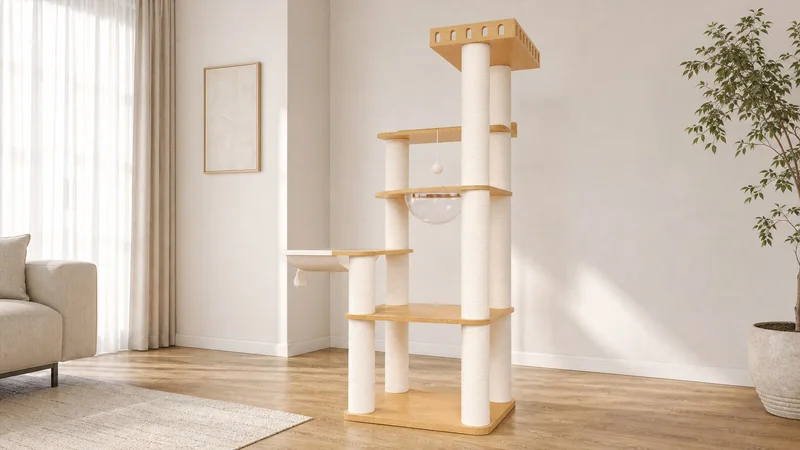
Most tall cat trees are described as a vertical stack. CT-0708-036 has a more deliberate profile: its side platform projects beyond the main frame, the transparent bowl sits beneath the next deck, a narrow upper shelf carries one tassel, and the highest square deck is defined by an open guard rail. The main rope-wrapped post rises on the right side of the composition while the remaining supports and platforms build out to the left. This is an asymmetric product, and its presentation should make that visible rather than reduce it to a generic “multi-level cat tree” label.
That distinction matters when a buyer is building a home-furniture collection that needs recognisable silhouettes. The supplier reference gives an editor, buyer, or product team clear points to photograph and inspect: the projecting side shelf, the transparent hemispherical bowl, the lower deck, the tall right-side post, the upper tassel shelf, and the railed top platform. This article separates what is recorded and visible from what must be verified on a real sample. It does not make claims about load limits, safety approvals, animal size, behavioural outcomes, or unrecorded material details.
Why the offset layout is the product story
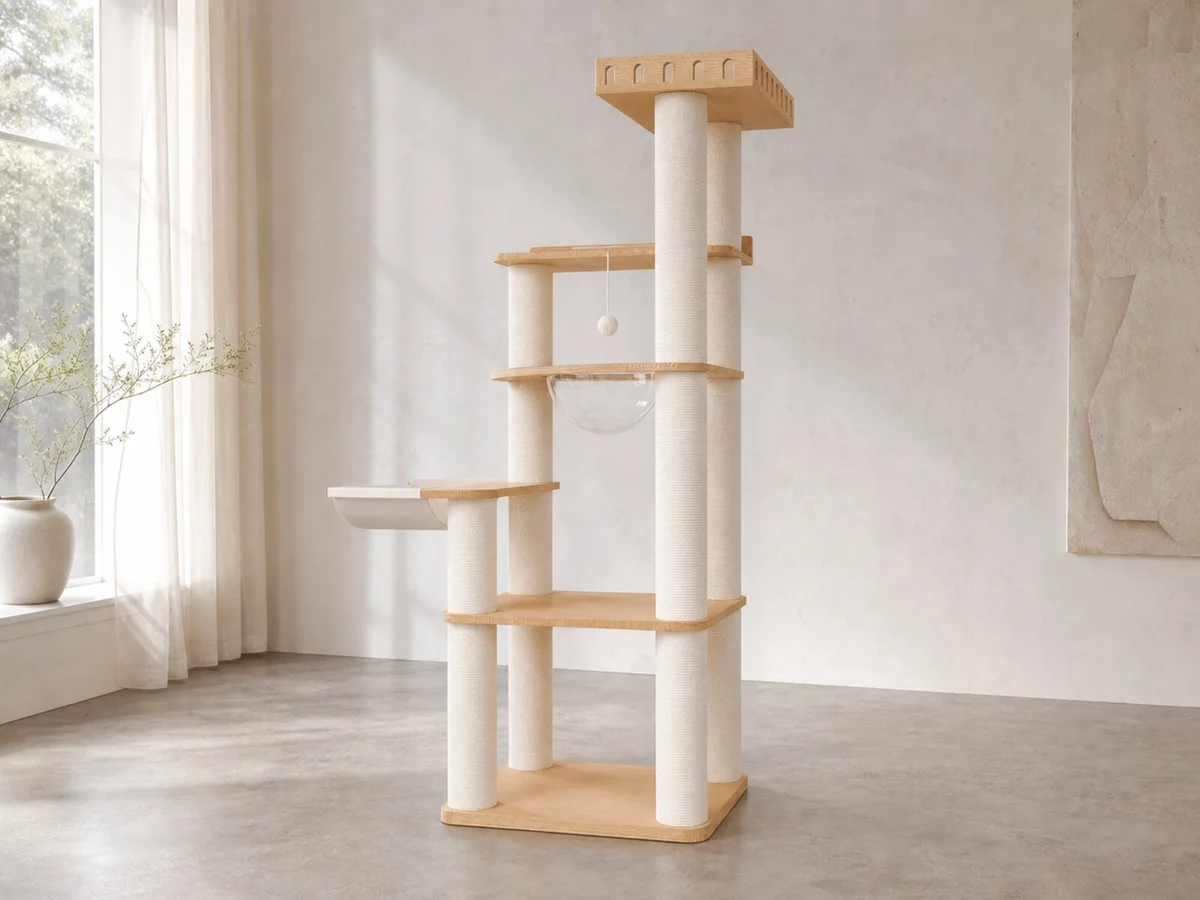
The reference image is easier to read from left to right than a typical centred tower. First comes the shallow side platform on the left. Next, the lower deck brings the structure back into the main frame. Above it, the clear bowl is suspended below a middle platform. The narrow shelf and tassel add a small upper detail before the composition reaches the square deck and its open rail. The major right-side post creates the highest vertical line, while the offset parts prevent the outline from becoming a simple rectangle.
For a buyer, this creates a practical content advantage. The primary listing image can show the full silhouette. A second image can isolate the left-side projection. A third can demonstrate the bowl mounting and underside of the middle deck. Further frames can show the rail pattern, tassel fixing, post wrapping, base corners, and connections between the decks and supports. The result is a photo sequence that answers specific visual questions without repeating the same front-facing room scene.
Supplier record for CT-0708-036
The imported record lists CT-0708-036 at 160 cm high on a 60 x 40 cm base. It identifies 12 mm rubberwood board and 8 cm solid pine scratching posts. The capsule field is entered as 30 cm, consistent with the transparent bowl shown beneath the middle deck. The source lists a 62 x 42 x 40 cm carton and an approximate gross weight of 25 kg. These are supplier-record figures for initial review; final product, carton, and weight details must be measured and approved on the physical sample.
| Record field | Current value | Sample-review focus |
|---|---|---|
| Model reference | CT-0708-036 | Keep this identifier with the source image, sample request, quotation, inspection record, and parts list. |
| Overall dimensions | 60 x 40 cm base; 160 cm height | Measure the assembled unit, including the full left-side projection and the railed top deck. |
| Panel specification | 12 mm rubberwood board | Review panel thickness, edges, finish, deck forms, shelf projection, and guard-rail construction. |
| Post specification | 8 cm solid pine scratching posts | Confirm core, diameter, rope coverage, post positions, and all deck connection points. |
| Capsule field | 30 cm | Check the actual bowl diameter, mounting position, transparency, edge finish, and the approved component material. |
| Carton record | 62 x 42 x 40 cm | Use the approximate 0.104 m3 cube only as an early comparison before final packing is signed off. |
| Listed gross weight | Approx. 25 kg | Weigh a complete packed sample before setting handling, warehouse, or freight assumptions. |
The available source does not state the bowl material, rope composition, wood coating system, tassel construction, fastener type, capacity rating, test programme, order minimum, or production schedule. A visual reference does not prove those details. They should be listed as confirmation items in the sampling and quotation process, with the target market’s own requirements added by the buyer.
Make asymmetry work in listing photography
Do not crop away the side platform in the hero image. It is one of the details that differentiates CT-0708-036. Keep the full base in frame and show the relationship between the left projection, central deck, bowl, tall posts, and top rail. In a secondary side view, show the depth of the projecting shelf and the bowl bracket area. In a rear view, document which posts carry each deck. In close-ups, show the guard-rail openings, rope finish, deck edges, tassel attachment, and base corners.
Product content should also distinguish confirmed facts from optional customisation. The approved model can be described with its visible asymmetric arrangement and source-record dimensions. A revised wood tone, rope colour, cushion or label proposal, carton artwork, barcode, and care insert must be separately confirmed. Changes to the base, board thickness, post count, bowl size, shelf position, rail dimensions, or connection method alter the structure and need a revised drawing and sample rather than a casual image edit.
Use a component order that matches the customer view
A clean presentation sequence begins at the floor, moves to the side shelf, returns to the lower deck, then follows the bowl and upper shelf toward the top rail. That order is useful for product-page captions, sales decks, image callouts, and inquiry conversations because the buyer can refer to a feature by its location rather than an ambiguous generic term. It also makes it easier to compare a final item with the sample photos: the left-side shelf should remain left-side, the bowl should remain under the middle deck, and the top rail should remain above the tall support structure.
This is especially important for a model with several visible height changes. A small change in shelf level, bowl location, or rail shape can make the product read as a different silhouette. Photograph deviations early, annotate them, and resolve them before product copy, listing graphics, and carton inserts are finalised. The quality control process should compare documented features and measurable dimensions, not depend on a broad “similar to image” instruction.
Approve the sample as a coherent silhouette
Start by confirming the 60 x 40 cm base and 160 cm overall height. Then check the base corners, lower deck, left-side shelf, all post locations, bowl mount, upper shelf, tassel, and guarded top platform against annotated source photographs. Measure the stated 12 mm board and 8 cm posts. Review the wood edges, rope wrapping, rail spacing, hardware, transparent bowl, tassel, floor-contact points, and finish consistency before giving approval.
The practical goal is not to duplicate a lifestyle rendering blindly. It is to ensure the physical sample, product-page facts, instructions, and pack-out all describe the same approved configuration. Keep a dated photo pack and written decision record. If a component is revised, update the drawing, photos, content, and packaging references together.
Private-label choices need a clear boundary
In an OEM or ODM discussion, a buyer can review finish direction, rope colour, label position, carton graphics, barcode, instruction layout, care information, and spare-part identifiers. These choices should follow an approved sample so that visual assets and product data stay aligned.
Structural revisions require their own review: changing the board gauge, footprint, height, post diameter, left shelf extension, bowl size, top rail, or assembly method affects more than presentation. It can change parts, drawing dimensions, packaging, instructions, and the quality checklist. Treat those changes as a new development stage with its own sample and sign-off route.
Plan packing around the offset components
The recorded carton of 62 x 42 x 40 cm gives a nominal cube of about 0.104 m3. Use that only for initial comparison. Final logistics planning depends on the actual carton, protective materials, component arrangement, packed weight, pallet pattern, destination requirements, and the carrier’s method of calculation. The approximately 25 kg source-record weight must be checked after final packing.
Request a packing layout that identifies the base, boards, posts, bowl, guard-rail pieces, tassel, hardware, instruction, and protective materials. Check protection around the bowl and long shelf edges, where fittings are secured, and whether the carton contents correspond to the assembly sequence. This is a product with an unmistakable profile; the pack-out should preserve the same details that the catalogue presents.
RFQ checklist for CT-0708-036
- State CT-0708-036, destination market, quantity plan, intended sales context, and requested delivery window.
- Measure the sample against the recorded 60 x 40 cm base, 160 cm height, 12 mm board, 8 cm posts, 30 cm capsule field, carton record, and packed mass.
- Approve the projecting shelf, bowl placement, lower deck, supports, upper shelf, tassel, top rail, rope wrapping, wood finish, hardware, labels, and instructions using marked images.
- Request full front, rear, both-side, underside, component, detail, assembly, and pack-out photography before production authorisation.
- Set written acceptance points for dimensions, component locations, finish, packing protection, and any destination-market requirements.
- Confirm commercial minimum, prototype timing, production schedule, spare-parts process, freight route, and quotation validity in writing.
CT-0708-036 gives buyers an asymmetric cat-tree silhouette that can be shown clearly rather than explained vaguely. The offset side platform, transparent bowl, upper tassel shelf, and guarded square deck create a useful visual hierarchy, while the supplier record provides a controlled starting point for sample confirmation. Visit the CT-0708-036 product page, then use the inquiry form to send your market, expected volume, finish direction, packing limits, and verification needs.