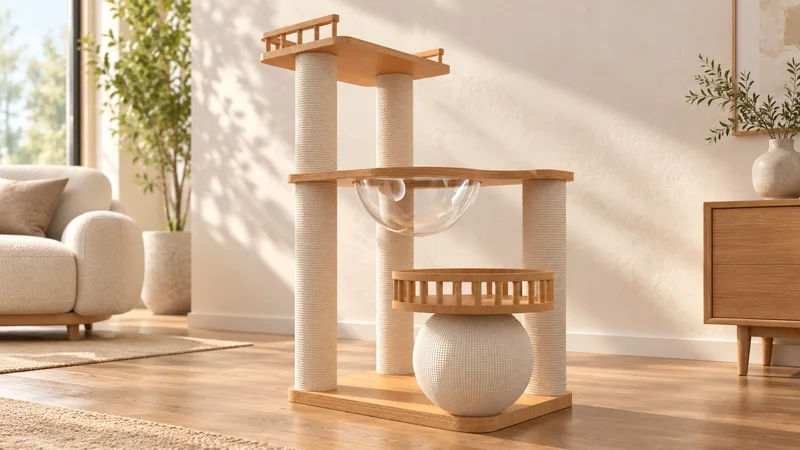
A cat tree can earn a place in a home collection through a recognisable silhouette as well as its height. CT-0708-083 has a particularly clear visual signature: a low circular platform with a spindle rail sits above a large, textured spherical element, while a transparent bowl hangs beneath the middle deck. Pale wood, off-white wrapped posts and open space connect the lower feature to a simple upper platform.
The supplier record lists a height of 100 cm and a 60 x 40 cm base. That gives buyers a different proposition from the tall towers and enclosed-den models already common in a broad cat-furniture range. This is a product to consider when the assortment needs a rounded accent, an open outline and a restrained material palette. Its appeal should be developed around the visible design, with the finished dimensions, materials and performance confirmed through the normal sample process.
A rounded detail that gives the whole model an identity
The lower circular platform is the first feature worth explaining. Its perimeter uses a continuous curved rail and short vertical spindles. Directly beneath it, the rounded textured element makes a strong visual contrast with the straight posts. Together they form a focal point close to the base, rather than concentrating all the design interest at the top.
The clear bowl repeats that rounded language higher in the structure. Its curved outline sits within a broad middle deck with a gently shaped edge. The upper deck introduces a more rectangular form, softened by rounded corners and short end rails. This repetition of curves is the reason to shortlist the model for a coordinated home collection: the parts read as one composition, even though they have different shapes and surface finishes.
Use precise names while discussing the lower feature. The reference shows a textured spherical component, but the record does not identify its core, covering, attachment or structural role. Calling it a cushion, a removable toy, a scratching ball or a storage compartment would introduce facts that have not been confirmed. Ask the supplier to name the assembly and provide close-up photographs before deciding how it should be described to customers.
The specification behind the silhouette
These are the current supplier-record values for CT-0708-083. They are useful for an initial range comparison and quotation brief. A finished drawing and approved sample should define the actual measuring points and tolerances.
| Field | Supplier-record value | What to confirm for the final product file |
|---|---|---|
| Height | 100 cm | Finished assembled height, including the upper rail. |
| Base | 60 x 40 cm | Base measurement and maximum projection of every platform. |
| Board | 12 mm rubberwood | Which boards use this specification, plus the edge and surface finish. |
| Post | 8 cm solid pine | Core or finished wrapped diameter, post lengths and wrapping specification. |
| Capsule field | 30 cm | Component identity, measurement points and usable inner bowl dimensions. |
| Carton | 62 x 42 x 30 cm | Sealed production-carton size, package count and packing arrangement. |
| Gross weight | 15 kg | Packed gross weight and assembled net weight as separate values. |
The recorded base corresponds to 0.24 square metres, calculated from 0.60 x 0.40 m. This is only the base rectangle. It does not establish the full space needed around projecting decks or the owner's preferred position in a room. Similarly, the 15 kg gross-weight field describes a packed-weight record; it cannot be used as a pet-weight limit or platform rating.
Where the model fits in a collection
For a home-oriented pet retailer, the model can fill the gap between a basic scratching post and a much taller feature tower. The listed one-metre height, open frame and distinctive lower form give the merchandiser a clear story without an enclosed box or hanging fabric bed dominating the view. The reference shows a bowl, a lower circular zone and an upper deck, providing several details to explain within a relatively simple composition.
For a furniture or lifestyle brand adding a pet category, the strongest connection is visual. The wood edges can echo a side table, while the curved lower rail and sphere can sit alongside rounded furniture forms. A coordinated display can share a color family or edge language without claiming that separately sourced products have identical timber, finish or construction.
For an ecommerce range, it is a useful candidate for a product page built around a few clear views: the complete model, the lower circular assembly, the transparent bowl and the upper deck. Buyers seeking an enclosed retreat, a fabric hammock or a verified large-cat rating should use those requirements as separate selection criteria. The visible design and current record do not answer them.
Coordinate the palette with real samples
The reference combines warm pale wood with off-white wrapping and a similarly light lower sphere. That narrow palette helps the shape remain readable. It also means small differences in undertone can become noticeable when the product is photographed beside a cream chair, white wall or oak cabinet.
Review the board finish, post wrapping and spherical component together under consistent lighting. Ask for physical finish and material samples where available, and keep an approved assembled sample as the final reference. A single photograph can shift warm wood toward yellow or orange and make off-white appear gray; it should not serve as the only color standard.
If an OEM or private-label brief proposes a different finish or wrapping color, request a revised sample and quotation. Confirm which parts change, whether the lower sphere can match, and whether the alteration affects dimensions, assembly or packing. A small color proposal becomes manageable when it is tied to named components and one approved revision.
Make the usable spaces visible
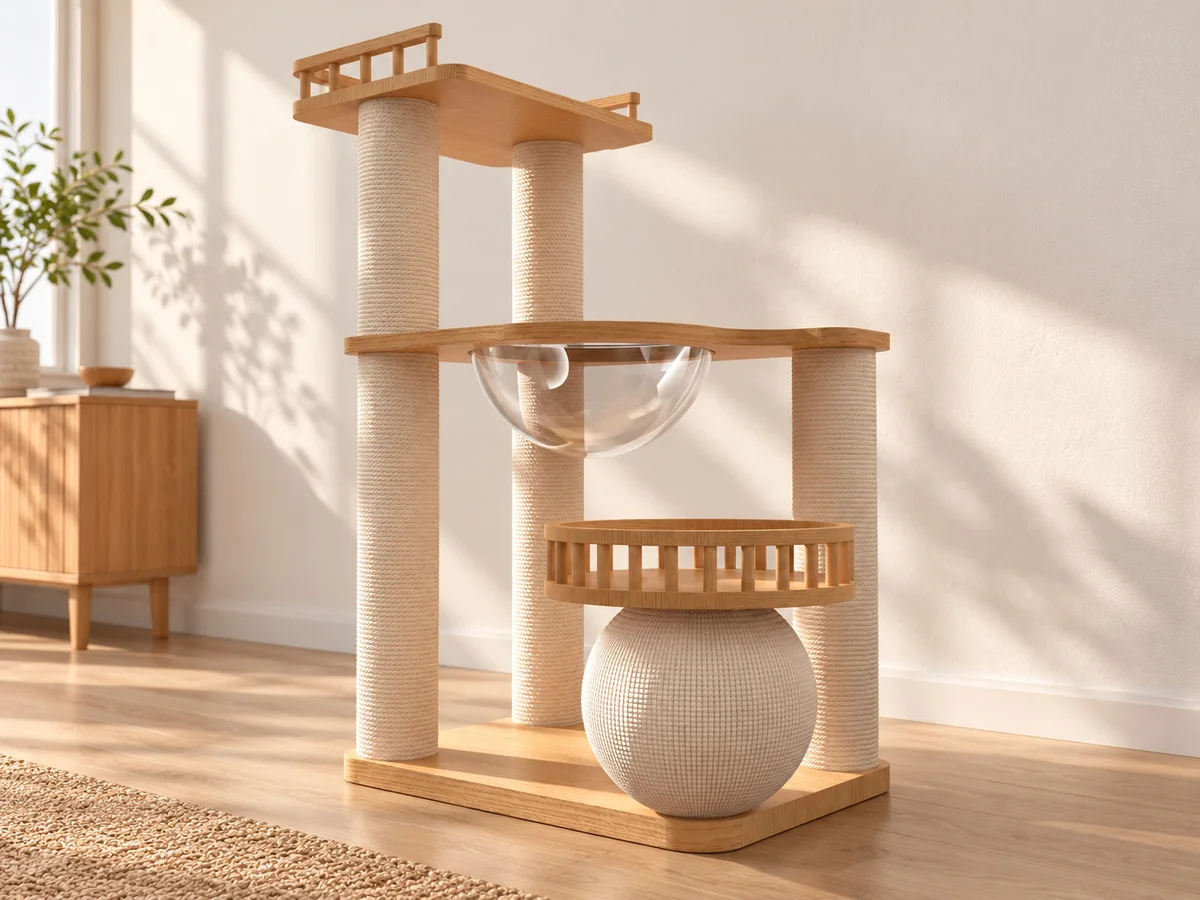
A design-focused range still needs practical product information. Request the usable surface dimensions of the upper deck and lower circular platform, the internal dimensions of the bowl, and the clear spaces between posts. Record the height of each level and the gaps between them on the assembled drawing.
The lower circular rail is especially important to photograph from above as well as from the side. A low camera angle emphasises its sculptural shape but hides much of the usable surface. The same is true of the transparent bowl: a side image communicates its curve, while a higher view explains the opening and its relationship to the wooden carrier.
The reference does not establish bowl material, removal method, care compatibility or rated capacity. It also does not show the internal connection between the rounded lower element and the platform above it. Those are useful sample-review questions because they determine what the product page and customer-care instructions can accurately say.
Build a display around the product's actual proportions
Two room settings can give this unchanged model different contexts. A warm living-room setting highlights the relationship between wood, upholstery and curved forms. A quiet showroom setting makes the clear bowl, rails and textured surfaces easier to read. In both, leave the complete base and upper rail in frame so the customer can recognise the supplied product.
Place the verified dimensions close to the imagery. Styled scenes are helpful for inspiration, but the scale of neighbouring furniture does not establish a measurement. A separate dimensional view lets the buyer evaluate the product in their own room without estimating from a chair or cabinet.
For retail presentation, pair the model with a small number of related products rather than surrounding it with competing towers. Repeat one visible design cue—pale wood, a curved edge or a light textile tone—and let the spherical lower feature remain the distinguishing detail. Confirm any display or installation requirements with the supplier before planning a showroom setup.
A concise sample brief for the buying team
Request CT-0708-083 by model number and agree a single revision for the quotation, drawing, sample and carton. The most useful brief contains the assembled dimensions, a component and material schedule, the lower sphere's construction, the bowl specification, approved finish references, assembly instructions and the final packing arrangement.
During sample review, check that the curved platform, sphere, wavy deck and upper rails match the approved shape. Check visible edges, wrapping consistency, surface finish, component fit and complete hardware. Define any required stability, load or durability evaluation separately, with an agreed method and acceptance criteria; the supplier sheet does not contain those results.
Keep care information specific to each material. Confirm how the wood, wrapping, lower textured element and clear bowl should be maintained, and whether any part may be removed or replaced. This supports a more useful listing than a general “easy-clean” claim whose meaning has not been agreed.
Our recommendation
Shortlist CT-0708-083 when your collection needs a compact-height cat tree with a distinct rounded focal point and an open wooden frame. Its clear bowl and low circular rail platform give the model two recognisable curved elements, while the restrained palette makes it a promising fit for coordinated home merchandising. The recommendation rests on those visible features and the supplier's recorded dimensions; final suitability depends on the approved sample and your product requirements.
Send an enquiry with your target market, order quantity, preferred finish direction and required product information. Ask for the dimensional drawing and lower-assembly detail early so the design story, sample approval and final product page all describe the same model.