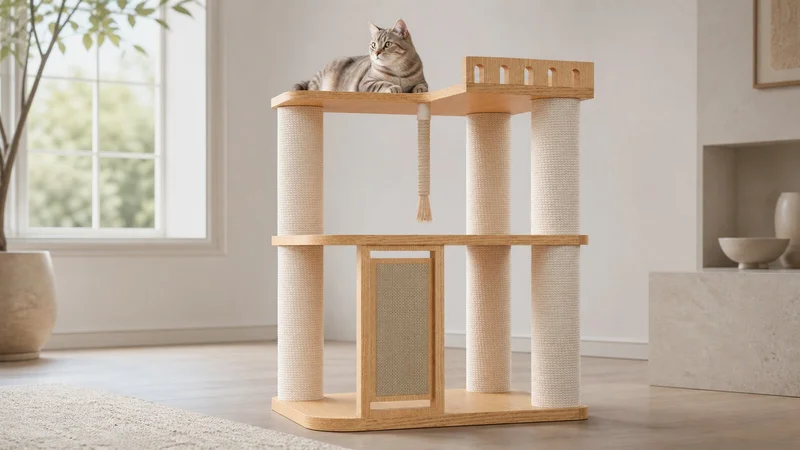
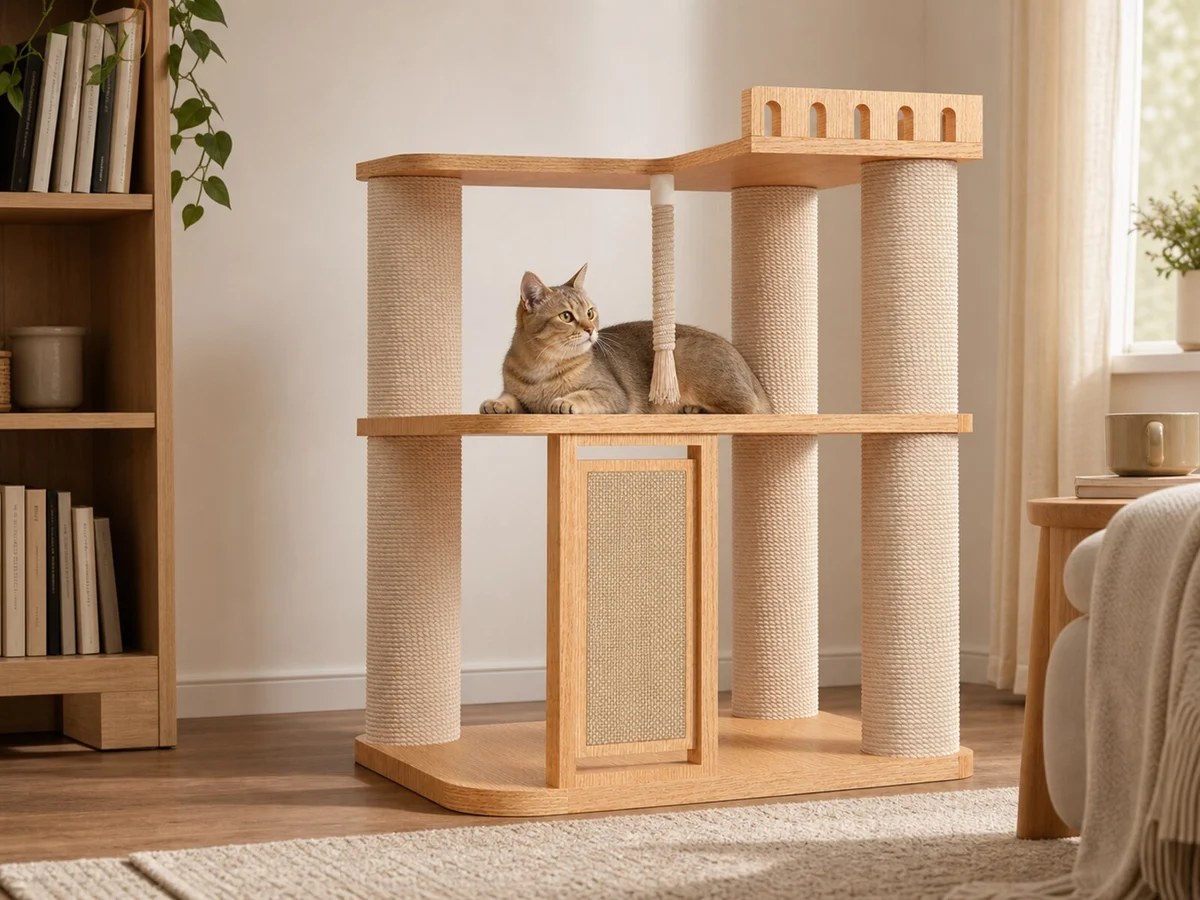
Some cat furniture models need a long explanation because their features are hidden inside a crowded silhouette. Solid Wood Capsule Cat Tree CT-0708-054 offers a more legible structure. The source image shows four tall rope-wrapped posts, a rectangular base, one full-width middle deck, a central framed scratching panel, a hanging tassel, and a broad upper deck with a raised guard rail at one end. The open frame lets a buyer see the major components without having to infer what sits behind a closed box or fabric cover.
That makes CT-0708-054 useful for a component-led product range. The model can be introduced through a visible parts map, controlled dimensions, assembly images, and a clear inspection sequence. This article does not claim a particular load rating, safety result, or behavioural outcome. It explains what is observable in the reference product and which details require confirmation on the physical sample.
Why an open frame helps buyers review the real product
With an open-frame design, the key components can be checked from more than one view. The base, four main posts, middle deck, central panel frame, upper deck, guard rail, and tassel are all visible in the source image. That is helpful when a buyer needs to turn a product concept into a sample brief, an assembly guide, an image checklist, or an inspection record. It reduces the temptation to rely on generic labels such as “multi-level” or “premium” without identifying what should actually be present.
The product story can stay practical: four tall wrapped posts establish the vertical structure; the lower central framed panel adds a separate visible surface; the middle deck provides a clear dividing level; the top deck creates the highest rest position; the guard rail changes the upper outline; and the suspended tassel is a distinct small component. Each one can be referenced in a drawing, photo set, component list, or quotation.
Supplier record for CT-0708-054
The imported supplier record identifies CT-0708-054 at 170 cm high with a 60 x 40 cm base. It lists 18 mm rubberwood board and 10 cm solid pine scratching posts. The capsule field is entered as “30 30*40,” which is not sufficiently clear to turn into a product claim without sample confirmation. The recorded carton is 62 x 42 x 35 cm, and the approximate gross weight is 28 kg.
| Record field | Current value | Practical check |
|---|---|---|
| Model reference | CT-0708-054 | Use one code for the source image, sample, inspection files, replacement parts, and follow-up order. |
| Overall dimensions | 60 x 40 cm base; 170 cm height | Measure the completed unit and use confirmed dimensions in listing graphics and room-fit comparisons. |
| Panel specification | 18 mm rubberwood board | Check panel thickness, edge treatment, finish, deck shape, and central frame construction. |
| Post specification | 10 cm solid pine scratching posts | Confirm core, diameter, wrapping coverage, position, and all connection points on the sample. |
| Capsule field | “30 30*40” | Clarify the intended component, measurement format, and whether it applies to this approved configuration. |
| Carton record | 62 x 42 x 35 cm | Provides an early cube estimate of about 0.091 m3 before final packing is confirmed. |
| Listed gross weight | Approx. 28 kg | Verify the finished packed weight before handling and transport decisions are made. |
The source data does not state the tassel material, panel surface composition, rope specification, coating system, fastener type, order minimum, production timing, capacity rating, or destination-market testing. The product image does not prove those details either. A buyer should request them in a written sample specification, along with the relevant acceptance requirements.
Turn the visible structure into a useful content sequence
A product listing should start with the full assembled profile and model number. The next frame can isolate the base and post layout. Then show the central framed scratching panel, middle deck, tassel attachment, upper deck underside, guard rail, post wrapping, hardware, and packed components. A simple diagram can number each part so that an inquiry, a spare-part request, and an assembly instruction all use the same vocabulary.
This is especially valuable for an ecommerce product program. Instead of repeating a lifestyle frame, the image set can answer practical questions: Is the rail at the top right end? Does the middle deck span the whole frame? Is the central scratching panel framed and vertical? How many tall posts are visible? What does the base look like? Product photography becomes a traceable extension of the approved item rather than a visual substitute for it.
Keep the assembly story as clear as the front view
The open structure should be documented from front, rear, both sides, and underneath. The assembly content needs to show the base, the sequence of posts, the lower panel frame, the middle deck, the upper posts, the top deck, the guard rail, tassel, fittings, and tightening sequence. It should also identify which fasteners are associated with which connection. This gives the buyer a practical way to compare a pre-production sample and a finished batch.
Do not infer the assembly method from the hero image alone. Ask for the approved drawing, hardware list, tools required, instruction draft, and a real assembly check. Record any supplier-specific sequence in the final instruction so that it matches the parts arriving in the carton.
Review the sample component by component
Start with the 60 x 40 cm footprint and 170 cm height. Then compare the base outline, all four post locations, the full-width middle deck, central panel placement, tassel location, top deck, and right-end guard rail to annotated reference images. Photograph any difference before an approval decision is made. A clear open frame makes deviations visible, so they should be documented rather than accepted through a general “similar to image” note.
Measure the stated 18 mm board and 10 cm posts. Inspect the rope wrapping, wood edges, rail openings, panel frame, panel surface, screws, joints, floor contact, hardware count, and finish consistency. Keep those results with the approved photographs, carton review, and buyer-defined requirements in the quality control process.
Separate branding choices from structural revisions
In an OEM or ODM discussion, buyers can define an approved wood tone, rope colour, panel appearance, label placement, carton artwork, barcode, instructions, care text, and spare-part codes. These changes can be evaluated against the approved physical sample and final product artwork.
Changing the base, height, board thickness, post diameter, number of posts, deck spans, panel size, guard rail, tassel location, or connection method changes the structure. It needs revised drawings, a new sample, updated packaging, and the appropriate review before production. Keeping that distinction clear prevents content, instructions, and actual components from drifting apart.
Carton planning for an open-frame item
The recorded 62 x 42 x 35 cm carton equals approximately 0.091 cubic metres. Use it as an early comparison figure only. Final freight planning depends on the actual carton, protection materials, confirmed packed weight, pallet pattern, destination receiving conditions, and the carrier’s calculation method. The source weight of approximately 28 kg must be checked against the finished packing configuration.
Request a packing map that identifies base, panels, posts, guard rail, tassel, hardware, instruction, and protection. Confirm which pieces are detached, how long edges are isolated, how the panel face is protected, where hardware is fixed, and how the carton's contents correspond to the assembly steps. A good pack-out helps preserve both the product and the clarity of the component-led story.
RFQ checklist for CT-0708-054
- Open the request with CT-0708-054, target country, quantity plan, channel, and desired delivery timing.
- Confirm the 60 x 40 cm base, 170 cm height, 18 mm board, 10 cm posts, and ambiguous capsule field on the physical sample.
- Approve the base profile, four posts, middle deck, framed panel, tassel, top deck, guard rail, wrapping, wood finish, fittings, labels, and instructions with annotated photographs.
- Request full front, rear, side, underside, detail, component, assembly, and carton photography before production release.
- Compare actual packing with the recorded 62 x 42 x 35 cm carton and approximate 28 kg gross weight, including the protection plan.
- Set measurable acceptance criteria for dimensions, component positions, finish, packaging, and any required verification.
- Agree commercial minimum, sample schedule, production calendar, spare-part process, shipping route, and quotation validity before order confirmation.
CT-0708-054 is a strong reference when a buyer wants an open-frame cat tree whose components can be explained, photographed, checked, and packed as one controlled system. Its four posts, central framed scratching panel, middle deck, tassel, and guarded upper deck make the product visually clear without adding unsupported claims. View the CT-0708-054 product page, then send target market, quantity, finish direction, packaging limits, and verification needs through the inquiry form.