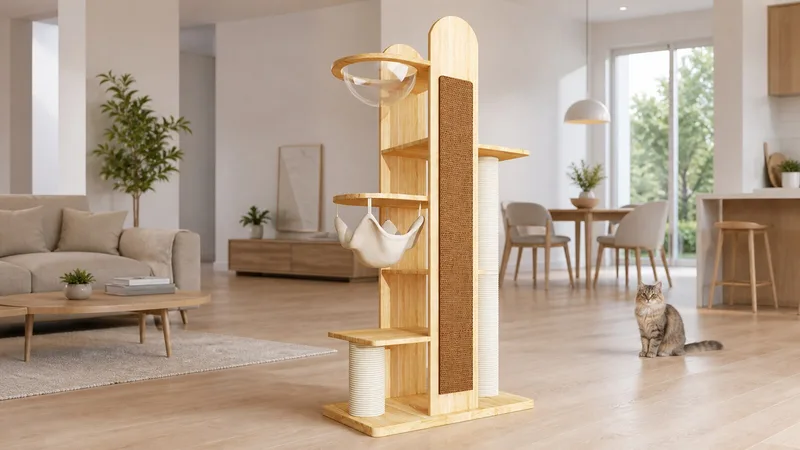
Most cat trees are photographed and sold as wall-side furniture. Their main features face one direction, and the rear is treated as something to hide. Capsule cat tree CT-0708-088 suggests a different product story. Its transparent bowl, hammock, lower step, long vertical scratching panel, platforms, and wrapped posts are arranged around a tall central spine, giving the model a more open, architectural silhouette.
That structure makes the product relevant to design-led collections and open-plan placement, but it also creates a stricter content requirement. A single front photograph cannot explain the entire product. Importers need to show how the functions relate across both sides, how much circulation space the installed item needs, and how the sample, instructions, and packaging preserve the exact component layout.
Why an open-plan model needs a different product brief
A wall-side cat tree can be evaluated mainly from the front. An open-plan model must make sense from several normal viewing directions. The base, rear connections, platform edges, post positions, and finish consistency become more visible. That means design decisions that would be hidden against a wall can affect the perceived quality of the complete product.
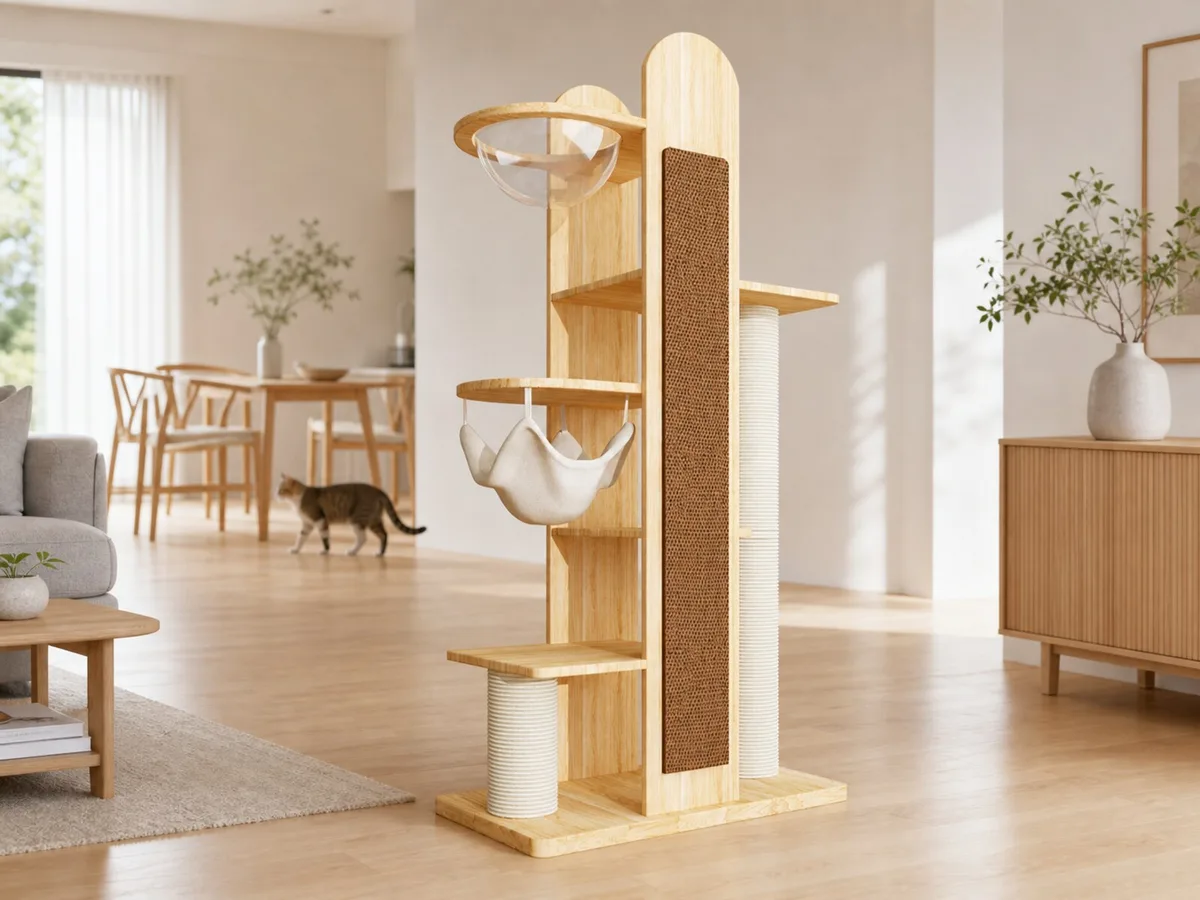
CT-0708-088 has a tall rounded central panel as its visual anchor. A long brown scratching panel runs vertically on the front. To the left are a low platform, a suspended fabric hammock, another shelf, and a transparent bowl held in a wooden ring near the top. A separate platform and tall wrapped post extend on the right. The arrangement looks light because the product is not enclosed by a large condo body.
“Dual-sided” is therefore a positioning description based on the visible arrangement, not a promise that every surface has been tested for every type of use. Final marketing should show the approved product and describe the actual components. Capacity, load, safety, or behavioral claims require defined testing and evidence for the final configuration.
Confirmed specification record
The current supplier record lists a height of 150 cm and an 80 x 40 cm base. It identifies 18 mm rubberwood board, 10 cm solid pine posts, and a 30 cm capsule diameter. The recorded carton is 82 x 42 x 45 cm with an approximate gross weight of 45 kg.
Multiplying the recorded carton dimensions gives approximately 0.155 cubic metres. That is useful for preliminary comparison, but not a final freight quotation. The approved packing method, carton count, pallet plan, protective materials, actual production weight, and carrier rules must be confirmed before landed-cost decisions.
| Item | Current record | Why it matters |
|---|---|---|
| Product number | CT-0708-088 | Links the source row, sample, images, quotation, inspection, and reorder. |
| Overall height | 150 cm | Supports room-scale photography and vertical-clearance planning. |
| Base size | 80 x 40 cm | Defines the recorded footprint before circulation and access clearance. |
| Board | 18 mm rubberwood board | Provides a reference for sample measurement, edge finish, and material confirmation. |
| Posts | 10 cm solid pine posts | Supports component, diameter, wrapping, and replacement-part checks. |
| Capsule diameter | 30 cm | Must be reconfirmed with the transparent bowl and wooden holder on the sample. |
| Carton | 82 x 42 x 45 cm | Equals about 0.155 m3 before pallets or additional protection. |
| Approx. gross weight | 45 kg | Affects handling, fulfilment, and shipping-method review. |
The record does not establish a fixed MOQ, lead time, load rating, exact fabric composition, exact wrapping fibre, coating system, or market certification. Those items remain quotation- and order-specific. Buyers should keep confirmed data separate from options that still need supplier and sample approval.
Plan the installed envelope, not only the base
An 80 x 40 cm recorded base does not mean the installed requirement is limited to that rectangle. The transparent bowl projects near the top-left. Platforms and the hammock extend on the left, while the right platform creates another access side. The buyer needs usable clearance around the feature areas, as well as space for assembly, cleaning, inspection, and normal movement through the room.
For open-plan placement, create a simple floor-plan overlay. Start with the measured base, then add the maximum projection of every upper component and the intended service clearance. Check doors, curtains, heat sources, direct traffic routes, lighting, dining chairs, low cabinets, and any furniture that may be moved during normal use.
Placement imagery should show the product standing naturally in the room rather than pressed against a wall just to save visual space. At the same time, it should not imply that the product can be used as a structural divider or barrier. It remains freestanding cat furniture, and any stability or anchoring requirements must follow the approved instructions and test evidence.
Build the image set around all-around understanding
A complete content package should include front, left three-quarter, right three-quarter, rear, and top-detail views. Each view has a specific purpose. The front records the long scratching panel and overall silhouette. The left view explains the transparent bowl, shelves, hammock, and lower platform. The right view shows the separate platform and tall wrapped post. The rear view documents connections and finish areas that may remain visible in an open room.
Detail images should show the transparent bowl and wooden ring, hammock attachment points, platform edges, brown scratching panel, post wrapping, base corners, hardware covers, underside connections, and component labels. A dimension graphic should show the 150 cm height and 80 x 40 cm base without obscuring the product.
Lifestyle images must remain faithful to the approved structure. Adding a second bowl, moving the hammock, shortening the scratching panel, changing platform heights, or removing the right post would create an inaccurate sales asset. For a design-led item, small structural differences are highly visible and can lead to avoidable inquiry, approval, and after-sales problems.
Use the transparent bowl and hammock as specification items
Transparent components create strong visual differentiation, but they need more than a generic “acrylic capsule” label. Confirm the material, dimensions, wall thickness, edge treatment, clarity standard, fastening method, protective film, cleaning guidance, replacement availability, and acceptable cosmetic criteria. The current record confirms a 30 cm capsule diameter, but the complete bowl and holder should be measured on the sample.
The hammock also needs an order-specific definition. Confirm the fabric composition, color reference, seam and attachment construction, removable or fixed status, care method, and replacement-part code. Do not assume that the material is washable or machine washable unless the approved specification states that clearly.
These details matter in capsule cat tree collections because transparent and textile parts are visually prominent. Color drift, surface marks, fabric shape, or attachment changes can alter the product more than a small hidden hardware difference.
Review packaging around exposed and contrasting surfaces
The 82 x 42 x 45 cm recorded carton needs to protect components with very different surfaces. Clear material can scratch. The long brown panel can shed or abrade nearby finishes. Wrapped posts can be compressed or marked. Natural wood edges, platform corners, and the rounded top can be damaged by movement inside the carton.
Ask for a packing map that identifies where the bowl, holder, hammock, panel, posts, platforms, base, hardware, and instructions are placed. Confirm protective sleeves, surface separators, corner protection, hardware containment, and any areas where metal parts could contact clear or finished components.
At approximately 45 kg gross weight, handling should be checked against the target warehouse, parcel, pallet, and delivery process. A retail cat furniture buyer should compare actual and dimensional weight, carton orientation, receiving limits, damage patterns, assembly service, and replacement-part handling before placing the model into a store or online range.
Approve the sample as a component map
Begin with the overall 150 cm height, 80 x 40 cm base, central spine alignment, base contact, and platform positions. Photograph the sample from all four sides. Then assign a component reference to the transparent bowl, wooden ring, upper shelf, middle shelf, hammock, lower platform, right platform, long scratching panel, short post, tall post, base, and hardware groups.
Continue with board thickness, post diameter, clear-part fit, hammock attachments, panel alignment, wrapping direction, wrapping ends, exposed edges, visible joints, fastener coverage, surface color, and assembly orientation. Each checkpoint should use measurements or approved visual references rather than broad instructions such as “good quality.”
The order-specific quality control plan should also define any stability, static-load, chemical, packaging, or market-specific tests required by the buyer. Test configuration, method, sample condition, acceptance criteria, and report format must be agreed before claims are published.
Keep a design-led OEM program controlled
An OEM cat tree program can review wood-tone references, scratching-panel color, post wrapping, hammock fabric, labels, logo position, barcode, instructions, component coding, carton artwork, and replacement-part packaging. A coordinated palette can help the model fit an interior-focused brand without changing its architecture.
Changes to height, base size, capsule position, platform layout, post diameter, hammock location, central spine, or long panel require structural review. They may affect balance, assembly, carton dimensions, content assets, and testing. They should be treated as development work rather than as simple color customization.
RFQ checklist for CT-0708-088
- Reference CT-0708-088 and state the target market, sales channel, expected quantity, and intended collection position.
- Reconfirm the 150 cm height, 80 x 40 cm base, 18 mm rubberwood board, 10 cm solid pine posts, and 30 cm capsule diameter.
- Confirm the clear bowl material, holder, hammock fabric, scratching panel, post wrapping, wood finish, hardware finish, and cleaning guidance.
- Review every platform, post, attachment point, base connection, central panel, and visible rear surface on the approved sample.
- Reconfirm the 82 x 42 x 45 cm carton, approximate 45 kg gross weight, disassembly sequence, internal protection, and final carton volume.
- Request front, side, rear, detail, assembly, packaging, and dimension images tied to the approved configuration.
- Define inspection tolerances and any stability, load, chemical, packaging, or market-specific testing required for claims.
- Confirm MOQ, sample schedule, production lead time, replacement parts, shipping route, and quotation validity after approval.
CT-0708-088 gives interior-focused buyers a product story that is different from a conventional wall-side tower. Its value comes from the relationship between the transparent bowl, hammock, vertical scratching panel, platforms, posts, and open central structure. Review the CT-0708-088 product page, then send the target market, quantity, finish direction, content requirements, packaging limits, and test needs through the cat tree inquiry form.