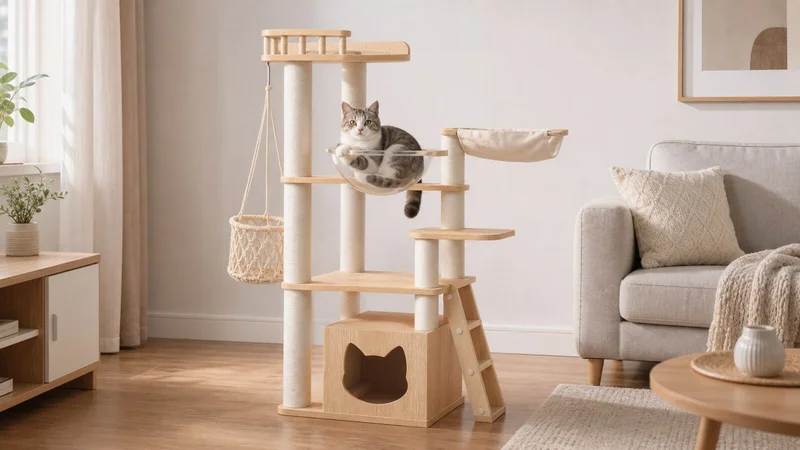
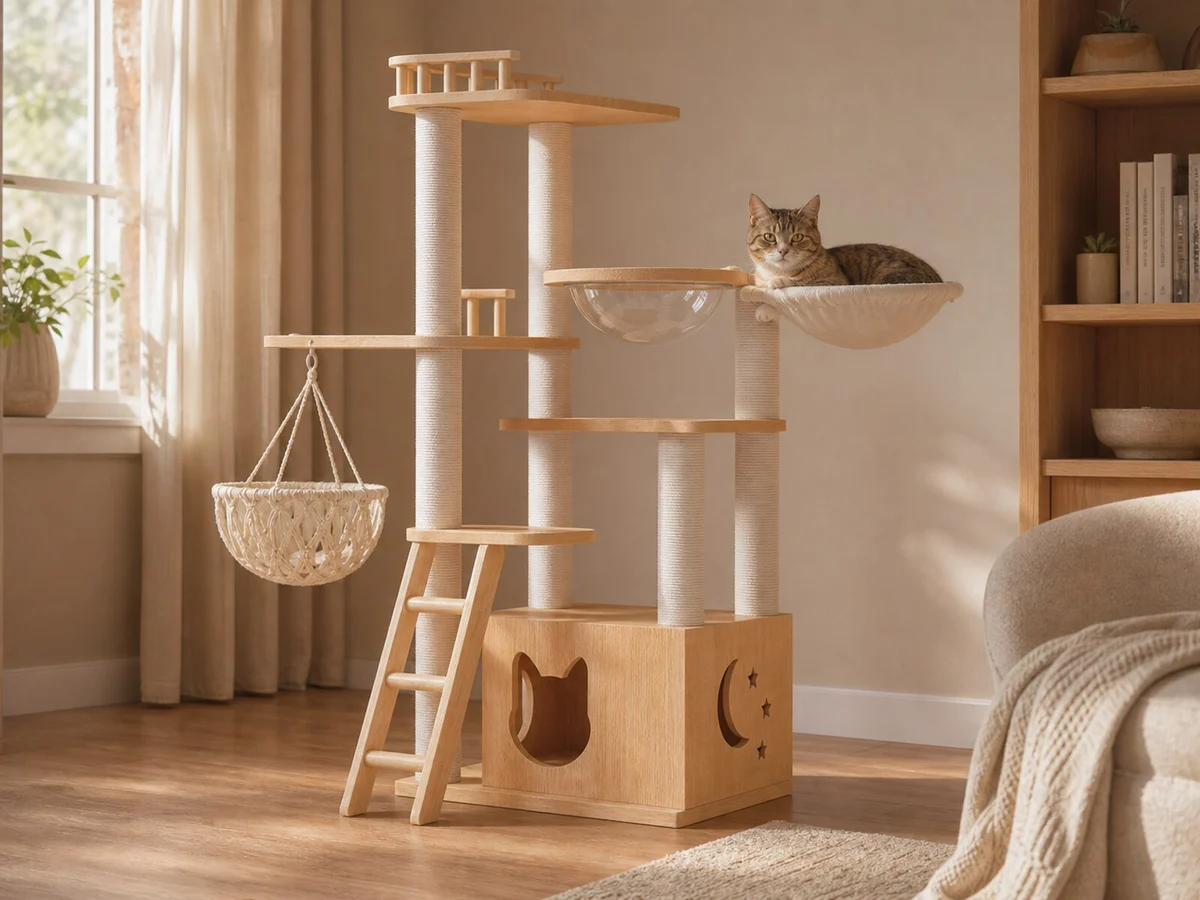
Some cat trees are chosen for a simple size or function filter. Others become memorable because the product has a recognizable visual identity that must remain intact from the first catalog image through the approved sample. Solid Wood Capsule Cat Tree CT-0708-061 belongs to the second group. The visible design combines a cat-shaped hideaway entrance, moon-and-stars side cutout, small ladder, clear resting bowl, hanging woven basket, fabric hammock, rope-wrapped posts, and a rounded top perch with a wood guard rail.
For buyers considering character-led indoor cat furniture, the opportunity is not a vague promise of “cute design.” It is a product whose specific visual details can be made consistent across photographs, packaging, instructions, replacement parts, and quality review. This guide examines CT-0708-061 through that lens. It separates what is recorded in the supplier data from what is visible in the reference image, and it identifies the details that should be confirmed before an order or customization is approved.
Why a character-led cat tree needs a controlled product identity
Distinctive furniture is easy to notice but also easy to misrepresent. If a sales image changes the hideaway opening, removes a decorative cutout, relocates the ladder, or substitutes a different hammock, the buyer is no longer reviewing the same product. With CT-0708-061, the cat-shaped entrance and moon-and-stars cutout are not background decoration. They are part of the item’s recognisable profile, just as the clear bowl, hanging basket, guarded top platform, and compact climbing route are part of its visible composition.
That does not require unsupported claims about pet behaviour, load capacity, material safety, or market suitability. A clear product story can use observable language: a cat-shaped lower entrance, decorative side cutout, clear bowl, hanging woven basket, fabric hammock, and small rung ladder. When a buyer wants a particular performance or compliance claim, that requirement needs an agreed sample, test method, acceptance criterion, and supporting evidence.
Supplier data to keep with this model
For CT-0708-061, the import record gives an overall height of 170 cm and a 60 x 40 cm footprint. It records 12 mm rubberwood panels, 8 cm pine scratching posts, a 35 cm capsule figure, and a 62 x 52 x 40 cm outer carton. The listed approximate gross weight is 32 kg.
| Item | Current record | Product-review relevance |
|---|---|---|
| Model reference | CT-0708-061 | Use this code on image approvals, drawings, inspection documents, and replenishment requests. |
| Recorded footprint | 60 x 40 cm; 170 cm tall | Use it for a dimension visual and to assess the physical placement of the assembled sample. |
| Panel record | 12 mm rubberwood | Measure representative panels and check the finish, cutout edges, and lower-box construction. |
| Post record | 8 cm pine posts | Verify diameter, rope coverage, orientation, and joint locations on the real unit. |
| Round-module figure | 35 cm | Match the final round component, mounting method, and related drawing before approval. |
| Export carton record | 62 x 52 x 40 cm | Provides an early cube calculation of about 0.129 m3, pending final packing confirmation. |
| Listed gross weight | Approx. 32 kg | Reconfirm on the completed, packed production sample before transport planning. |
The spreadsheet does not define the composition of the hanging basket, hammock textile, transparent bowl, coating, or hardware; it also gives no order minimum, production schedule, load claim, or country-specific testing position. A photograph cannot fill these gaps. Treat them as open questions to be resolved in a sample specification and commercial offer.
Build the listing around recognisable components
Start the product page with a searchable, traceable name: “Solid Wood Capsule Cat Tree CT-0708-061.” Follow it with the visible identity rather than a long string of marketing labels. A buyer should be able to scan the lower cat-shaped entrance, the side moon-and-stars motif, the ladder, clear bowl, hanging basket, hammock, rope-wrapped posts, and guarded upper perch. The 170 cm height and 60 x 40 cm footprint belong in a readable dimensions section, not crowded into the product title.
This approach helps a product line look intentional. The character motif becomes a defined design language, while the concrete component list makes the item reviewable. It also makes it easier to compare CT-0708-061 with a simpler capsule cat tree without implying that one design serves every customer or room type.
Use photography to prove continuity, not invent a new model
Lead with a full-height frame that makes the complete silhouette legible at a believable room scale. Then provide evidence views: each face of the lower box, the ladder joints, bowl mount, basket suspension, hammock anchors, rope wrapping, platform edges, guard rail, base corners, fittings, assembly sequence, and packed configuration.
Each frame needs a job. The complete profile establishes recognition. The lower-box close-up proves the character opening and decorative cutouts. The side view clarifies the bowl and hammock placement. The rear view documents support posts and platform structure. A packing image connects the visual item with the shipment the buyer will actually receive. This is particularly important for a model with several visible accessories, because a missing or substituted piece changes the product identity immediately.
Approve the sample at the level of the details buyers notice
Begin with the complete silhouette: 170 cm height, 60 x 40 cm base, lower-box proportion, ladder angle, post positions, bowl location, hanging-basket location, hammock location, top platform, and guard rail. Then inspect the cat-shaped entrance, the moon-and-stars cutout, and the cat-shaped side cutout against annotated reference photographs. These items should have a visible approval decision, not a general note that the product is “similar.”
Measure the 12 mm board and 8 cm post record on the sample. Review surface finish, edges, wrapping, fastener coverage, platform contact, basket suspension, hammock attachment, bowl fixing, base contact, and assembly orientation. The quality control process should store the image reference, measurements, carton check, and any buyer-defined test requirements together so that quality review has the same reference point as sales content.
Keep customization choices from blurring the approved reference
In an OEM or ODM cat furniture program, the brief can define a wood-tone reference, rope colour, basket or hammock textile, branding position, carton artwork, care information, barcode format, instructions, and spare-part IDs. Evaluate those choices against one signed-off physical reference.
Any revision to the footprint, height, panel gauge, post size, box form, cutout artwork, ladder, bowl mounting, basket suspension, hammock position, rail, or platform layout is a redesign rather than a colour selection. It must be controlled by revised drawings, a new prototype, an updated pack-out, and the verification appropriate to the change.
Confirm carton planning before the launch image is approved
Multiplying the three recorded carton dimensions gives about 0.129 cubic metres. Use it only as a preliminary comparison number: the final freight result follows the finished carton, protective inserts, confirmed packed weight, pallet layout, destination constraints, and the transport provider’s own calculation. The 32 kg figure likewise needs a finished-unit check.
Request a pack-out diagram for all visible components: lower box, board panels, posts, clear bowl, hammock, hanging basket, ladder, guard rail, hardware, instructions, and protective materials. Confirm which pieces are detached, how the bowl is separated from hard edges, how textile components are protected, and how the decorative panels avoid abrasion. A character-led product is judged quickly by details, so the pack-out should protect the same details shown in the listing.
RFQ checklist for CT-0708-061
- Open the brief with CT-0708-061, intended country, forecast volume, selling route, and preferred arrival window.
- On the assembled sample, document the stated 60 x 40 cm base, 170 cm height, 12 mm panels, 8 cm posts, and 35 cm round-module record.
- Use annotated photographs to approve the cat opening, lunar motif, side cutout, ladder, bowl, basket, hammock, rail, surface treatment, rope, fittings, and customer-facing labels.
- Request a controlled photo pack covering every side, the bottom, individual components, assembly stages, and the sealed export carton.
- Compare the actual packed carton with the 62 x 52 x 40 cm and approximately 32 kg record; include the protective-material plan and receiving restrictions.
- Write acceptance limits for measurements, artwork, module location, surface appearance, packing, and the buyer’s required verification.
- Before placing the order, settle commercial minimums, prototype timing, production window, component support, routing, and offer expiry.
CT-0708-061 is useful when a cat-furniture line needs a character-led model that can be described with real, reviewable details. The lower cat-shaped hideaway, moon-and-stars motif, ladder, clear bowl, hanging basket, hammock, and guarded perch create a product identity that should stay consistent from image generation through sample approval and delivery. Review the CT-0708-061 product page, then send the quantity, destination, finish direction, packaging needs, and verification requirements through the inquiry form.