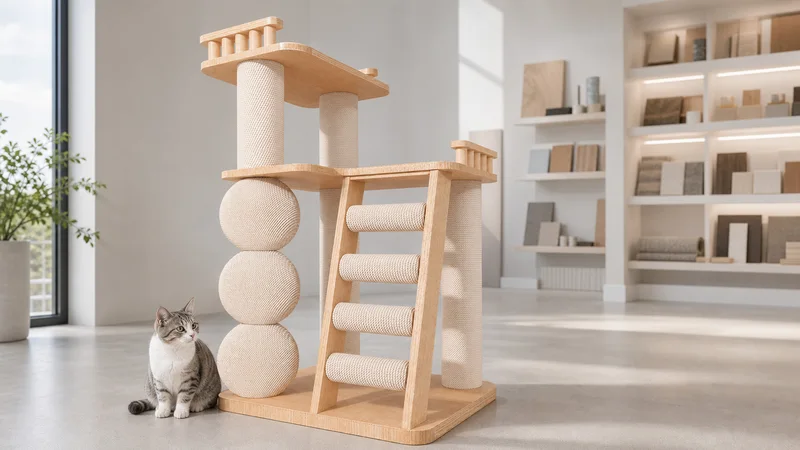
Activity-focused cat furniture needs a clearer product story than a generic title such as "large cat tree." Buyers need to understand how the platforms, climbing elements, scratching surfaces, and resting areas connect. Solid wood cat tower TW-0708-037 gives pet brands a distinctive structure to work with: a central inclined wooden frame with four rope-wrapped cylindrical steps, three circular rope-wrapped side modules, several elevated platforms, short wooden guardrails, and multiple rope-wrapped posts.
This article does not position the model as another heavy-duty wholesale tower. The stronger angle is product development for a pet brand that wants an activity-led SKU with a recognizable silhouette. That means the buying team must evaluate not only dimensions and price, but also how the movement route is explained, how the repeated rope components are controlled, how assembly is documented, and how the product will be photographed for retail or ecommerce use.
What makes this model visually different
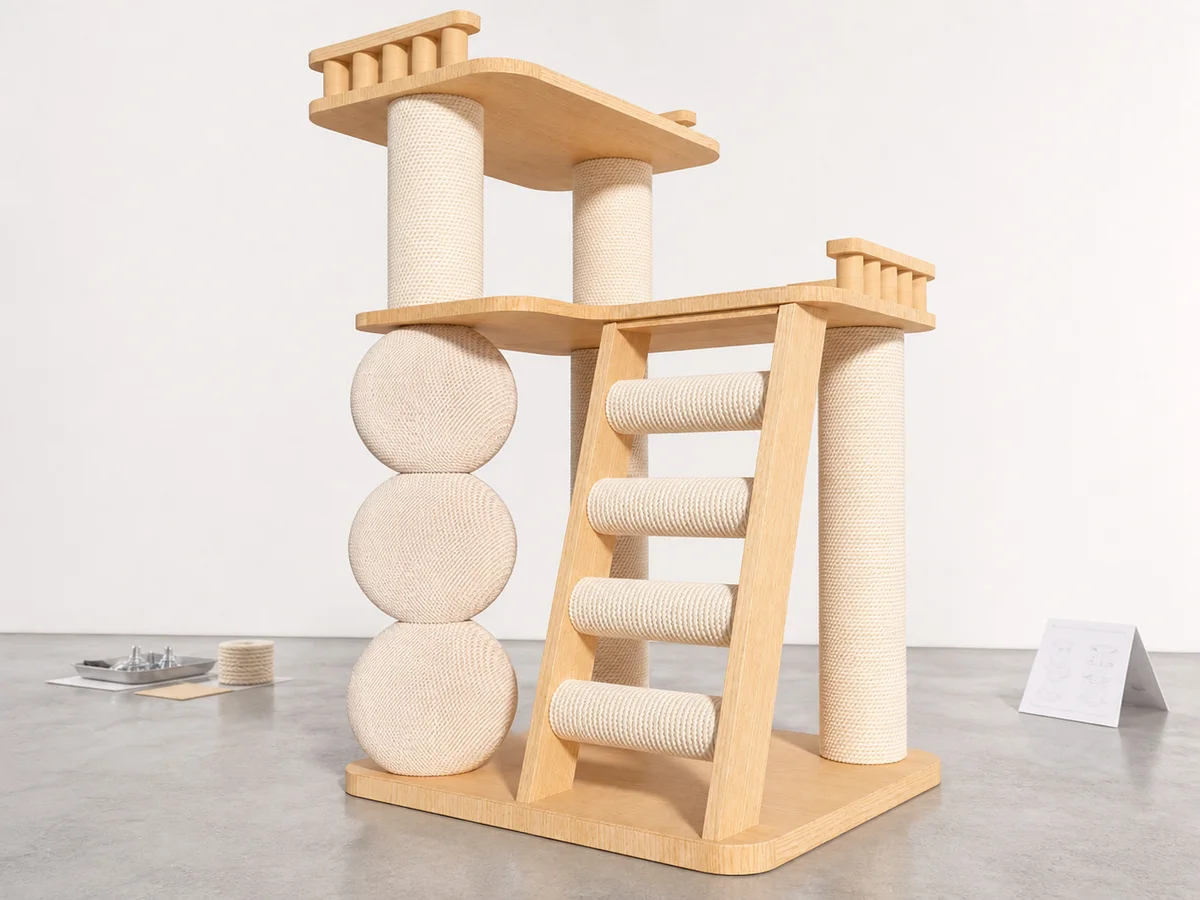
The central climbing frame is the first feature a buyer notices. Four horizontal rope-wrapped cylinders sit between two inclined wooden rails. To the left, three large circular rope-wrapped modules form a vertical stack below the middle platform. Above them, two tall wrapped posts support the top platform. A separate right-side post supports the middle platform, where a short wooden guardrail creates another visible detail.
These elements give the model a stronger functional sequence than a tower made only from flat shelves. They also create more opportunities for product content: a full silhouette image, a side view of the incline, close-ups of each rope finish, connection details under the platforms, and an assembly sequence. Brands should still avoid promising accessibility, exercise outcomes, or a specific load capacity unless those claims are supported by approved testing.
Within a solid wood cat tower range, this model can be positioned as the activity-focused option rather than the tallest or heaviest option. That distinction helps a catalog avoid presenting several natural-wood towers with nearly identical descriptions.
Specification record to keep consistent
The current record lists TW-0708-037 at 90 cm high with a 60 x 40 cm base. The carton reference is 62 x 52 x 40 cm, and gross weight is recorded as 25 kg. Material is listed as solid rubberwood boards with solid pine scratching posts. The supplier specification also records a 10 cm solid pine post diameter and 18 mm rubberwood board thickness.
| Specification | Current record | Buyer use |
|---|---|---|
| Product number | TW-0708-037 | Connects samples, photography, quotations, instructions, and repeat orders. |
| Overall height | 90 cm | Supports assortment comparison and intended room-placement review. |
| Base | 60 x 40 cm | Provides the initial floor-footprint reference before use clearance is checked. |
| Carton | 62 x 52 x 40 cm | Supports warehouse, parcel, pallet, and shipping-volume planning. |
| Gross weight | 25 kg | Relevant to receiving, fulfillment, and customer handling information. |
| Post and board references | 10 cm post; 18 mm board | Useful when comparing the approved sample with later production. |
These values should be reconfirmed on the approved sample and final order specification. MOQ remains subject to model and order quantity. Lead time is confirmed after sample and order details, so it should not be converted into an unsupported fixed promise in a launch calendar.
Build the product description around a route, not a feature dump
For a pet brand, the most useful description order follows what a customer can see. Start with the four-step inclined ramp, then explain the three circular side modules, elevated platforms, guardrails, and wrapped support posts. Dimensions and carton data belong in a specification section, not in an overloaded title.
This route-based structure is especially useful for ecommerce cat tree content. The first image should show the full model. A second image should show the ramp angle and step spacing. Additional images can cover rope texture, guardrail details, post connections, base footprint, and the packed component set. A short assembly or demonstration video can then follow the same order, helping the listing explain the product without relying on vague lifestyle language.
For pet specialty retailers, the same hierarchy helps sales teams identify why this SKU is different from a condo, capsule tower, or scratching post. The display description can focus on the visible activity structure while the technical sheet carries the material, dimension, carton, and gross-weight details.
Sample checks for the ramp and repeated components
The inclined frame should be evaluated as a complete assembly. During sample review, check the frame-to-base connection, the position and alignment of all four cylindrical steps, the spacing between the steps, and the relationship between the top of the frame and the middle platform. Confirm that the assembly instructions identify the correct orientation and hardware for each connection.
The three circular side modules also need a repeatable reference. Review their diameter, thickness, alignment, wrapping direction, surface consistency, and connection to the supporting structure. Because the model contains several visually similar rope parts, photographs and component codes are more reliable than a loose description such as "cream scratching pieces."
Post-to-platform connections, guardrail parts, board edges, base contact, and overall stability on the intended floor surface should be included in the sample checklist. Any performance or load statement needs its own approved evidence. Visual inspection alone is not a substitute for a tested claim.
Rope, color, and repeat-order consistency
Rope is a large part of this product's visible identity. The posts, ramp cylinders, and circular side modules create repeated cream surfaces across the whole tower. A small color or texture difference can therefore be more noticeable than it would be on a model with only one scratching post.
Before approval, a brand should define the rope or wrapping reference, color tolerance, wrapping direction where relevant, end fixing, and acceptable surface appearance. Ask whether the same rope lot can be coordinated for one order and how changes will be controlled for repeat production. If replacement components are part of the program, confirm which parts can be supplied separately and how they will be identified.
Wood tone and board finish need the same treatment. A signed physical sample, approved photography, and written finish reference are stronger controls than a color name alone. Lighting and camera settings can shift natural-wood color, so ecommerce images should not become the only production standard.
Assembly content is part of the product
TW-0708-037 contains more directional components than a simple post-and-platform tower. The inclined frame, four steps, circular modules, guardrails, and several posts need an instruction sequence that makes orientation clear. During sample assembly, record the hardware count, tools required, order of operations, and any point where left-right orientation could be confused.
For customer-facing content, one exploded component image and several short assembly frames can reduce uncertainty. Parts should use the same codes in the instruction sheet, hardware bag, carton checklist, and after-sales record. Brands should request confirmation of the final instruction format and language before mass printing.
Packaging and fulfillment review
The current carton reference is 62 x 52 x 40 cm at 25 kg gross weight. Buyers can use those values for preliminary logistics planning, but the final packing method should be confirmed after the sample is approved. Review how wooden rails, guardrails, round wrapped modules, posts, platforms, and hardware are separated and protected inside the carton.
For ecommerce fulfillment, discuss edge protection, movement inside the carton, component abrasion, hardware containment, instruction placement, outer marks, and barcode requirements. For wholesale or retail distribution, confirm pallet pattern, mixed-SKU identification, and whether replacement parts travel in the same shipment. Packaging claims should reflect the approved pack, not a generic description copied from another model.
OEM decisions for an activity-led SKU
An OEM cat furniture program can review wood tone, rope color, finish, guardrail style, labeling, instructions, carton marks, and hardware organization. Structural changes to the ramp, step spacing, platform layout, post diameter, or board thickness require a new engineering and sample review. They should not be treated as simple color options.
The order-specific quality control plan should identify the approved dimensions, component count, visual references, assembly points, packaging checks, inspection records, and any testing requested by the buyer. No general certificate or unverified performance statement should replace those product-specific controls.
RFQ checklist for TW-0708-037
- Reference TW-0708-037 and state the intended channel: brand collection, ecommerce, pet retail, or wholesale.
- Confirm the 90 cm height, 60 x 40 cm base, 62 x 52 x 40 cm carton, and 25 kg gross weight on the approved sample.
- Review the four ramp steps, three circular side modules, platforms, guardrails, posts, base, and all connection hardware.
- Define rope reference, color tolerance, wrapping appearance, wood tone, and finish approval method.
- Request the component list, hardware count, assembly instructions, image plan, and replacement-part options.
- Confirm carton protection, outer marks, barcode needs, pallet planning, and mixed-SKU identification.
- Agree the sample checks, inspection records, and any testing required for product claims.
- Confirm MOQ and lead time from the final quantity, customization scope, packaging, and production route.
TW-0708-037 is a strong candidate for a pet brand that wants an activity-focused solid wood tower with a recognizable climbing structure. Review the TW-0708-037 product page, then send target channel, quantity, finish direction, content requirements, sample checklist, and packaging needs through the cat tower inquiry form.