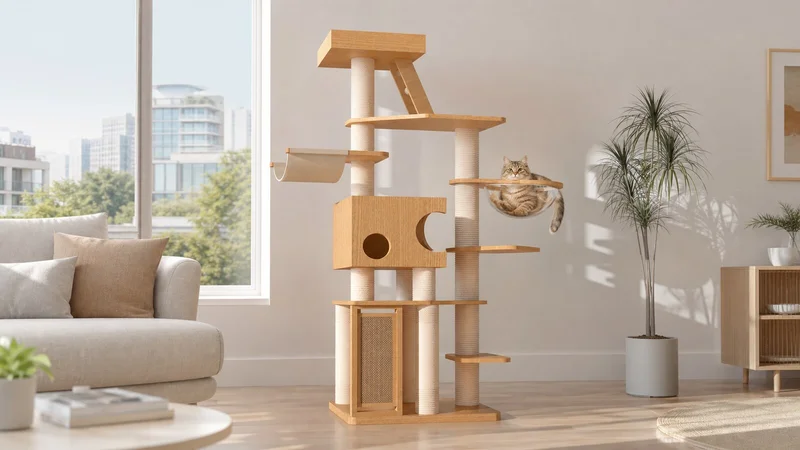
One reason cat trees become difficult to compare is that the product photos show several functions at once, but the listing does not explain how those functions are separated. Solid Wood Cat Tree CT-0708-016 gives a clearer starting point. Its 160 cm structure combines a lower framed scratching panel, a raised hideaway box, a fabric hammock, a transparent resting bowl, rope-wrapped posts, and staggered platforms. Each feature occupies a different level rather than competing for the same surface.
This article is about the product's visible resting and climbing layout. It is not a claim that every cat will use every module in the same way. For a buyer building an indoor cat-furniture range, the useful question is whether the layout gives customers a recognizable mix of enclosed, suspended, transparent, and open resting choices while keeping the product record, sample, photography, and quotation aligned.
Why separate resting choices matter in the product story
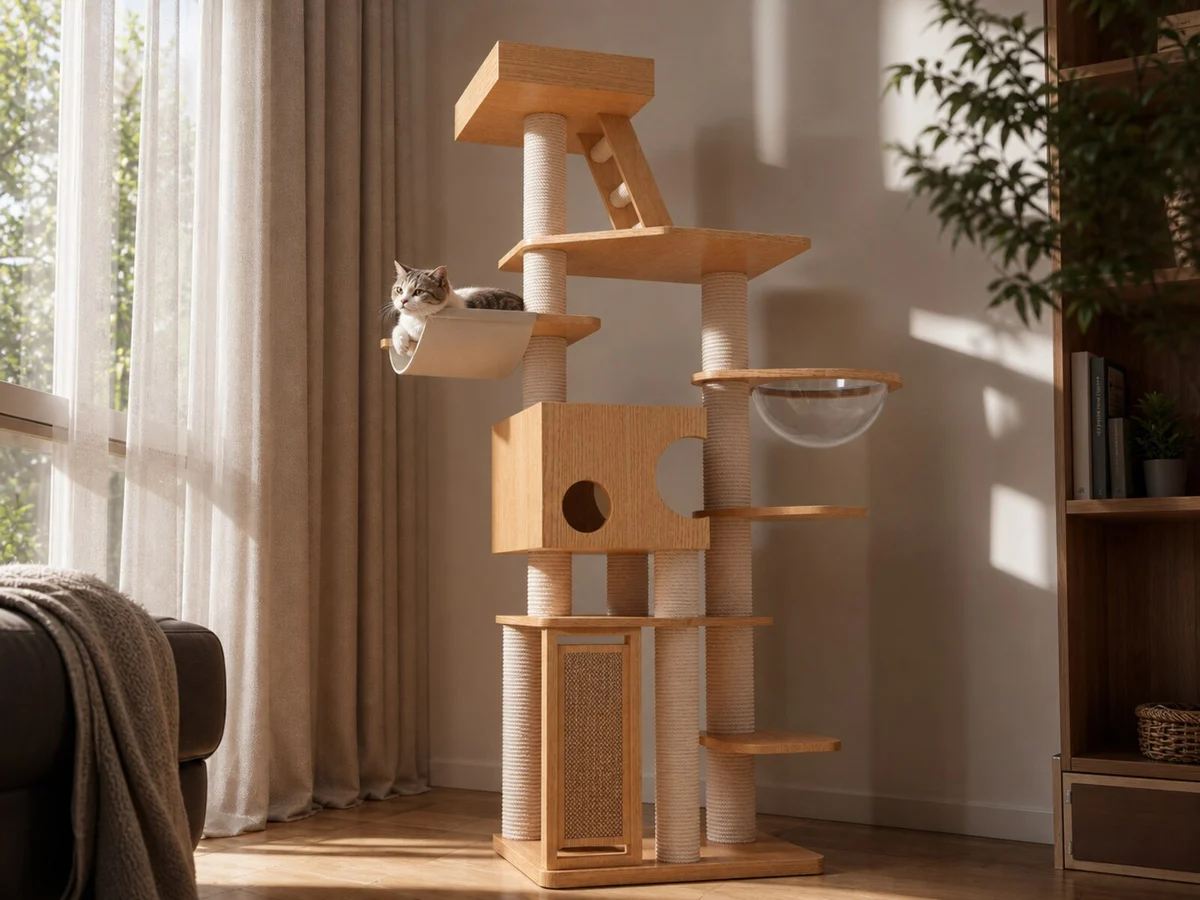
A tall cat tree does not need to be described as simply "multi-function." That phrase gives no buyer a reason to understand the structure. CT-0708-016 has four visible types of rest or pause points: the box-like hideaway, the fabric hammock, the clear bowl, and the open platforms. The product also has a framed vertical scratching panel and multiple rope-wrapped posts. Together, these details create an understandable hierarchy for a catalog page: enclosure below, suspended rest to the left, elevated observation to the right, and climbing routes between them.
That hierarchy is useful for consumer-facing images and for B2B comparison. A buyer can use it to distinguish this model from a basic vertical post, a compact tower with one perch, or a capsule-focused tree. The description should remain literal. The current supplier record and source image support the presence of these components; they do not establish a capacity rating, behavioral outcome, or suitability for a defined number or size of cats.
Confirmed record for CT-0708-016
The supplier record lists a 70 x 70 cm base and 160 cm overall height. It identifies 18 mm rubberwood board, 12 cm solid pine scratching posts, and a 40 cm capsule diameter. The recorded carton is 75 x 75 x 50 cm with an approximate gross weight of 65 kg.
| Item | Current record | Why it matters |
|---|---|---|
| Product number | CT-0708-016 | Keeps the listing, sample, image approval, inspection, and reorder on one traceable reference. |
| Overall size | 70 x 70 cm base; 160 cm height | Provides the starting point for room-fit, dimension graphics, and warehouse planning. |
| Board | 18 mm rubberwood board | Should be measured and visually reviewed on the approved sample, including edges and finish. |
| Posts | 12 cm solid pine scratching posts | Gives the record for component diameter, placement, and wrapping review. |
| Capsule diameter | 40 cm | Identifies the recorded round resting module; verify the final component and opening details on the sample. |
| Carton | 75 x 75 x 50 cm | Equals about 0.281 m3 before palletisation, protective additions, or carrier rules. |
| Approx. gross weight | 65 kg | Needs final confirmation against production pack-out and destination handling requirements. |
The source record does not specify the fabric composition of the hammock, the exact clear-bowl material, coating system, hardware specification, order minimum, load rating, production lead time, or destination-market test requirements. These are quotation and sample-confirmation points. They should not be guessed from a lifestyle image.
Use the layout to structure product-page content
A strong product page should help a buyer understand the tree from base to top. Start with the product name and model number, then show the complete profile. The next sequence can follow the actual structure: framed scratching panel at the base, lower support posts, hideaway box, hammock, transparent bowl, side steps, upper platform, and top perch. A second image from a different angle should show the rear supports, post placement, bowl fixing, hammock attachment, underside of the platforms, and base corners.
It is better to label a component precisely than to add generic superlatives. "Fabric hammock" and "transparent resting bowl" tell the buyer what is physically present. "Vertical framed scratching panel" gives a reviewer a specific surface to inspect. The same language can be used in the product page, a commerce content plan, a sample checklist, and a replacement-part list without making the content sound copied or vague.
Plan images around the real routes and rest zones
The hero image should show the full silhouette at a credible scale, with all main modules visible. One supporting lifestyle frame can show the hammock in use or the bowl in use, but it should not hide the hideaway openings, scratch panel, or steps. Detail frames should then document the woven panel, post wrapping, rounded platform edges, box openings, bowl mounting, hammock seams and attachments, hardware, labels, assembly, and carton.
For a buyer, that image system does more than make the listing attractive. It reduces the risk that a sample is approved from one beautiful front view while the final product's components, depth, connections, and packaging remain unclear. The reference images used here preserve the full CT-0708-016 layout. Any approved revision to the board tone, post wrapping, bowl, hammock, platform size, or module position should receive a new image set and revised item record.
Keep sample review tied to the component map
Review the physical sample in the same order as the listing. Confirm the 70 x 70 cm base and 160 cm height first. Then check the 18 mm board record, 12 cm post diameter, number and placement of visible platforms, hideaway openings, framed scratching panel, hammock support points, clear-bowl fixing, top-platform support, and the complete base contact with the floor.
Close-up photographs with a measuring tool are more useful than verbal notes such as "good quality" or "same as photo." Record the sample's front, side, rear, underside, and packed configuration. Put an acceptance decision beside each component: approved, change requested, or awaiting information. The quality control process can then connect visual approval with measurable checks, packaging review, and any destination-specific testing a buyer requires.
Packaging and handling should be decided before launch
The recorded 75 x 75 x 50 cm carton has an estimated volume of 0.281 cubic metres. This is a useful early calculation only. Freight planning still depends on the final carton, actual gross weight, packing materials, pallet configuration, destination rules, and the carrier's dimensional-weight calculation. At the quoted approximate gross weight of 65 kg, handling and receiving requirements should be confirmed before committing to the shipping method.
Ask for a pack-out diagram that identifies the board panels, posts, bowl, hammock, hardware, instructions, and protective materials. It should make clear which pieces are detached, how hard edges are isolated from transparent or fabric components, how the scratching panel is protected, and how all hardware is fixed inside the carton. This prevents packaging from becoming an afterthought after product photography is already approved.
OEM choices: distinguish surface changes from structural changes
Within an OEM or ODM cat furniture discussion, buyers may ask about approved wood-tone references, wrapping color, hammock fabric, logo location, care label, carton artwork, barcode, instructions, and replacement-part coding. These decisions can be assessed against the approved sample and quotation.
Changes to the 70 x 70 cm footprint, overall height, board thickness, post diameter, hideaway shape, bowl size or fixing, hammock location, platform geometry, or base construction are structural changes. They require engineering review, an updated drawing, a new sample, packaging assessment, and any necessary verification. Keeping that distinction clear protects both the product identity and the accuracy of the final listing.
RFQ checklist for CT-0708-016
- State model CT-0708-016, destination, target quantity, intended sales channel, and requested delivery timing.
- Confirm the 70 x 70 cm base, 160 cm height, 18 mm board, 12 cm posts, and recorded 40 cm capsule dimension on the sample.
- Approve the exact wood tone, post wrapping, framed scratching-panel surface, hammock material, transparent-bowl material and fixing, hardware, and care wording.
- Sign off front, side, rear, underside, component, assembly, and final-carton photographs against the approved sample.
- Review the recorded 75 x 75 x 50 cm carton, approximate 65 kg gross weight, pack-out diagram, protection plan, and destination receiving limits.
- Define measurable criteria for dimensions, finish, component placement, packaging, and any required safety or market verification.
- Agree order minimum, sample timing, production calendar, spare-part support, shipping route, and quotation validity before release.
CT-0708-016 is a useful product reference when a range needs more than one visible kind of rest without turning the listing into a long, unsupported claims list. Its hideaway box, hammock, clear bowl, scratch panel, rope-wrapped posts, and staggered perches can be presented as a traceable layout, then confirmed through the sample and RFQ. View the CT-0708-016 product page or send the destination, quantity, finish direction, packaging expectations, and verification requirements through the inquiry form.