A cat furniture range often jumps too quickly from a simple scratching post to a tall multi-level tree. That leaves an important buying position unfilled: customers who want more function and stronger visual value than a basic scratcher, but do not want a full-height structure. Solid wood cat tower TW-0708-081 is worth reviewing for that middle position.
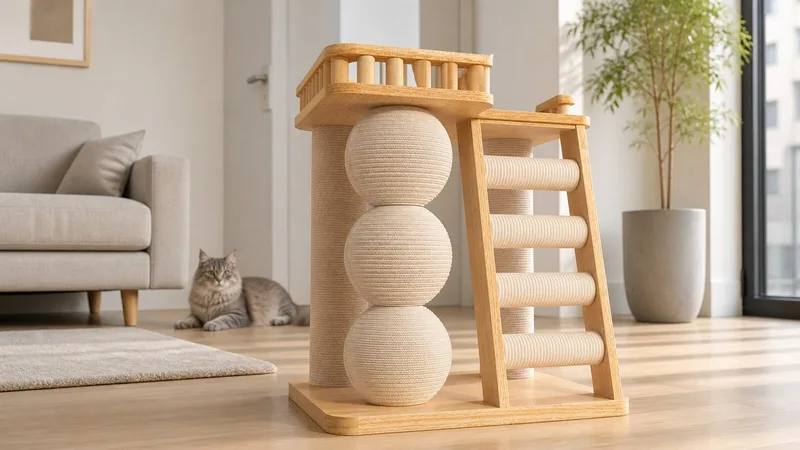
The model is recorded at 70 cm high on a 60 x 40 cm base. Its visible layout combines a guarded upper platform, a large vertical wrapped post, three rounded wrapped forms, and a slanted frame with four wrapped horizontal rungs. That gives the product a recognizable silhouette without a capsule, condo, hammock, or tall stack of platforms. For importers and private-label buyers, the commercial question is not whether it can replace every cat tree. It is whether the model can give a starter collection a clear step between entry-level scratching products and taller furniture.
Start with the gap in the range, not the product height
A useful assortment gives each model a reason to exist. If two products have different heights but communicate the same benefit, the lower-priced one may simply compete with the higher-priced one. TW-0708-081 has a clearer role when it is presented as a compact activity-and-scratching station rather than as a shortened version of a large tower.
Its low silhouette can appeal to buyers planning products for smaller rooms, low furniture layouts, or consumers who do not want a tall structure to dominate the room. Those are positioning directions, not performance guarantees. The final listing should still show the real dimensions, complete structure, intended placement clearance, assembly requirements, and any tested claims for the approved production version.
Within the solid wood cat tower collection, a sensible comparison set would include one low-profile model, one medium-height model with more resting areas, and one tall model with stronger vertical activity. This helps a buyer build good-better-best choices without forcing every customer toward the largest SKU.
Confirmed data for TW-0708-081
The supplier record identifies 18 mm rubberwood board and 10 cm solid pine posts. It lists a 62 x 42 x 35 cm carton and an approximate gross weight of 20 kg. Multiplying the recorded carton dimensions gives approximately 0.091 cubic metres per carton. That calculated volume can support early logistics comparison, but freight planning must use the final approved packing specification, carton quantity, pallet method, and carrier rules.
| Item | Current record | Buying relevance |
|---|---|---|
| Product number | TW-0708-081 | Keeps the inquiry, sample, quotation, artwork, inspection, and reorder tied to one reference. |
| Overall height | 70 cm | Defines the low-profile position and supports accurate lifestyle scale. |
| Base size | 60 x 40 cm | Supports floor-space planning and comparison with other starter products. |
| Board | 18 mm rubberwood board | Must be confirmed on the sample together with edge finish, color, and construction. |
| Posts | 10 cm solid pine posts | Provides a recorded reference for component and wrapping checks. |
| Carton | 62 x 42 x 35 cm | Equals about 0.091 m³ before pallets or outer protection. |
| Approx. gross weight | 20 kg | Supports handling, shipping-method, and landed-cost review. |
MOQ, lead time, load rating, exact wrapping fibre, coating system, test compliance, and market-specific documentation are not fixed by this record. They should be confirmed for the selected quantity and customization scope. Product copy should not turn a visual feature into an unsupported safety, durability, age, or weight-capacity claim.
Read the structure as a set of customer-facing functions
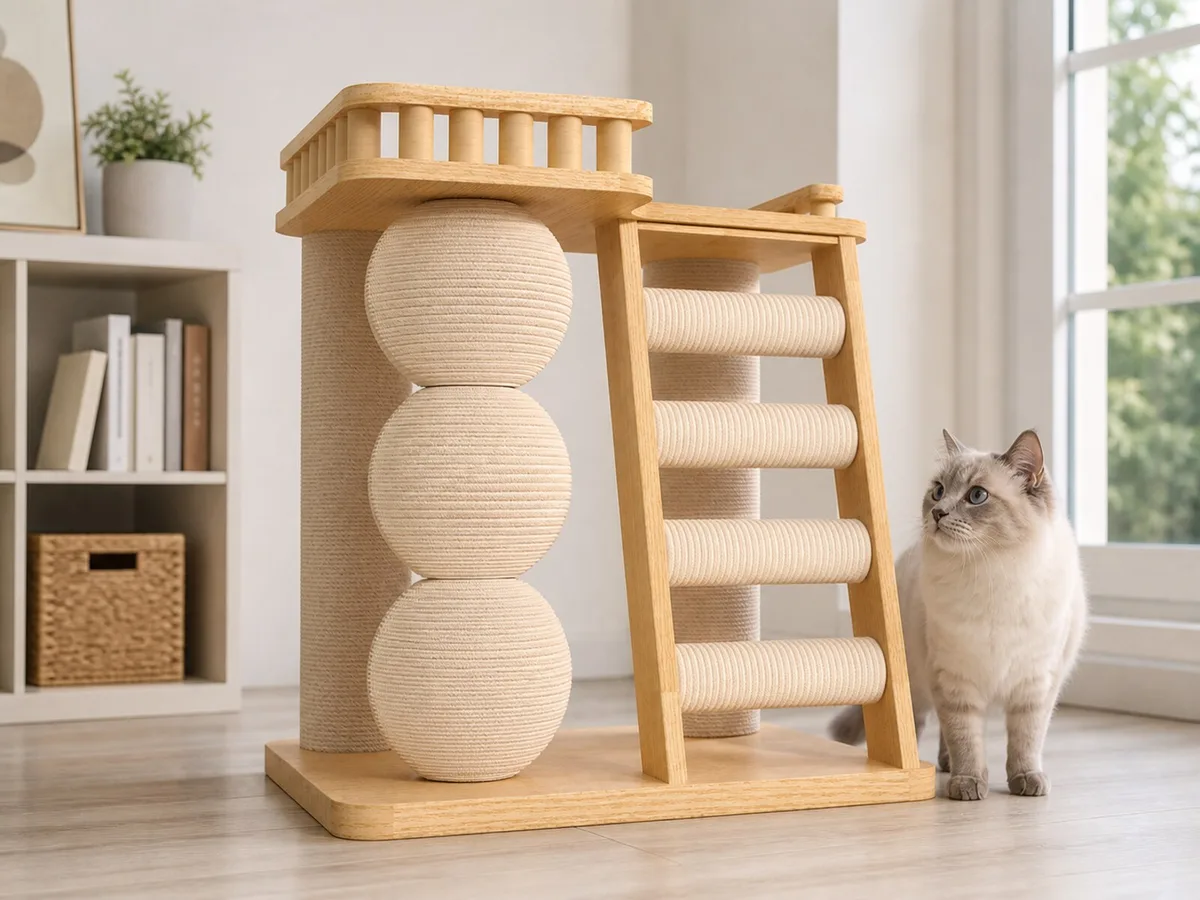
The product image shows four feature groups. The large rear-left wrapped post creates a continuous vertical scratching surface. Three rounded wrapped forms provide a second texture-rich visual element. The slanted right frame contains four horizontal wrapped rungs. Above them, a square platform is bordered by a wooden rail with vertical spindles.
Those features can be described accurately without inventing behavior. Use phrases such as “multiple wrapped scratching surfaces,” “four-rung inclined frame,” and “guarded upper platform.” Avoid promising that a certain type, age, or number of cats will use every area. Cat size, movement, preference, training, placement, and the final tested structure all influence real use.
The low-rise format also makes the full product easier to show in one image. A listing can present the base, posts, three rounded forms, four rungs, and upper rail without relying on an extreme wide-angle photograph. That is useful because customers can understand the actual component count before purchase.
Build a starter collection around clear trade-ups
A basic scratching post usually competes on price, simplicity, and a small footprint. A tall tree competes on vertical scale, multiple levels, capsules, condos, or larger resting areas. TW-0708-081 should sit between those endpoints with a different message: more visual structure and more surface variety than a basic post, while remaining lower and simpler than a full-height tree.
For wholesale planning, compare three dimensions across the range: visible function, occupied floor area, and carton burden. The purpose is not to choose the smallest carton at any cost. It is to make sure each increase in product and logistics cost creates a benefit the customer can see. If a medium model has a larger carton but no clearer function than TW-0708-081, the range may need editing before purchase.
For private-label programs, give each level a stable role. The entry model may focus on scratching. This bridge model can combine scratching, stepping, and a guarded platform. A taller model can add capsules, hammocks, or more vertical separation. Naming, photography, comparison tables, and store filters should reinforce those differences instead of presenting every item as a generic “multi-functional cat tree.”
Make small-space content specific rather than vague
“Suitable for apartments” is too broad on its own. Useful content starts with the 60 x 40 cm recorded base and 70 cm height, then shows the product beside familiar furniture at a realistic scale. It should explain that the buyer still needs clearance for assembly, cleaning, access to the wrapped surfaces, and normal movement around the product.
The image set should include a straight-on full product view, left and right three-quarter views, top platform and rail detail, the three rounded forms, all four rungs, the base corners, post wrapping, underside connections, hardware pack, and packed carton. A dimension graphic can show overall height and base size, but it should not cover the product or imply a dimension that has not been checked on the sample.
Lifestyle images must preserve the approved structure. Removing a rung to simplify the scene, adding a cushion to the top, changing the rail, or creating an extra platform would make the content more attractive but less reliable. For a B2B buyer, consistency between source image, sample, listing assets, and delivered product is part of content quality.
Use the carton record to ask better commercial questions
The recorded 62 x 42 x 35 cm carton is only slightly larger than the 60 x 40 cm base in two dimensions, suggesting that the final packing method and disassembly sequence deserve close review. Buyers should confirm which parts are removed, how the rail and ladder frame are protected, where the three rounded components sit, and whether wrapped surfaces can rub against hardware or finished wood during transport.
At approximately 20 kg gross weight, the carton should be checked against the target channel's handling rules, shipping brackets, warehouse limits, and damage-claim patterns. Do not assume that a compact product automatically produces low fulfilment cost. Compare dimensional weight, actual weight, oversize thresholds, drop-test requirements, pallet efficiency, and the cost of additional corner or surface protection.
A good quotation therefore separates product price from packaging decisions. Ask whether the standard carton is suitable for the destination, whether stronger board or internal protection changes dimensions, and whether instruction inserts, barcodes, labels, or private-label graphics affect the packing plan.
Turn the sample into a repeatable approval record
Begin by confirming overall height, base size, board thickness, post diameter, and the position of every visible component. Photograph the sample from the same views that will be used online. Count the three rounded wrapped forms and four ladder rungs, then record the rail spindle layout, post positions, base orientation, hardware, and assembly sequence.
Continue with surface and connection checks. Review board edges, color consistency, visible joints, wrapping direction, wrapping ends, fastener coverage, base contact, rail connections, rung alignment, and any points that could be assembled in the wrong direction. The buyer's quality control specification should define acceptable visual references and measurement tolerances instead of relying on “same as sample” alone.
If stability, static load, chemical, flammability, or market-specific requirements apply, agree the exact method, configuration, laboratory or inspection party, acceptance criteria, and reporting format. Do not publish a performance claim before the relevant evidence exists for the final product.
Customize the offer without losing the model identity
An OEM cat furniture program can review wood-tone references, wrapping color and material, labels, logo placement, barcode, instruction language, carton artwork, hardware identification, and replacement-part coding. These changes can create a recognizable private-label offer while preserving the approved geometry.
Changes to the 70 cm height, 60 x 40 cm base, rail design, rung count, rounded forms, board thickness, post diameter, or connection layout are structural changes. They require a separate feasibility review, updated drawing, sample, packing assessment, and any required retesting. They should not be quoted as simple color options.
RFQ checklist for TW-0708-081
- Reference TW-0708-081 and state the target market, buyer channel, expected quantity, and intended position in the range.
- Reconfirm the 70 cm height, 60 x 40 cm base, 18 mm rubberwood board, and 10 cm solid pine posts.
- Confirm the exact construction, wood finish, wrapping material, wrapping color, hardware finish, and cleaning guidance.
- Review the large rear post, three rounded wrapped forms, four horizontal rungs, slanted frame, guarded top platform, and base on the sample.
- Reconfirm the 62 x 42 x 35 cm carton, approximate 20 kg gross weight, disassembly plan, internal protection, and final carton volume.
- Provide the required logo, label, barcode, instruction, carton-mark, and language files.
- Define inspection tolerances and any stability, load, chemical, packaging, or market-specific testing needed for approved claims.
- Confirm MOQ, sample schedule, production lead time, replacement parts, shipping method, and quotation validity after specifications are approved.
TW-0708-081 is not a substitute for every tall cat tree, and that is exactly why it can strengthen a product range. It gives buyers a visually distinct low-profile option with recorded solid wood components, several wrapped surfaces, a guarded platform, and a manageable product envelope. Review the TW-0708-081 product page, compare it with the rest of the range, and send your target channel, quantity, finish direction, packaging limits, and test requirements through the cat tower inquiry form.